
Import Duty on JDM Drift Parts from Japan: US, UK, AU, NZ, CA (2026)
The Rundown
- The US $800 de minimis exemption was indefinitely suspended on 24 June 2026, so even a $120 used bumper from Japan now needs a customs entry.
- Japanese-origin wheels, bucket seats, brakes, gearboxes, diffs and body panels enter the United States at 15% under HTS 9903.94.43, not the 2.5% printed against heading 8708.
- The UK charges 20% import VAT above £135 and 2% duty on heading 8708 parts, and that duty only falls to 0% if you hold origin evidence from Japan.
- Australia's threshold is A$1,000 and New Zealand's is NZ$1,000, but Canada's is CA$20 for Japanese goods — the CUSMA CA$40 and CA$150 limits cover US and Mexican shipments only.
- An Australian consignment worth over A$1,000 adds A$50 import processing and A$48 biosecurity by air on top of 10% GST.
Contents
Yes, you pay. The United States suspended its US$800 de minimis exemption on 24 June 2026, so a box of used parts now needs a customs entry from the first dollar; the UK charges 20% import VAT above £135, Australia 10% GST above A$1,000, New Zealand 15% GST above NZ$1,000, and Canada wants duty and 5% GST on anything from Japan worth more than CA$20. Every figure below was checked on the official government pages on 6 September 2026.
Whole-car imports work differently and are covered separately — see the guides for the USA and Australia, the UK and Canada. This page is about the box: a set of wheels, a spare gearbox, a bumper, two bucket seats.
What does each country charge on a box of used parts?
| Country | Threshold | At or below it | Above it | Duty on heading 8708 parts | Origin claim needed |
|---|---|---|---|---|---|
| United States | US$800, suspended since 24 Jun 2026 | Nothing is exempt — entry required from the first dollar | Informal entry up to US$2,500, formal above that | 2.5% general, but 15% for Japanese-origin parts on the Section 232 list | No preference exists; the 15% is a Section 232 rate |
| United Kingdom | £135 | Seller charges 20% VAT at checkout, no duty | 20% import VAT plus duty, collected by the carrier | 2.00% third country, 0.00% with a Japan preference claim | Statement on origin from the exporter, or importer’s knowledge |
| Australia | A$1,000 | Supplier or platform charges 10% GST at checkout | Import declaration, 10% GST, duty, A$50 processing, A$48 biosecurity by air | 5% general, Free under JAEPA | Certificate of Origin or origin certification document |
| New Zealand | NZ$1,000 | Overseas supplier charges 15% GST at checkout | 15% GST on goods plus duty, freight and insurance, plus levies | 5% normal, Free under CPTPP | CPTPP origin certification |
| Canada | CA$20 for Japanese goods | Duty and tax free | 6% duty plus 5% GST, or 13% HST in some provinces | 6% MFN, Free under CPTPP | CPTPP origin certification |
The thresholds below the line are not really gifts. In the UK, Australia and New Zealand the tax is simply moved to the checkout and collected by the seller instead of the border. What the threshold actually buys you is speed: no entry, no broker, no phone call from the courier.
Why is the United States suddenly the expensive one?
For years American buyers were the lucky ones. A US$700 set of wheels came in under Section 321 and nobody asked a question. That ended twice in 2026: rule 91 FR 37789 killed the exemption for couriers and freight on 24 June 2026, and 91 FR 37801 did the same for postal items, with the new mail entry process starting 24 July 2026.
That step 4 is the one nobody expects. Look up heading 8708 in the tariff and you see 2.5%, so people budget for 2.5%. But US note 33 to subchapter III of chapter 99 lists the automobile parts caught by Section 232, and the list includes 8708.29 (body panels and aero), 8708.30 (brakes), 8708.40 (gearboxes), 8708.50 (axles and diffs), 8708.70 (wheels), 8708.80 (suspension) and 9401.20.00 (motor vehicle seats). For products of Japan, HTS 9903.94.43 sets those at a flat 15%. Almost everything a drifter buys is on that list.
One narrow exception is worth knowing: the residual code 8708.99.81 is not in note 33, so a part that genuinely classifies there stays at 2.5%. That is a classification question, not a choice.
Which document does a used part almost never come with?
Every zero rate in the table above is conditional. The UK’s 0.00%, Australia’s Free under JAEPA, and the CPTPP rates in New Zealand and Canada all need proof that the goods originate in Japan — and that proof has a specific author.
In the UK the statement on origin is made by the exporter on a commercial document; the alternative is importer’s knowledge, which means you personally hold evidence of the production process and the materials used. For Australia, the ABF guideline is blunt: the importer must have a Certificate of Origin, or an origin certification document or a copy of one, at the time the goods are imported, and a Certificate of Origin has to be completed by an authorised body.
Now picture the reality. You won a 20-year-old S14 rear bumper from a private seller on Yahoo Auctions. There is no exporter with an EORI number, no authorised body, no bill of materials. So the paperwork that unlocks 0% does not exist, and you pay the third-country rate. That is the step you cannot fix from overseas: the declared value, the HS code and the origin evidence are all written in Japan, by whoever puts the box on the counter, before you ever see it.
Where we come in
We buy the part in Japan, photograph and video it before you commit, and prepare the invoice, HS code and any available origin evidence at our end so the box arrives classified correctly rather than guessed at. See how parts sourcing from Japan works, including what we can and cannot document on a used private-sale part.
Who writes the declaration on your box?
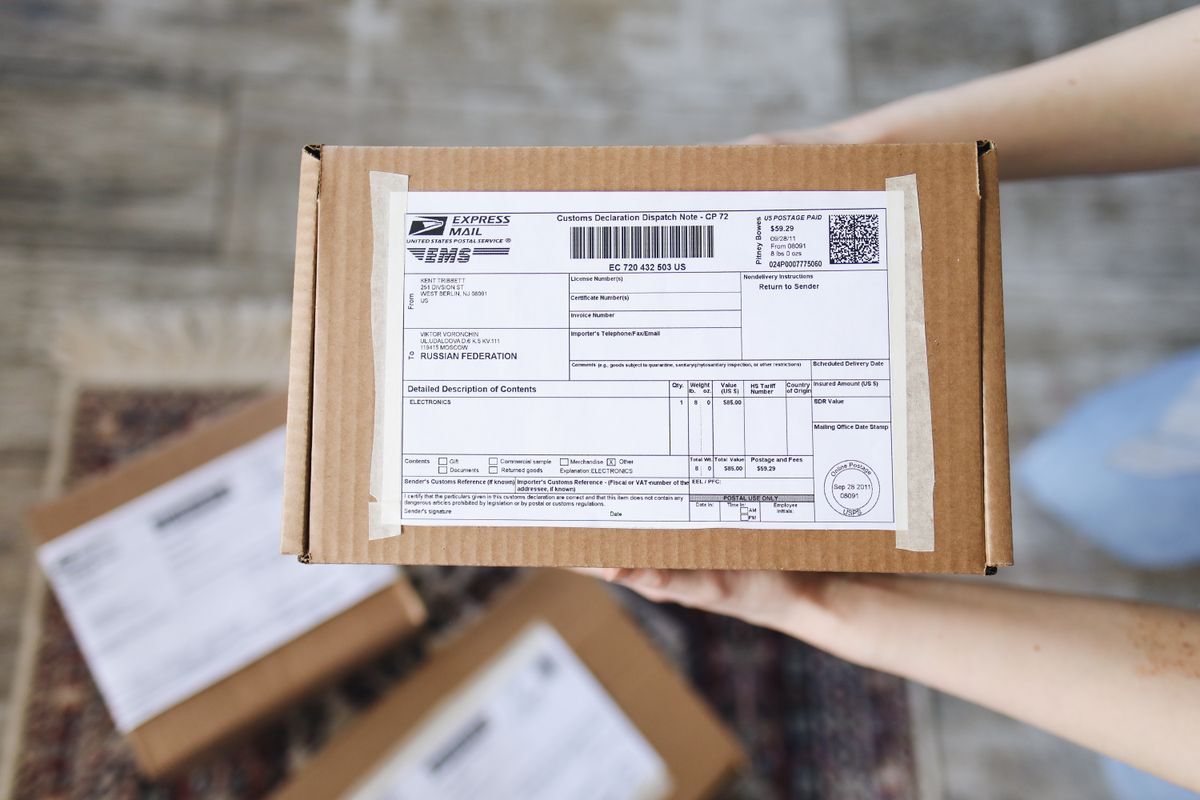
The sender does. Japan Post’s own guidance says to fill out a CN22 or CN23 “with a detailed description of the contents, including the name, quantity and price of each item” and attach it to the item. Proxy services follow the same line: Buyee states that the item price on the invoice cannot be edited and stays the same as the price you paid.
Don't get caught out
The declaration must be accurate. Do not ask a seller or forwarder to under-declare the value, mark parts as a gift, or split one purchase into several boxes to sit under a threshold. All of those misstate a legal document, and the downside is not a small fine — it is seizure of the parts and a flag on everything you import afterwards.
There is one honest saving that is often missed. In the United States, mail shipments are exempt from the Merchandise Processing Fee, except items sent by Inbound Express Mail or EMS. Since EMS is the default for most Japanese sellers, that exemption usually does not reach you — but it is a real difference between EMS and ordinary airmail on a small parcel.
What should you check before you press bid?
Before you commit
- The HS heading. Most drift parts are 8708; seats are 9401.20. Look it up on your own country's tariff site.
- Your threshold in your own currency — US$0 in practice, £135, A$1,000, NZ$1,000, CA$20.
- Whether the total value crosses the line once freight is added. New Zealand charges GST on goods plus duty plus freight and insurance.
- Whether any origin document can realistically exist for a second-hand part. Usually it cannot.
- The fixed charges above the threshold: A$50 import processing and A$48 biosecurity by air in Australia, an Import Entry Transaction Fee and a Customs Number in New Zealand.
- The courier's own clearance fee, which is separate from the tax and is not set by customs.
The practical conclusion is unglamorous. Duty rarely kills a parts order on its own; it is the combination of a 15% US rate on a heavy item, volumetric freight and a clearance fee that turns a cheap win into a bad one. Work it out before you bid, not when the courier emails you. If you are pricing a big item, read the notes on gearbox and diff shipping and on buying used wheels and tyres in Japan alongside this page, because weight and duty compound.
One last note on honesty in both directions. Rates move. The US position changed twice inside eight weeks in mid-2026, and this page reflects the official pages as they read on 6 September 2026. If your shipment is large enough that the difference between 2.5% and 15% matters, check the tariff yourself on the day you buy — the sources below are the primary pages, not summaries of them.
Frequently asked questions
Do I pay import duty on car parts shipped from Japan to the USA?
Yes. As of 6 September 2026 the US$800 de minimis exemption is indefinitely suspended, under a rule published at 91 FR 37789 effective 24 June 2026 for all modes except post, and 91 FR 37801 effective 24 July 2026 for postal items. Every shipment now needs a formal or informal customs entry and CBP collects all applicable duties and fees. Japanese-origin parts on the Section 232 list, such as wheels, brakes, gearboxes and bucket seats, are dutiable at 15% under HTS 9903.94.43.
How much VAT and duty will I pay on JDM parts sent to the UK?
As of 6 September 2026 a consignment worth £135 or less has VAT charged by the seller at checkout and no customs duty on non-excise goods. Above £135 you pay 20% import VAT to the delivery company plus customs duty. For heading 8708 vehicle parts the UK third-country rate is 2.00%, which drops to 0.00% under the UK-Japan preference only if you hold a statement on origin from the exporter or can rely on importer's knowledge.
Is there a duty-free threshold for importing car parts into Australia and New Zealand?
Yes, but they only defer the tax rather than remove it. As of 6 September 2026 Australia's low value threshold is A$1,000 and New Zealand's is NZ$1,000, and below those the overseas supplier or platform charges GST at checkout — 10% for Australia, 15% for New Zealand. Above the threshold you lodge an import declaration and pay GST plus duty; Australia adds a A$50 import processing charge and a A$48 biosecurity charge on air consignments over A$1,000.
What is the de minimis for shipping parts from Japan to Canada?
It is CA$20, not CA$40 or CA$150. As of 6 September 2026 the CBSA applies the higher CUSMA thresholds of CA$40 for taxes and CA$150 for duty only to courier shipments from the United States and Mexico. Goods from any other country, Japan included, keep the CA$20 remission. Above that you pay 5% GST, or HST at 13% in some provinces, plus 6% MFN duty on most heading 8708 parts unless a CPTPP origin claim is made.
Can I ask the Japanese seller to write a lower value on the customs form?
No. The declaration is a legal document and it must state the real contents and the real price. As of 6 September 2026 Japan Post requires the sender to fill in a CN22 or CN23 with the name, quantity and price of each item, and proxy services state that the invoice price cannot be edited from what you actually paid. Under-declaring a value, marking goods as a gift, or splitting one purchase across boxes to sit under a threshold all misstate that document and put your goods and your future shipments at risk.
 Can I Bring My Own Drift Car to Japan? Temporary Import (2026)
  Buying a GT Wing From Japan: Prices and How a 1.7 m Wing Ships (2026)
  Buying a Used Intercooler or Radiator from Japan (2026)
  Can You Ship a Roll Cage from Japan? Sizes, Rules & Costs (2026)