
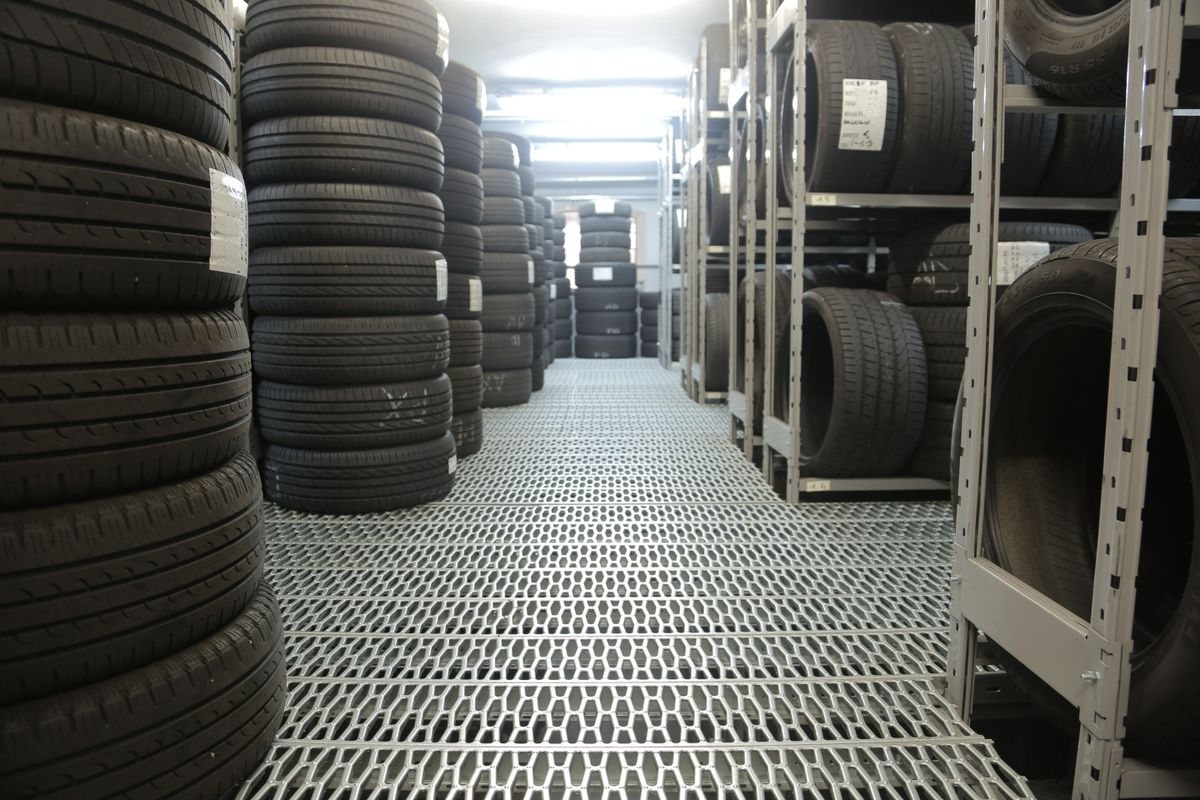
Buying Used JDM Wheels & Tyres from Japan (2026)
The Rundown
- Wheels and tyres are not on anyone's prohibited list — but Buyee's own shipping page refuses packages containing wheels with tyres on sea mail, and lists Tires among the items DHL cannot carry. Those two lines close more routes than any ban.
- The stamps are real but narrower than people think. JWL is a manufacturer's self-certification against an MLIT technical standard; VIA is a re-test by the Japan Vehicle Inspection Association. Neither says anything about the used wheel in front of you.
- Every Japan Post service stops at 30 kg — 20 kg to Australia. A mounted 18-inch corner is roughly 20 kg, so a set of four cannot travel as one parcel to anywhere, at any price.
- EMS is billed on actual weight, so four single-corner parcels at 21 kg each cost ¥53,500 apiece to the USA and ¥46,600 to Oceania, Canada and Europe. That is the real number people miss.
- JATMA recommends replacing tyres 10 years after manufacture even if they look fine, and VALINO already has four US operations plus distributors in the UK, Australia and Canada — for current-model rubber, shipping from Japan often makes no sense.
Contents
A square set of Work Meisters in the right offsets. SSR Professors with lips you cannot buy new any more. Four Volk TE37s on half-worn VALINOs for less than one new wheel costs at home. Wheels are what make people open a proxy account — and what most often ends with the buyer abandoning the purchase at the shipping-quote screen.
The reason is not a ban. Wheels and tyres are legal, unremarkable cargo. What stops them is a stack of published rules nobody puts on one page. Here is that page. Every figure below was read off the official sources on 9 August 2026.
Wheels and tyres out of Japan — the published limits
What JWL and VIA actually certify
Turn a Japanese wheel over and you will find letters cast into the back of the spokes. They mean something specific, and much narrower than the forums suggest.
JWL is the mark defined in 別添2, the light-alloy disc wheel technical standard attached to Japan’s 保安基準 (hoan kijun — the national vehicle safety regulations). The standard sets three bench tests: rotating bending fatigue, radial load endurance and impact. It also dictates the marking — applied “by casting or stamping” (鋳出し又は刻印) somewhere that stays visible with the wheel bolted to the car, alongside size, offset and the maker’s name or trademark. JWL-T is the same idea for trucks and buses. It is not a higher grade of JWL, and a passenger-car wheel does not need it.
The part people miss is who does the testing. WORK’s consumer notice, published as a JAWA member, states it plainly: this technical standard “requires the manufacturer to conduct testing on its own responsibility” (製造者自らの責任において試験を行う必要があります). JAWA’s certification page says the same — because the national standard is self-certification, aftermarket products get a confirmation test at a public third-party body.
That body is VIA: the 一般財団法人日本車両検査協会, the Japan Vehicle Inspection Association, working through the light-alloy wheel testing council it runs with the Japan Aluminium Association and NAPAC’s JAWA division. Only wheels that pass the confirmation test and are entered on the register may show the VIA mark, and that mark is a registered trademark of the association — it cannot lawfully be used without permission. A third sticker, the JAWA 品質認定証, goes on member wheels that clear both and carries product liability insurance.
| Mark | Who tests | What it tells you |
|---|---|---|
| JWL | The manufacturer, to the MLIT standard | The model was self-certified against three bench tests |
| JWL-T | The manufacturer | Same, for trucks and buses — not an upgrade |
| VIA | Japan Vehicle Inspection Association | The model was re-tested by a third party and registered |
| JAWA 品質認定証 | JAWA member scheme | Sticker on a JWL + VIA wheel, with PL insurance attached |
A stamp certifies a design, not your wheel
Every one of those marks was earned by a sample from a production run, sometimes decades ago. None of them knows about the kerb strike in 2019, the barrel weld a previous owner had done, the lip that was re-rolled, or the crack hiding under fresh paint behind a spoke. JAWA's own campaign page warns that wheels which do not meet adequate safety standards are on sale, and that a wheel which cracks at a small bump can cause a serious accident. On the used market the marks are a starting filter, not a verdict — and we could not find any public lookup on the association's pages that lets a buyer check an individual wheel's VIA registration by serial (checked 9 August 2026).
The freight wall, and why this category is different
Our oversized-parts guide is about volumetric weight — paying for air. Wheels invert that. tenso states that except for DHL and ECMS its fees are worked out on actual weight, and Japan Post’s EMS tariff is a straight weight table. On the postal routes, volume is not what bills you. Mass is, and mass is the one thing a wheel-and-tyre set has in abundance.
Assume — and treat these as assumptions until you weigh yours — an 18×9.5 forged wheel at about 10 kg and a 265/35R18 semi-slick at about 11 kg. One mounted corner is roughly 21 kg; four corners about 84 kg. Against the published ceilings: every Japan Post international service stops at 30 kg, EMS caps length at 1.5 m and length-plus-girth at 3 m, and several destinations are tighter — Australia at 20 kg and 1.05 m, Germany at 1.05 m with length-plus-girth of just 2 m.
One parcel for a set is not expensive. It does not exist.
| Route for a set of four | Parcels | EMS cost to the USA | EMS to Oceania / Canada / Europe |
|---|---|---|---|
| One mounted corner per parcel (21 kg) | 4 | ¥53,500 each → ¥214,000 | ¥46,600 each → ¥186,400 |
| Tyres off: two bare wheels per box (20 kg) | 2 | ¥51,100 each → ¥102,200 | ¥44,500 each → ¥89,000 |
| Tyres off: one tyre per box (11 kg) | 4 | ¥29,500 each → ¥118,000 | ¥25,600 each → ¥102,400 |
Rates are Japan Post’s official EMS table including the special additional surcharge for zones 3 and 4; weights are the assumed figures above. Read the Australian case carefully: at a 20 kg ceiling a mounted 21 kg corner cannot be posted at all, and a two-wheel box lands exactly on the limit. Germany’s 2 m length-plus-girth is the other quiet killer — box a mounted 18 properly and you are at roughly 70 cm a side, which is 70 cm of length plus 200 cm of girth before you tape it shut.
Will a proxy even take them?
Yes — and then their own rules take the routes away one by one. This is the same shape as the pickup-only problem: nothing is forbidden, but nothing quite works either.
tenso.com lists “Suspensions (car parts)” under high-pressure gas and “Engine” under other prohibited goods; tyres and wheels appear nowhere on it. Buyee’s all-country prohibited list names “Engines” and “Internal-combustion engines” and again says nothing about wheels or rubber. Japan Post’s nonmailable-articles page names エンジン and does not name タイヤ or ホイール. So far, so good.
Buyee’s shipping-method page is where it unravels. Japan Post sea mail — the cheapest lane, and the obvious answer to a heavy set — carries the line “Packages that include wheels with tires are not allowed.” DHL, the fast lane, lists “Tires” among the items that cannot be shipped. And Buyee states it uses DHL specifically for packages over 30 kg actual weight, a side over 1.5 m, or total length and width over 3.0 m. Put those three lines together: a mounted set is barred from the cheap route, barred from the fast route, and the carriers left — EMS and FedEx — stop at 30 kg. UPS goes to 70 kg at 2.74 m, but Buyee says you cannot select it yourself and must contact customer support.
UP GARAGE, which is where most used JDM wheels in Japan actually sit and which now absorbs croooober.com traffic onto its own ec domain, ships internationally only by DHL Express, FedEx, EMS and surface mail. Its FAQ also closes the obvious workaround: orders are processed only for the item as listed, and a set “cannot be separated or sold in part, even if you agree to pay the full price.” No buying half a set to stay under a ceiling.
Tyres age out, and Japan is not always the answer
The rubber is the half people get wrong. JATMA, the Japan Automobile Tyre Manufacturers Association, publishes two figures. Tyres more than five years old from the start of use should be inspected at a tyre shop to judge whether they are still fit to keep using. And tyres more than ten years past manufacture should be replaced — explicitly, JATMA says this applies “even if they appear usable” and even if the tread has not worn down to the legal limit. The association also notes those are guidelines, and that storage and use conditions can cut either way.
Reading the age is easy once you know where to look. On tyres made from 2000 onwards, the last four digits of the serial give week then year: 1220 is the twelfth week of 2020. Pre-2000 tyres use three digits. A set of “barely used” drift tyres from a garage clear-out is very often eight-year-old rubber that spent those years going hard in a shed.
Then the harder question: should the tyres come from Japan at all? For VALINO — the drift-specific Japanese brand most people mean — the answer for current models is usually no. VALINO’s own international page lists VALINO TIRES USA LLC in Houston plus three further US operations, along with distributors in the UK, Canada, Australia, France, Sweden, Poland, Hungary, Malaysia, Thailand and Hong Kong. Paying EMS by the kilogram for something your local distributor stocks is a bad trade. Japan wins on discontinued compounds, odd sizes and whatever is sitting used in a lock-up — and every one of those is an age question first.
Price the new set before you bid on the used one, because the floor is lower than most people assume. The cheapest tyre D1 actually registers is the ZESTINO GREDGE 07R at ¥12,650 a corner, tax included, so four new corners of a homologated competition tyre start near ¥50,600 before any freight. Our drift tyre directory sets all nineteen D1-registered brands side by side, with every published price we could verify for the same 265/35R18 rear, checked 14–16 September 2026. Run your used set against that ladder first: once the asking price plus EMS gets close to a new set, the only thing still justifying the purchase is a date code you have actually seen photographed.
Ask the seller this before you bid
- Photos of the back of every spoke face — the JWL, VIA and maker stamps live there, and so do repairs.
- The four-digit date code on each tyre sidewall, photographed, not described.
- Whether any barrel has been welded, re-lipped or straightened, and by whom.
- Weight per corner as it stands — this decides your shipping options before anything else does.
- Whether the tyres can come off the rims, because that one answer reopens sea mail and DHL.
What the two routes cost
| Route | What it is | What you pay |
|---|---|---|
| Self-serve proxy + EMS | Buyee or tenso, split into single-corner or wheels-only parcels within your country’s ceiling | Item price, the proxy’s own published fees, and EMS on actual weight — ¥53,500 per 21 kg parcel to the USA, ¥46,600 to Oceania, Canada and Europe |
| Self-serve, tyres removed locally | Same, but you buy rims and rubber as separate shipments and mount at home | ¥44,500 per 20 kg wheel pair and ¥25,600 per 11 kg tyre to zone 3 — plus local mounting and balancing |
| Consolidated freight, managed in Japan | Set collected, inspected, tyres separated if needed, palletised and shipped as cargo | No published rate exists — freight is quoted per shipment on weight, dimensions and port. Actual cost plus a fee, quoted as one total up front |
Anyone giving you a flat figure for that third row before seeing your set and your destination is guessing. Insist on the method instead: purchase price, collection, tyre work, packing, export paperwork and freight, added into one number before you commit — the same standard the gearbox and diff guide applies to drivetrain freight.
The one step you cannot take from abroad
Every route above forks on the same physical act: somebody in Japan has to break the tyres off the rims.
That reopens Japan Post sea mail, whose refusal is written specifically against “wheels with tires”. It takes tyres out of the DHL exclusion. It halves the parcel weight so an Australian buyer can exist inside a 20 kg ceiling at all. And it is the only way anyone sees the inner barrel, the back of the mounting face, the weld line, the re-rolled lip and the crack behind the spoke — the places a used wheel actually fails, all hidden while a tyre is fitted.
You cannot do that from Sydney or Seattle. Buyee and tenso are warehouses, not workshops; UP GARAGE staff cannot modify or separate an item at all.
That is the step we take on
We buy the set domestically on a Japanese address, collect it, and get the tyres off the rims here. Then you see what the seller could not show you: video and photos of each barrel and inner rim, the mounting face, any weld or re-lip work, the cast or stamped JWL and VIA marks on the back of the spoke face, the maker's stamp and size and offset, and a close read of the four-digit date code on every sidewall so you know exactly how old the rubber is. You decide after that, not before. We pack faces apart, split the parcels to your country's actual weight and length-plus-girth ceilings, and quote purchase price, collection, tyre work, packing and freight as one total up front — actual cost plus a fee, agreed before anything is bought. Send us the listing URL and your destination city.
What they sell for in Japan right now
What full sets actually fetched in Japan this season, sets of four only, singles and pairs excluded, so the median is the price of a set you would ship.
| Part | Sold (120 days) | Median | Middle half (Q1–Q3) |
|---|---|---|---|
| Work Meister S1 (set of 4) | 40 | ¥128,500 ($803) | ¥82,000 – ¥211,320 |
| Work Emotion (set of 4) | 106 | ¥61,100 ($382) | ¥44,250 – ¥98,450 |
| SSR Professor (set of 4) | 50 | ¥139,995 ($875) | ¥90,751 – ¥190,618 |
| Weds Kranze (set of 4) | 120 | ¥81,001 ($506) | ¥58,825 – ¥104,278 |
| RAYS Volk TE37 (set of 4) | 122 | ¥192,000 ($1,200) | ¥141,408 – ¥295,750 |
| Enkei RPF1 (set of 4) | 65 | ¥93,800 ($586) | ¥80,000 – ¥133,232 |
Completed Yahoo! Auctions sales in the 120 days to 24 September 2026, the part only, before collection, crating and freight; dollars at ¥160 to $1. The live table, refreshed on the 1st of every month, is the JDM drift parts price index; what is listed this morning is on drift parts for sale today, and each chassis has its own page: S13, 180SX, S14, S15, AE86, JZX100.
The short version
Nobody bans wheels. The postal ceiling is 30 kg, 20 kg to Australia, and a mounted 18-inch corner is about 20 kg on its own, so a set of four is four parcels before the conversation starts — at ¥53,500 a parcel to the USA. Sea mail refuses wheels with tyres by name and DHL refuses tyres by name, which removes the cheap lane and the over-30 kg lane in one go. The stamps on the back of the spokes are real, but JWL is the maker’s own certification and VIA a third-party re-test of a design, and neither has ever seen the wheel you are bidding on. The rubber, meanwhile, has a clock on it that JATMA puts at ten years.
Still deciding which channel to buy through, the proxy and exporter comparison covers the fee side of that choice.
Frequently asked questions
What do JWL and VIA marks on a Japanese wheel actually mean?
JWL is the mark for a passenger-car light-alloy wheel that meets the technical standard attached to Japan's vehicle safety regulations, and the marking must be cast or stamped into the wheel where it is visible with the wheel fitted. Crucially it is self-certification: as WORK's own consumer notice puts it, the standard requires the manufacturer to conduct the testing on its own responsibility. VIA is the separate step — the wheel is re-tested by the Japan Vehicle Inspection Association through the light-alloy wheel testing council, and only wheels that pass and are registered may display the VIA mark, which is a registered trademark of that association. JWL-T is the truck and bus version of the standard, not an upgrade of JWL. Neither mark says anything about the used wheel in front of you: both were earned by a sample from a production run, and when we checked the association's pages on 9 August 2026 there was no public lookup that lets a buyer check an individual wheel's VIA registration by serial.
Can I ship a set of four wheels and tyres from Japan in one box?
No. Every Japan Post international service caps at 30 kg, and 20 kg to Australia, while a mounted 18-inch corner runs around 20 kg on its own. Buyee's shipping page also states that packages including wheels with tyres are not allowed on Japan Post sea mail, and lists Tires among the items that cannot go via DHL — which is the carrier Buyee says it uses for anything over 30 kg. The practical routes are one corner per parcel by EMS or FedEx, tyres separated from rims, or consolidated sea freight outside the proxy system.
Is it worth buying VALINO tyres from Japan instead of a local distributor?
Usually not, for current models. VALINO's own international page lists VALINO TIRES USA LLC plus three further US operations, along with distributors in the UK, Australia, Canada, France, Sweden, Malaysia, Thailand, Hong Kong and more. Shipping rubber from Japan means paying EMS on actual weight for something your local distributor already stocks: a single mounted corner at 21 kg costs ¥53,500 to the USA and ¥46,600 to Oceania, Canada and Europe, per parcel, on the Japan Post rates we read on 9 August 2026. Where Japan still wins is discontinued compounds and sizes nobody outside Japan carries, and that is a used-market question, which brings the age of the tyre straight back into play: JATMA advises replacing tyres 10 years after the date of manufacture even if they appear usable.
 Shipping a Used Gearbox, Diff or Engine Out of Japan (2026)
  Shipping Aero, Seats & Wheels from Japan: The Oversized Problem (2026)
  Used JDM Exhaust from Japan: Shipping Limits and Costs (2026)
  Buying a JDM Front Clip (Half-Cut) From Japan (2026)