
Shipping a Used Gearbox, Diff or Engine Out of Japan (2026)
The Rundown
- A complete engine is a named air dangerous good in Japan Post's own database, and IATA-classified goods cannot go by international mail 'regardless of the types of mail items or means of transportation' — sea mail included. There is no postal route for an engine.
- Buyee lists 'Engines' and 'Internal-combustion engines' in its prohibited items for all countries. tenso.com lists 'Engine' too, plus 'Suspensions (car parts)'. These are published policies, not case-by-case decisions.
- A transmission or a differential is not banned by name — searches for ミッション, トランスミッション and ディファレンシャル return no entry. What blocks them is the oil still inside and a hard 30 kg ceiling on every Japan Post international service.
- EMS tops out at 30 kg (20 kg to Australia) and ¥75,100 for a 30 kg parcel to the USA. Weigh your part before you bid: over 30 kg, every postal route is closed regardless of what the part is.
- Condition is the other half. UP GARAGE grades used parts on a five-star scale that bottoms out at 'Junk — repair is required', and bearing noise, synchro wear and shaft play do not appear in a photograph.
Contents
You found the gearbox. A close-ratio five-speed on Yahoo Auctions, or a Torsen diff on UP GARAGE, or a running 1JZ from a breaker in Saitama at a price that makes your eyes water. You paste it into your proxy account and the answer comes back: we can’t handle this item. No counter-offer, no “contact us for a quote” — just no.
This is not the oversized-parcel problem. Aero and seats get expensive because they are big and full of air, and we covered that volumetric-weight fight separately. A drivetrain part is the opposite animal: small, absurdly dense, and full of oil. It fails on completely different rules, and those rules are published. Every figure below was read off the official pages on 30 July 2026, and the dangerous-goods verdicts were re-read on 22 August 2026.
Drivetrain freight out of Japan — the published limits
The rule that closes the postal route
Japan Post’s English guidance is unusually blunt. Items covered by the International Air Transport Association’s Dangerous Goods Regulations “cannot be sent via international mail, regardless of the types of mail items or means of transportation,” and it adds the part that surprises everyone: “Please note that the items cannot be accepted even as sea mail.”
Read that twice. Surface mail is not a loophole. If the item is on the list, the list follows it onto the boat.
Then there is the question of what is on the list. Japan Post runs a searchable dangerous-goods name database, and the Japanese prohibited-items page spells out the same thing in its examples table: under “other harmful articles,” alongside e-cigarettes and power banks, it names エンジン — engine.
Your gearbox is not banned. The oil in it is
Here is where the detail actually pays. Appearing in that database does not mean an item is banned — the database grades each name, and most drivetrain entries are accepted on a printed condition rather than refused. Each entry carries three verdicts (domestic mail, domestic air, international mail); the international one is the column below, re-read on 22 August 2026.
| What you want to send | Japan Post’s verdict for international mail | What it means for you |
|---|---|---|
| Engine (エンジン/Engine) | Refused | No mail route exists, air or sea |
| Motor oil (エンジンオイル, petroleum classes 3 and 4) | Conditional | Accepted only in a crate, wooden box, or boarded top and bottom and banded |
| Lubricating oil, grease (潤滑油・絶縁油) | Conditional | You must confirm the flash point is above 60°C and write that on the item-name line |
| Oil filter (オイルフィルター) | Accepted | Plain ○ on all three lines — the filter is not the problem |
| Suspension, incl. gas dampers (サスペンション) | Conditional | Accepted only if you confirm it is not gas-type and state that — which most coilovers cannot |
| Airbag module, seat-belt pretensioner | Refused | Common S-chassis interior parts, and no condition redeems them |
| Transmission (ミッション / トランスミッション) | No entry returned | Not prohibited by name |
| Differential (ディファレンシャル) | No entry returned | Not prohibited by name |
So a gearbox is not contraband. It is an ordinary heavy object that happens to contain a listed dangerous substance. That distinction is the whole game: an engine is refused for being an engine, while a transmission or a diff is refused for being over the weight limit, or for still having listed lubricant sloshing around inside a casing nobody can see into.
Which means the fix for a gearbox is mechanical, not legal. Drain it, prove it is dry, get it under the ceiling, and the postal objection largely evaporates. The fix for an engine is that there is no fix — it changes transport mode or it stays in Japan.
"I'll just send it by surface mail" does not work
Japan Post states that IATA dangerous goods cannot be accepted even as sea mail, so switching from EMS to surface does not get an engine out of Japan — it only slows down the refusal. And because contents are X-rayed after acceptance, a parcel declared vaguely enough to slip through the counter can be returned to the sender before it ever leaves the country.
Tier one: everything you can do without help
This tier is real, and for a drained diff or a small gearbox it is the cheapest route by a wide margin. It also has published edges you should know before you bid.
The ceilings. Every Japan Post international service — EMS, and International Parcel in its air, SAL and surface forms — stops at 30 kg, and some destinations stop lower. The dimensional limits vary by country in ways that catch people out:
| Destination | Max weight | Max length | Length + girth |
|---|---|---|---|
| USA | 30 kg | 1.5 m | 2.75 m |
| United Kingdom | 30 kg | 1.5 m | 3 m |
| Canada | 30 kg | 1.5 m | 3 m |
| Australia | 20 kg | 1.05 m | 3 m |
| Germany | 30 kg | 1.05 m | 2 m |
The price at the ceiling. EMS is not cheap once you are pushing dense freight through it. Straight off Japan Post’s official rate table:
| Parcel weight | Zone 3 — Oceania, Canada, Europe, Middle East | Zone 4 — USA | Zone 1 — China, Korea, Taiwan |
|---|---|---|---|
| 20 kg | ¥44,500 | ¥51,100 | ¥18,600 |
| 25 kg | ¥55,000 | ¥63,100 | ¥22,600 |
| 30 kg (ceiling) | ¥65,500 | ¥75,100 | ¥26,600 |
Zones 3 and 4 include Japan Post’s special additional surcharge. Note what that top row means for an Australian reader: your ceiling is 20 kg, so the 30 kg column is not available to you at any price.
The refusals. The workaround industry has drawn its lines and printed them. Buyee’s prohibited items list for all countries contains both “Engines” and “Internal-combustion engines”, and the service states that where it has determined it cannot handle an item, you cannot purchase it through Buyee even to ship domestically. tenso.com, the forwarding side of the same group, lists “Engine” under other prohibited goods and — read this one twice if you buy suspension — “Suspensions (car parts)” under high-pressure gas.
UP GARAGE, which absorbed Croooober (croooober.com now redirects into UP GARAGE’s own domain, checked 30 July 2026), sells used parts internationally but only through DHL Express, FedEx, EMS and Surface mail. Its FAQ is explicit that there is no other forwarder option, that orders can only be processed if a shipping cost to your country is available online, and that store staff cannot disassemble or modify anything — the item ships in the condition shown in the pictures. No pallet lane, no freight desk.
So tier one honestly covers: a drained differential, a drained gearbox that weighs under your country’s ceiling, bellhousings, tailshafts, cases and internals. It does not cover an engine, ever.
Tier two: freight, and how it gets priced
Past 30 kg, or the moment residual oil is in the picture, the item stops being mail and becomes cargo. That means air freight or ocean LCL, an export declaration, and a person in Japan who can present the item correctly.
The route is worth seeing laid out, because most of it happens after the auction closes.
Retailers of new parts already run this pipeline. RHDJapan answers the question directly in its FAQ — asked whether it can ship “suspensions, engines, transmissions, oils, and other hazardous or oversized goods,” it says yes, describing itself as a licensed export company with qualified staff preparing export documentation, shipping full container loads, pallets and individual oversized items by custom quote. Exactly the right capability — but it applies to their catalogue. A licensed exporter of new parts is not going to bid on a used 1JZ from a dismantler in Gunma for you.
On cost, be suspicious of anyone quoting freight as a flat number. Air cargo and LCL are priced per shipment on chargeable weight, dimensions, route and port, so any figure you see written down should be treated as TBC until it is a quote for your actual box to your actual destination. What you should demand instead is a method: purchase price, domestic movement, drain and pack, crate or pallet, export paperwork and the freight leg, added up into one total before you commit — not a deposit followed by surprises.
A photograph cannot grade a gearbox
The other half of this, and the half that costs people more money than freight ever does, is that a used drivetrain part cannot be assessed from a listing.
UP GARAGE is systematic about condition: a five-star scale running from brand new down to ☆☆☆☆☆, “Junk item — part is imperfect, with defects. Repair is required!” That grading is honest about what it is, and what it is is a judgement about signs of use. Auction and breaker listings are looser still, usually a handful of photos of a clean-looking casing.
Now list what actually decides whether a used gearbox is worth buying: bearing whine, synchro wear on second and third, input shaft play, output seal condition, whether the oil that came out was silver, whether the bellhousing has been drilled by a previous owner, whether the case has a hairline crack behind a mounting boss. None of that is in a photograph. A diff hides its own version — backlash, clutch pack condition in a mechanical LSD, whether it actually locks. Ten clean photos and a three-star rating tell you the part looks fine, which is not the same claim.
The one step you cannot do from abroad
Everything above has a workaround except one link in the chain: somebody physically has to drain the oil out of that gearbox in Japan, dispose of it properly, and document the item as dry.
You cannot do that from Melbourne or Manchester. No proxy warehouse will do it either — Buyee and tenso simply refuse the item rather than service it, and UP GARAGE staff are barred from modifying anything. That single mechanical step, ten minutes with a drain pan, is the entire reason a used drivetrain part looks unbuyable from overseas. It is not a customs problem or a legal problem. It is a nobody-on-site problem.
That step is the one we take on
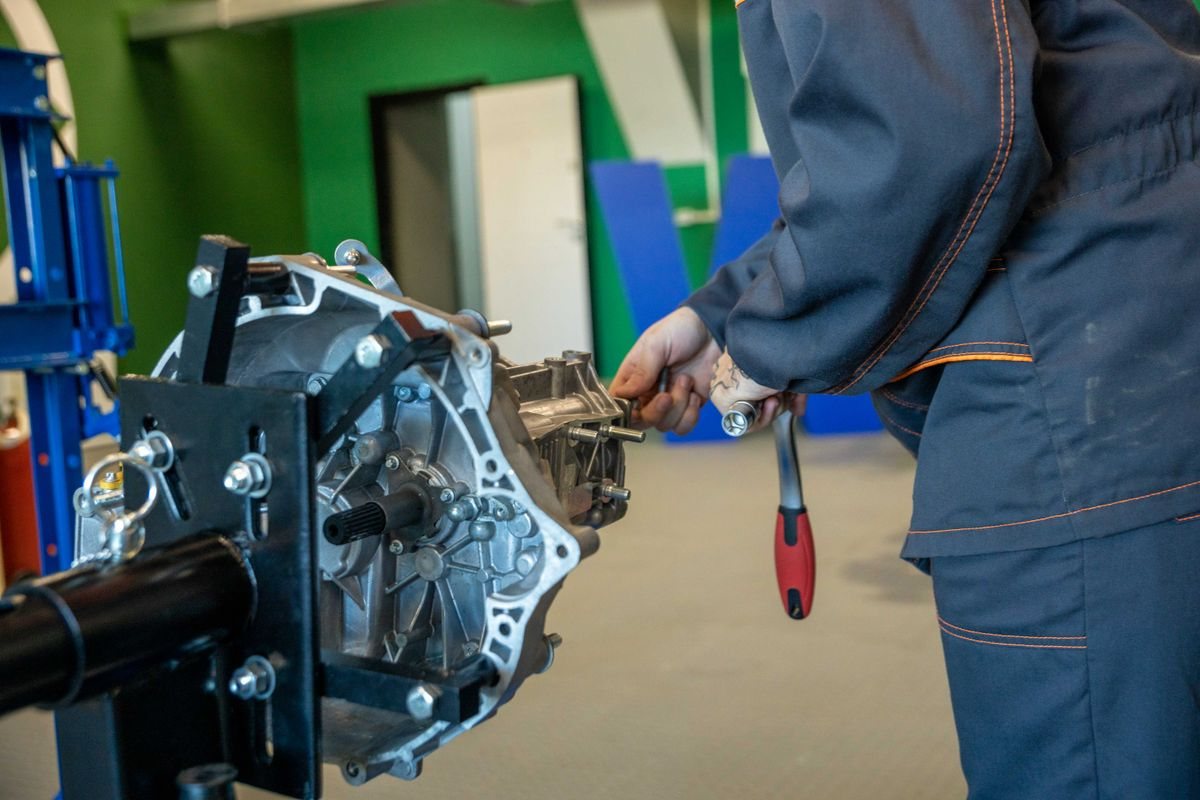
We buy the part domestically on a Japanese address, collect it, drain it and pack it for actual weight on a braced pallet or crate, prepare the export paperwork, and quote the freight as one total — purchase, handling, packing and shipping in a single number before you commit, so nothing appears later. And because we have the part in our hands here in Japan, you decide on evidence rather than on a seller's photos: we send a video and photo walkthrough of the casing and mounting faces, the bellhousing, input and output shaft play, thread and fixing condition, the stamped codes so you can confirm it is the ratio and spec you actually wanted, and what the oil looked like coming out. Send us the listing URL and your destination port or city.
What they sell for in Japan right now
The gearboxes and diffs this article is about, priced from completed Japanese sales rather than forum memory. A used R154 in detail, including rebuilt prices, is in buying a used R154 gearbox from Japan. Brand LSD rows are brand-wide; the S-chassis row is the diff category filtered to Silvia fitment.
| Part | Sold (120 days) | Median | Middle half (Q1–Q3) |
|---|---|---|---|
| SR20DET 5-speed gearbox | 8 | ¥87,000 ($544) | ¥67,975 – ¥98,000 |
| R154 gearbox (1JZ/2JZ) | 18 | ¥181,500 ($1,134) | ¥150,000 – ¥216,325 |
| Z33 6-speed gearbox (for swaps) | 7 | ¥90,000 ($563) | ¥75,000 – ¥158,000 |
| 2-way LSD for S13–S15 (any brand) | 81 | ¥92,000 ($575) | ¥63,500 – ¥127,000 |
| Cusco LSD (RS/MZ, 2-way) | 42 | ¥121,000 ($756) | ¥70,751 – ¥174,788 |
| KAAZ LSD (2-way) | 58 | ¥104,000 ($650) | ¥69,712 – ¥121,000 |
| OS Giken Super Lock LSD | 20 | ¥95,950 ($600) | ¥71,000 – ¥150,750 |
| Nismo GT LSD Pro (2-way) | 56 | ¥100,500 ($628) | ¥55,250 – ¥143,250 |
Completed Yahoo! Auctions sales in the 120 days to 24 September 2026 for the LSD rows; the three gearbox rows were re-read on 3 October 2026 counting complete gearboxes only, after we found propeller shafts, clutch sets and loose gears in the earlier figures (the R154 row had shown ¥99,900 across 66 sales). The part only, before collection, crating and freight; dollars at ¥160 to $1. The live table, refreshed on the 1st of every month, is the JDM drift parts price index; what is listed this morning is on drift parts for sale today, and each chassis has its own page: S13, 180SX, S14, S15, AE86, JZX100.
The short version
An engine has no postal route out of Japan and never did — it is a named dangerous good, refused by air and by sea, and the two biggest proxy and forwarding services print that in their own rules. A gearbox or a differential is a different case: legal to mail, but capped at 30 kg, priced up to ¥75,100 at that ceiling to the USA, and only acceptable once the oil is out. Both problems come down to the same missing ingredient, which is hands on the ground doing something physical to the part before it can travel.
If you are still choosing between channels for smaller items, the proxy and exporter comparison covers the fees side, and the discontinued-parts guide covers what to do when the part number itself has gone.
Frequently asked questions
Why does Buyee refuse engines?
Because Buyee's prohibited items list for all countries names them: both 'Engines' and 'Internal-combustion engines' appear on it. The underlying reason is that an engine is classed as a dangerous good for air transport, and Japan Post's own guidance states IATA-classified dangerous goods cannot be sent as international mail regardless of the type of mail or means of transportation — even as sea mail. Buyee also states that where it has determined it cannot handle an item, you cannot buy it through the service even for domestic shipping. It is a published policy, so there is no version of this you can argue your way around. Both lists were re-read on 22 August 2026, and note what the ban attaches to: the engine itself, not its bulk. A drained gearbox or diff under the 30 kg Japan Post ceiling has no entry on either list.
Can I ship a used gearbox from Japan by EMS?
Only if it fits the ceilings and it is genuinely dry. A transmission is not a named prohibited item — Japan Post's dangerous-goods name search returns no entry for ミッション, トランスミッション or ディファレンシャル. But every Japan Post international service caps at 30 kg (20 kg to Australia and some other destinations), EMS caps length at 1.5 m, and motor oil, gear oil and grease are all themselves listed dangerous goods. Weigh the unit and confirm it has been drained before you commit to anything.
How much does it cost to ship an engine from Japan?
There is no published rate, because there is no postal service that will carry one. It moves as freight — air cargo or ocean LCL — and freight is quoted per shipment on actual weight, dimensions, route and port, so treat any flat figure you see online as TBC. What you should insist on is a single total before you commit: purchase price, domestic transport in Japan, draining and packing, crate or pallet, export documentation and the freight leg, added up in one number rather than revealed in instalments. For scale, the postal route an engine cannot use stops at 30 kg and ¥75,100 for a 30 kg EMS parcel to the USA, ¥65,500 to Oceania, Canada and Europe, on the rate table read on 30 July 2026. Freight begins where that ends.
 Buying Used JDM Wheels & Tyres from Japan (2026)
  Shipping a Used Engine from Japan: SR20DET, 1JZ, RB (2026)
  Parts Japan Can't Post: Airbags, Fuel Tanks & Gas Shocks (2026)