
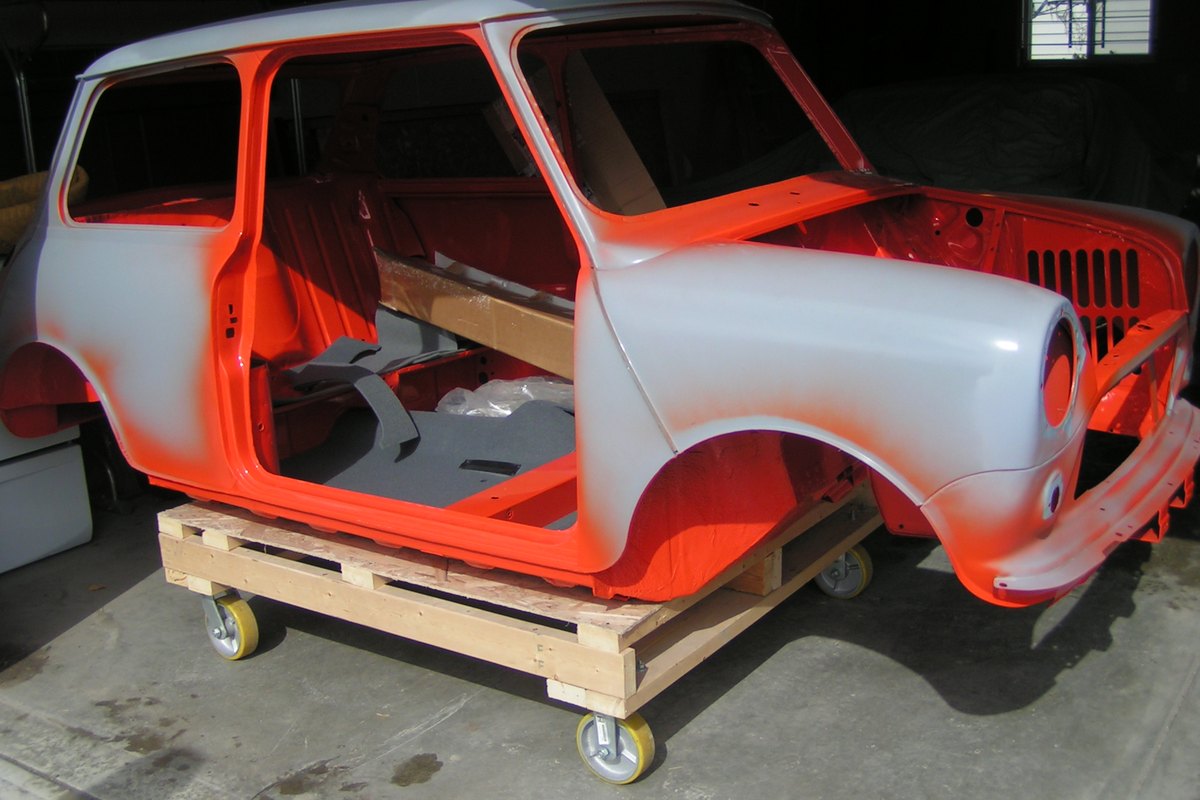
Buying a Bare Drift Shell From Japan and Shipping It (2026)
The Rundown
- Japan's Customs Tariff Schedule, in force 8 August 2026, puts a car body in its own heading: 87.07, Bodies (including cabs), for the motor vehicles of headings 87.01 to 87.05, with 8707.10 covering bodies for passenger cars. A complete car sits in 87.03. The two are different goods on the same declaration form.
- Japan Customs writes the export certificate requirement against exactly 2 states: a 登録自動車 (registered vehicle) and a car already on 一時抹消 (temporary deregistration), with either certificate issued from 6 months before the export date. A shell through 永久抹消登録 (permanent deregistration after dismantling) is in neither, and no official page we could read on 20 September 2026 says which line it lands on.
- Size is not the obstacle. Maersk publishes a 20 ft standard steel container at 5,896 mm internal length, 2,350 mm internal width and 2,393 mm to the load line; Nissan's own heritage figures put an S13 Silvia at 4,470 mm long and 1,690 mm wide. One shell fits a 20 ft with about 1,426 mm to spare.
- The published payload of that 20 ft box is 28,200 kg, against a complete 1989 S13 kerb weight of 1,120 kg. Weight never decides a shell shipment, so the quote is built on cube, handling and the yard work, not on the scale.
- No proxy route exists at any price. ZenMarket names automobiles as an example of goods it cannot ship on size and weight, and will only move anything over 150 cm or 30 kg through FedEx, DHL or UPS. Buyee's all-country prohibited list adds that where it has decided it cannot handle an item you may not buy it at all.
Contents
- Is a bare shell a vehicle or a part when it leaves Japan?
- Which Japanese paperwork applies, and what is not officially stated
- Will a shell fit in a container, and how many?
- Why no proxy or courier will move a shell
- RoRo or container, and how the quote is built
- The one step you cannot do from overseas
- What arrives at the other end
A Japanese bodyshell at a glance
You can buy a clean Japanese shell and get it home, and the hard parts are not the ones people expect. A shell fits a container easily, because a 20 ft standard box gives you 5,896 mm of internal length against the 4,470 mm Nissan publishes for an S13 Silvia. What actually decides the job is paperwork and handling: whether the body still exists in the Japanese vehicle registry, and the fact that something with no wheels, no engine and no brakes has to be lifted onto a truck, taken to a yard and stuffed into a box by people standing next to it in Japan. Every rule, dimension and limit here was checked on the official pages on 20 September 2026.
Is a bare shell a vehicle or a part when it leaves Japan?
On the tariff side the answer is clear and it is not the one most buyers assume.
| What you are exporting | Japan’s tariff heading, in force 8 August 2026 | Wording on the official schedule |
|---|---|---|
| A complete car | 87.03 | Motor cars principally designed for the transport of persons |
| A chassis with the engine on it | 87.06 | ”Chassis fitted with engines, for the motor vehicles of headings 87.01 to 87.05” |
| A bodyshell | 87.07, subheading 8707.10 | ”Bodies (including cabs), for the motor vehicles of headings 87.01 to 87.05”, 8707.10 “For the vehicles of heading 87.03” |
| Loose panels, subframes, arms | 87.08 | ”Parts and accessories of the motor vehicles of headings 87.01 to 87.05” |
So a body has a heading of its own, sitting between a complete car and a box of parts. That is the frame to argue from at the declaration, and it is the reason a shell shipment does not simply inherit the used-car export routine that our Japan-side export paperwork guide sets out in full.
Which Japanese paperwork applies, and what is not officially stated
Japan Customs FAQ 5502 writes its requirement against two states, and a dismantled shell is in neither of them.
Note that 永久抹消登録 is not a lighter version of the export route. MLIT’s document list demands the owner’s 実印 (registered personal seal) and a 印鑑証明書 (certificate of seal registration) issued within the last three months, plus the inspection certificate and the plates, exactly as the export route does. Seal registration belongs to people on a Japanese municipal residents’ register.
Then the honest gap. We could not find an official Japanese page stating what, if anything, a body already through 永久抹消登録 must show at the export declaration. Japan Customs’ general export procedures page requires the goods to be brought into a bonded area and a declaration filed, and nothing more specific survives official reading. Treat that answer as TBC and settle it with the customs broker who will file the declaration.
Will a shell fit in a container, and how many?
Yes, comfortably, and the numbers are published by the carriers.
| Measure | Maersk 20 ft standard steel | Maersk 40 ft standard steel |
|---|---|---|
| Internal length | 5,896 mm | 12,032 mm |
| Internal width | 2,350 mm | 2,350 mm |
| Internal height to load line | 2,393 mm | 2,393 mm |
| Door opening | 2,350 x 2,274 mm | 2,340 x 2,274 mm |
| Maximum payload | 28,200 kg | 28,800 kg |
Set that against Nissan’s heritage record for a 1989 Silvia K’s: 4,470 mm long, 1,690 mm wide, 1,290 mm tall, 1,120 kg complete with engine, glass and trim. One shell of that size clears the 20 ft internal length by about 1,426 mm, which is where a crate of doors, a bonnet and a subframe goes. Two fit end to end inside a 40 ft with roughly 3,092 mm left, on our own arithmetic from those two published figures.
Weight is the wrong thing to worry about
That 20 ft box is rated to carry 28,200 kg. A shell stripped from a car that weighed 1,120 kg complete is nowhere near it, so nothing here is decided by the scale. What is decided is the cube it occupies, whether it is cradled so it cannot move, and whether the yard can get it in through a 2,274 mm door opening with no wheels under it. Chassis vary, so measure the actual shell.
Why no proxy or courier will move a shell
This is where the usual Japan shopping route ends, and it ends earlier than it does for an engine.
| Service | Published ceiling, read 20 September 2026 | Takes a bodyshell? |
|---|---|---|
| ZenMarket | Nothing over 150 cm or 30 kg except via FedEx, DHL and UPS | No. Its own examples of goods it cannot ship on size and weight are “automobiles, motorcycles, heavy machinery, boats” |
| Buyee | Prohibited list names Engines, Internal-combustion engines and Asbestos | No. It also states that where it has determined it cannot handle an item you cannot buy it through the service even for domestic delivery |
| Postal and courier lanes | Built around parcels, not 4.5 m objects | No. A shell has no parcel route at any weight, which we worked through for a bare engine |
| Ocean container, LCL or FCL | No ceiling a bodyshell approaches | Yes. This is the route, and it is quoted per shipment |
FROM JAPAN’s own limits would have been worth citing here. Its rules pages returned HTTP 403 to us on 20 September 2026, so we are leaving that service out rather than describing limits we could not read.
RoRo or container, and how the quote is built
A running car can be driven onto a RoRo vessel, which is how most complete cars leave Japan in our import process guide. A shell cannot roll, so it changes category. Höegh Autoliners’ Cargo Measuring Standard, published through its customer centre, splits bookings into segments that include POV (previously owned vehicle) and a separate BB, break bulk / static / stuffed rolltrailers, and requires actual dimensions before the cargo is booked and measured before delivery to the port. A non-rolling shell is therefore not booked as a used car but as static cargo, and whether a given carrier accepts one on a given sailing is a question for that carrier rather than something their public pages answer.
For price, the method is the only honest thing anyone can give you. JETRO’s guidance states that the base ocean rate is applied to the higher of volume or weight, the freight-calculation ton, then adds CFS handling for consolidated cargo, terminal handling, bunker and currency adjustments, customs clearance, de-vanning, drayage and storage. A shell bills on cube, so the number that moves your quote is the cradle it travels in. The same volumetric fight applies to aero, seats and wheels in the same box.
The one step you cannot do from overseas
Name it precisely, because there is one link with no remote substitute. A deregistered shell is sold by a Japanese dismantler or a private seller who quotes on a Japanese phone number, takes Japanese payment, and will not release the body to anyone who is not standing in the yard with a truck. Then somebody has to lift it, strap it to a cradle, get it to a container yard and stuff it, which no proxy service offers at any price.
The condition question is settled in the same place. Rust in the chassis rails, a soft floor, a repaired strut tower and filler over a previous impact do not appear in a listing gallery, and they decide whether the shell is worth the freight. We inspect it in Japan and send you a video and photo walk-through of the underside, the rails, the floor, the engine bay and every repair area before you commit. Our auction sheet guide covers the grading marks a Japanese seller may already have disclosed.
That is the part we take on
We call the seller in Japanese, confirm which deregistration the shell has already been through, buy it domestically, and record it where it stands before it moves. Then we collect it by road, build the cradle, stuff the container at a Japanese yard and prepare the export declaration, with purchase, collection, yard work, crating and freight quoted as one total up front, actual costs plus a handling fee. Send us the chassis code, the condition you need and your destination port to start a shell and parts container job.
What arrives at the other end
Destination rules are written for vehicles, and a body is not one, which cuts both ways. NHTSA’s importation rules in 49 CFR Part 591 mention a body in exactly one place: a reconstructed motor vehicle is one “whose body is less than 25 years old and which is mounted on a chassis or frame that is not its original chassis or frame and that is less than 25 years old”. That matters if you plan to put a recent shell on an older frame. Beyond it, we could not read an official NHTSA statement on importing a bare shell, so we are not going to invent one. Get your own broker’s answer in writing before the container is booked.
If you are buying a shell to build a car and then come and use it here, the Drift Japan event and track calendar has the dates. If what you want is an engine and a loom rather than a body, that is a different object with different rules, covered in our front clip and half-cut guide.
Frequently asked questions
Can I buy just a shell from Japan and have it shipped to me?
Yes, but only as freight bought inside Japan, never through a proxy account or the post. ZenMarket's prohibited and restricted items page, read on 20 September 2026, gives automobiles as an example of goods that cannot be shipped on size and weight grounds, and limits anything longer than 150 cm or heavier than 30 kg to FedEx, DHL and UPS. Buyee's all-country prohibited list states that for items it has determined it cannot handle you cannot purchase them through the service even for delivery inside Japan. A shell is bought domestically, collected by truck, stuffed into a container at a Japanese yard and declared for export, and the total is quoted per shipment because no carrier publishes a rate for it as of 20 September 2026.
Does a bare shell need Japanese export deregistration?
It depends on what the shell still is in the registry, and the official pages stop short of answering it for a dismantled body. Japan Customs FAQ 5502, read on 20 September 2026, imposes the 輸出抹消仮登録証明書 on the owner of a 登録自動車 (a registered vehicle) and the 輸出予定届出証明書 on a car already carrying 一時抹消 (temporary deregistration), and says both certificates must be submitted to customs at the export declaration. MLIT's registration portal describes a third state, 永久抹消登録, which is the procedure used once the car has been handed to a recycling operator and properly dismantled, and which is recorded against the dismantling report date and mobile report number. We could not find an official page stating which certificate, if any, a shell in that third state needs at export, so treat it as TBC and settle it with the customs broker before the container is booked, as of 20 September 2026.
Will an S13 or S14 shell fit inside a 20 ft shipping container?
On published figures, yes, with room left over. Maersk's dry container specification gives a 20 ft standard steel box 5,896 mm of internal length, 2,350 mm of internal width, 2,393 mm of height to the load line and a door opening 2,350 mm wide by 2,274 mm high, with a 28,200 kg maximum payload. Nissan's heritage record for a 1989 Silvia K's gives the complete car as 4,470 mm long, 1,690 mm wide and 1,290 mm tall, so a shell of that chassis clears the length by roughly 1,426 mm. A 40 ft box at 12,032 mm internal length takes two such shells end to end on our own arithmetic. Both pages were read on 20 September 2026.
How much does it cost to ship a car shell out of Japan?
There is no official published rate, because no postal or proxy service carries a shell and freight is quoted per shipment. JETRO's trade guidance on freight costs, re-read on 20 September 2026, explains that the base ocean rate is applied to the higher of volume or weight, the freight-calculation ton, and that CFS handling for consolidated cargo, terminal handling, bunker and currency surcharges, customs clearance, de-vanning, drayage and storage sit on top of the rate itself. For a shell the volume side dominates, because a 20 ft container's 28,200 kg payload is never reached by a body that came off a 1,120 kg car. Insist on one total covering purchase, collection, the yard work, stuffing and freight before anything is bought, as of 20 September 2026.
 The Japan-Side Export Paperwork for a Drift Car (2026)
  How to Import a Drift Car from Japan: The Whole Process (2026)
  Can a Foreigner Buy a Drift Car and Keep It in Japan? (2026)
  How to Import a Drift Car from Japan to the US: Forms & Duty (2026)