
How to Import a Drift Car from Japan: The Whole Process (2026)
The Rundown
- The order is fixed and it starts before you shop: the United States admits a car only once it is 25 years old, Transport Canada stops regulating at 15 years, and Australia wants its concessional RAV approval in hand before the car ships.
- Japan's side is a registry step, not a formality — the export deregistration is filed with the owner's 実印 (registered seal) and a 印鑑証明書 issued within the last 3 months, the plates are surrendered, and the government fee is ¥500.
- The export-scheduled notification can only be filed from 6 months before your planned export date, and the certificate is valid only up to that date.
- Duty is the small number: 2.5% into the US, 6.1% into Canada, 5% into Australia, 10% into the UK, 0% into New Zealand. It is the 5%–20% GST or VAT on top that moves the total.
- Checked against the CBP, Transport Canada, MLIT and Japan Customs pages on 9 September 2026; 470 priced drift chassis were on the Japanese retail market at our last census on 21 August 2026.
Contents
- How do I import a drift car from Japan?
- Can you legally import a Japanese drift car into your country?
- Where does the car actually come from?
- What happens in Japan after you buy it?
- RoRo or container, and what actually drives the shipping cost?
- What is waiting for you when the ship arrives?
- How long does it take, and when does the money leave your account?
Importing a drift car from Japan at a glance
How do I import a drift car from Japan?
Importing a drift car from Japan is one sequence with six stages: confirm your country’s age rule, buy the car, deregister and export it in Japan, ship it, clear customs and compliance, then register it. The first stage and the last one are yours to do at home. The stages in between need either someone standing at a Japanese counter or a licence you cannot hold from abroad: dealer auctions are closed to overseas buyers, the export deregistration is filed with the owner’s registered seal and a seal certificate issued within the last three months, the plates are handed in there, and Japan Customs confirms the resulting certificate at the export declaration. Two stages also carry hard gates that no money can move — the United States will not permanently admit a car under 25 years old, Canada stops regulating at 15 years, and Japan’s export certificate can only be filed from six months before your planned export date. Every rule, fee and deadline below was checked against the official pages on 9 September 2026, and the CBP, Transport Canada, MLIT and Japan Customs pages behind the age rules, the export certificate and the 2.5% US duty were re-read on 16 September 2026 with none of them moved.
This page is the map, and each stage has its own guide: the 25-year rule, importing to the USA, Australia, the UK and Canada, New Zealand, the Japan-side export paperwork and asbestos and biosecurity. Each is linked again below where it belongs in the sequence.
Can you legally import a Japanese drift car into your country?
Answer this before you look at a single listing, because it deletes most of the market for some readers and none of it for others.
The United States runs the strictest clock. CBP states that a vehicle less than 25 years old must comply with the Federal Motor Vehicle Safety Standards to be permanently imported, and the 25 years are counted from the date of manufacture. That is why an S13 or S14 is easy in 2026 and an S15 is a month-by-month question — the 25-year rule guide works through the chassis one by one, and the US process guide covers the forms.
Canada is the loosest of the big four. Transport Canada states that vehicles older than 15 years of age are not regulated at the time of importation by the Motor Vehicle Safety Act, and that age is determined by the month and year of manufacture on the statement of compliance label. Australia gates at 25 years through a concessional RAV entry approval that has to be granted before the car ships; the UK has no age bar at all. Those three are covered together in importing to Australia, the UK and Canada. New Zealand is the odd one out — no age gate, but LVV certification after the car lands, which is where a coilover-and-cage build gets expensive; see importing a drift car into New Zealand.
Don't get caught out
Every clock above runs on the build month, not the model year on the listing. A car advertised as a 2001 S15 can have been built in late 2001 or in 2002, and that difference is a year of storage. Get a photo of the build plate on the exact chassis before money moves.
Where does the car actually come from?
Three routes, and they are not variations of each other. Dealer auctions are the wholesale side with the deepest selection, sold as-is. Exporter stock is the simplest and most transparent, priced closest to Japanese retail. Private sales inside the drift community are where genuinely built cars change hands.
Retail is your ceiling, not your target. Our census of Goo-net on 21 August 2026 counted 470 priced cars and put the medians at ¥3.80M for an S13, ¥2.88M for an S14 and ¥4.35M for a JZX100 Chaser — full breakdown in Market Check #2, route-by-route cost stack in buying a drift car from Japan. Then learn to read the two documents that describe the car: the auction sheet and the Japanese used-car listing.
The stage you cannot do from overseas
Auction membership is closed to you: USS requires a Japanese used-vehicle dealer licence held for over a year, permanent premises, a ¥100,000 deposit and two Japanese guarantors who own property, and it states that guarantors cannot be foreign nationals. We hold the membership and bid on the lot you pick — and before you commit, we look at the car in Japan and send you a video and photo walkthrough of the underside, frame rails, engine bay and a cold start. See how our export desk works, from bidding on your behalf to a landed quote — actual cost plus our fee, with the total quoted up front.
What happens in Japan after you buy it?
The car has to leave the Japanese registry before it can leave the country, and which procedure applies depends on one thing: whether it still wears plates.
A registered car goes through 輸出抹消仮登録 (export deregistration). MLIT’s document list is specific — the application sealed with the owner’s 実印 (registered personal seal), a 印鑑証明書 (seal registration certificate) issued within the last three months, the 車検証, and the number plates handed in at the counter. The planned export date is written on the application. A car already sitting deregistered uses a 輸出予定届出 (export-scheduled notification) instead, which MLIT says can be filed from six months before the planned export date.
Then Japan Customs checks it. The customs guidance is that the certificate is submitted and confirmed at the export declaration, so this is not optional paperwork you can tidy up later. The government fee is ¥500 per procedure, and the detail — including the recycling deposit refund and who can hold the seal — is in the Japan-side export paperwork guide.
RoRo or container, and what actually drives the shipping cost?
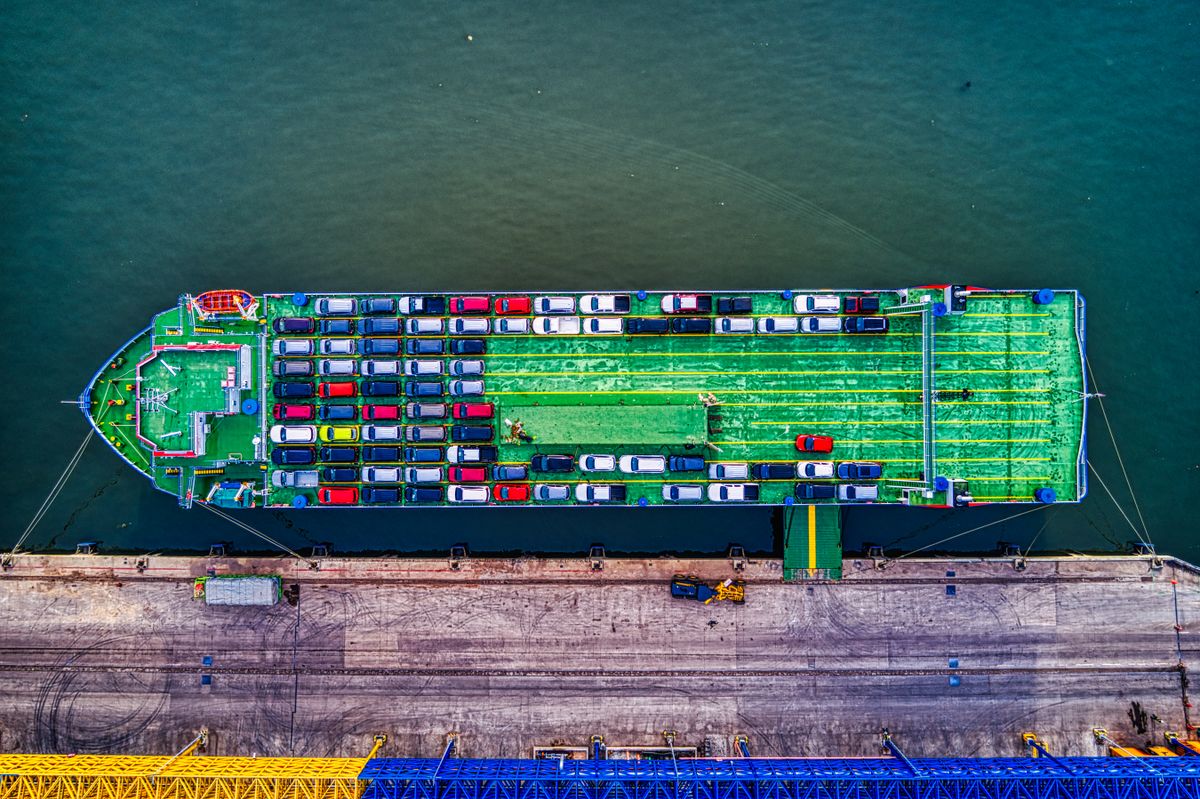
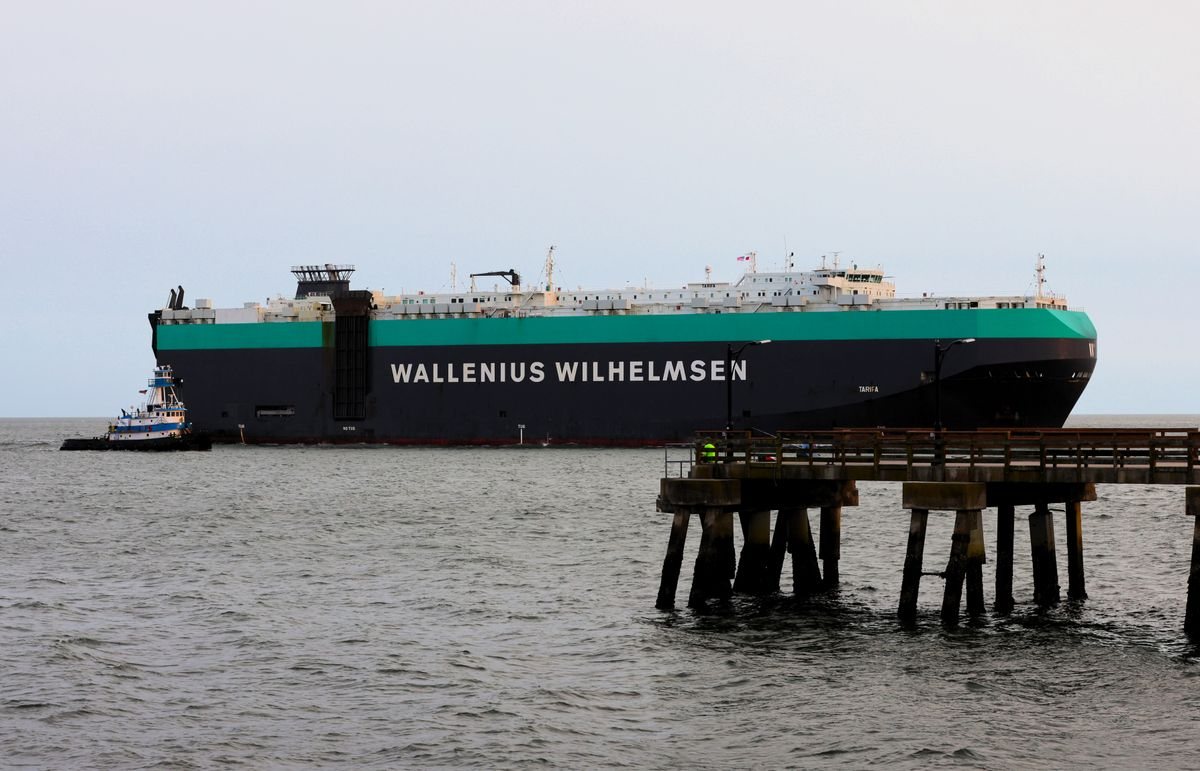
RoRo is the default for a running car. Höegh Autoliners describes it plainly: vehicles are driven or towed onto the vessel via a wide stern ramp by stevedores, secured with braces or straps, and placed on decks according to their dimensions and weight. Nothing goes in the car, because the car is not a box.
A container makes sense when the car does not run, when it is stripped or caged, or when you are shipping wheels, panels and spares with it. It costs more per car unless you share the box.
Cost is driven by the space the car takes, the route, and the sailing you actually get. Quotes come as FOB (loaded on the ship in Japan) or CIF (delivered to your port), and neither includes anything your own country charges. Transit time is a property of the vessel’s port rotation, so take it from the booking rather than from an average. One thing is fixed: CBP states the undercarriage must be steam-sprayed or cleaned thoroughly before shipment to remove foreign soil, and for a used car into New Zealand that cleaning has to be done by an approved system in Japan — see asbestos and biosecurity checks.
What is waiting for you when the ship arrives?
Three separate things, usually from three separate agencies. Money first: duty is 2.5% into the US, 6.1% into Canada, 5% into Australia, 10% into the UK and 0% into New Zealand, with GST or VAT of 5% to 20% on top and calculated on the car plus freight. Then the forms — in the US, NHTSA’s HS-7 with Box 1 and EPA Form 3520-1 with Code E, filed with the CBP entry. Then the inspections: biosecurity everywhere, and an asbestos regime in Australia that has no tolerance level and looks hardest at brakes and gaskets.
How long does it take, and when does the money leave your account?
| Stage | Who charges you | When it lands | What it costs |
|---|---|---|---|
| Age-rule check | Nobody | Before you shop | Time only — build-month proof on the exact chassis |
| Buying the car | Seller, exporter or auction agent | Day of purchase | Car price plus the agent’s fee; retail medians ¥2.88M–¥4.35M as of 21 Aug 2026 |
| Export deregistration | MLIT counter, via whoever files it | Days after purchase; filable up to 6 months before export | ¥500 government fee plus the filing work |
| Inland transport and booking | Shipper or forwarder | Before the sailing | Priced on the space the car takes; quoted per sailing |
| Ocean freight | Carrier or forwarder | At booking (CIF) or separately (FOB) | Route and vessel dependent — from the booking, not an average |
| Duty and tax | Your customs authority | Before the car is released | US 2.5% plus a bond above US$2,500; CA 6.1% + 5% GST; AU 5% + 10% GST; UK 10% + 20% VAT; NZ 0% + 15% GST |
| Compliance and inspection | Regulator or certifier | After arrival | AU RAV approval (30 business days, before shipping); NZ entry certification and LVV; biosecurity and asbestos |
| Registration | State, province, DVLA or NZTA | Last | Local fees; NZ requires the LVV plate within 2 months of the inspection |
Read that as a cash-flow diagram, not a schedule. The car is paid for early, the Japanese fees are trivial, the freight is one large payment in the middle, and the border charges land at the end while the car sits in a compound accruing storage. Budget the last two rows before you bid on the first one.
If the plan includes a trip to watch the cars run, the Drift Japan Event & Track Calendar has the dates. Rules move — the US changed twice in eight weeks in mid-2026 — so this page carries the date it was last read off the official sources: 9 September 2026, with the age rules, the export certificate and the US duty rate re-read on 16 September 2026.
Frequently asked questions
How do I import a drift car from Japan?
Six stages in a fixed order, and the first one decides whether the rest can happen. Start with your country's age rule, because the clock runs from the build month: the United States admits a car only once it is 25 years old and Canada stops regulating at 15 years. Then the Japan side, which is a registry step rather than a formality — the export deregistration is filed with the owner's 実印 (registered seal) and a 印鑑証明書 issued within the last 3 months, the plates are surrendered at the counter, and Japan Customs confirms the resulting certificate at the export declaration; it can be filed from 6 months before your planned export date. What catches people last is the arrival: duty of 0% to 10% depending on the country, GST or VAT of 5% to 20% on top of car plus freight, and then whatever your own regulator demands before it can be registered. The CBP, Transport Canada, MLIT and Japan Customs pages behind those rules were re-read on 16 September 2026.
How long does it take to import a car from Japan?
There is no single published number, so budget from the clocks that are official. As of 9 September 2026, Japan's MLIT lets the export-scheduled notification be filed from 6 months before your planned export date and the certificate expires on that date; Australia's concessional RAV entry approval is quoted at 30 business days of assessment and must be granted before the car ships; and New Zealand requires the LVV plate to be fitted within 2 months of the certification inspection. Ocean transit itself depends on the route and the vessel's port rotation, so take it from the actual booking rather than a forum figure.
Can I import a drift car from Japan to the USA?
Yes, once the specific car is old enough. As of 9 September 2026 CBP states that a vehicle less than 25 years old must comply with the Federal Motor Vehicle Safety Standards to be permanently imported, and the 25 years run from the build month, not the model year — so a 1995-built S14 clears in 2026 and a late-2001 S15 has to be checked to the month. At the port you file NHTSA form HS-7 with Box 1 ticked and EPA Form 3520-1 with Code E, plus the CBP entry, for which CBP asks for the shipper's or carrier's original bill of lading, the bill of sale and the foreign registration. Duty is 2.5% of the price paid or payable, and a customs bond is required above US$2,500.
Do I need an export certificate to ship a car out of Japan?
Yes. As of 9 September 2026 Japan Customs requires the export certificate to be submitted and confirmed at the export declaration, so the car cannot legally leave without it. Which certificate depends on the car: a registered car with plates goes through 輸出抹消仮登録 (export deregistration), which needs the owner's 実印 and a 印鑑証明書 issued within the last 3 months and the surrender of the number plates, while a car already deregistered uses a 輸出予定届出 (export-scheduled notification), filed from 6 months before the export date. The government fee is ¥500 for each procedure.
Where do people actually buy drift cars in Japan — auction, exporter or private sale?
All three, and they price differently. As of 9 September 2026 dealer auctions are the wholesale side but are closed to overseas buyers directly: USS requires a Japanese used-vehicle dealer licence held for over a year, permanent premises, a ¥100,000 deposit and two Japanese guarantors who own property, and states that guarantors cannot be foreign nationals. Exporter stock is the easiest route and sits closest to retail, and private sales inside the Japanese drift community are where built cars hide. For a ceiling, our 21 August 2026 census of 470 priced cars put the median asking price at ¥3.80M for an S13, ¥2.88M for an S14 and ¥4.35M for a JZX100 Chaser.
 The Japan-Side Export Paperwork for a Drift Car (2026)
  Import Duty on JDM Drift Parts from Japan: US, UK, AU, NZ, CA (2026)
  What ジャンク Means on Yahoo! Auctions: Drift Parts Listing Terms (2026)
  How to Import a Drift Car from Japan to the US: Forms & Duty (2026)