
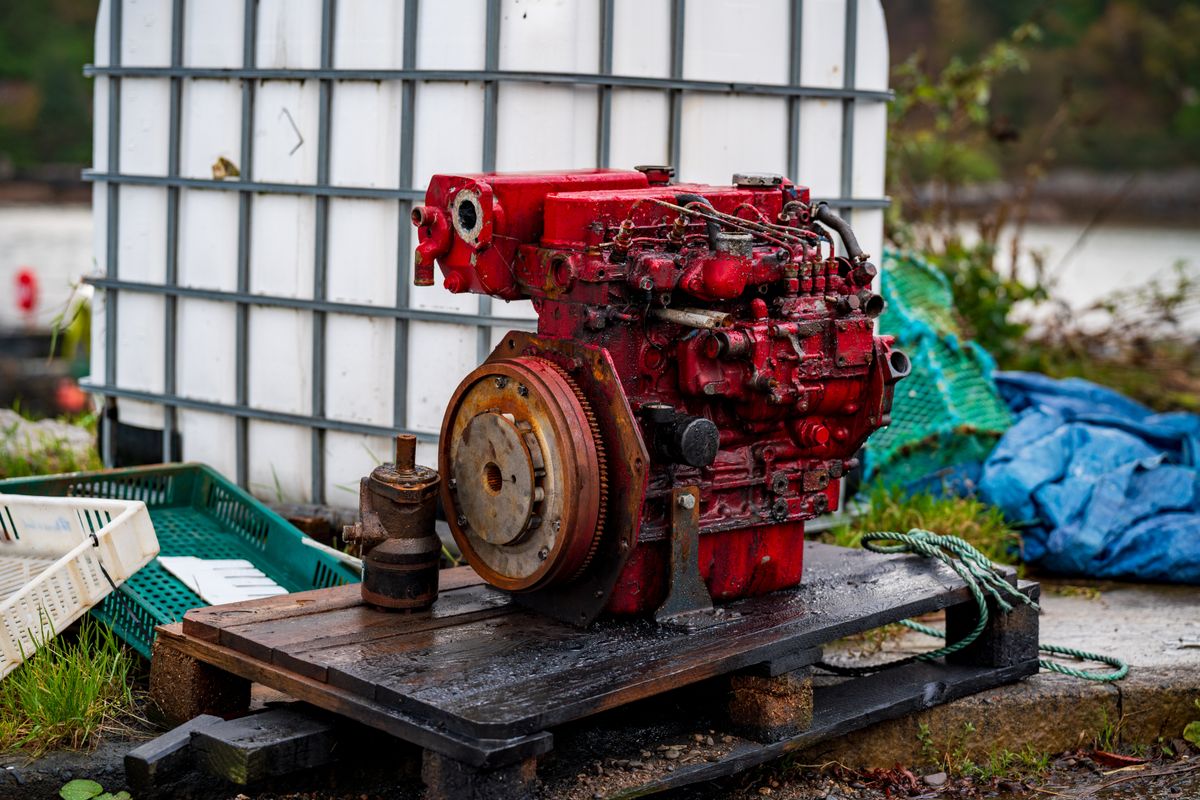
Shipping a Used Engine from Japan: SR20DET, 1JZ, RB (2026)
The Rundown
- Japan Post's air dangerous-goods name search grades エンジン/Engine as refused on all three of its lines: ordinary domestic mail, domestic carriage by air, and international mail. Unlike a fuel tank or a suspension assembly, no condition is printed that would get you past it (checked 19 September 2026).
- Every proxy route closes before weight even matters. Buyee's all-country prohibited list names Engines and Internal-combustion engines, tenso.com names Engine, and ZenMarket refuses anything longer than 150 cm or heavier than 30 kg through the carriers it uses.
- Courier ceilings are published and an engine walks straight through them. DHL Express's 2026 Japan guide allows 70 kg per non-palletised piece inside 120 x 80 x 80 cm, requires anything over 70 kg to go on a pallet, and refuses pieces over 1,000 kg or 300 cm.
- It leaves as freight, and freight has no rate card. JETRO's trade guidance, last updated in July 2025, states the base rate is applied to the greater of volume or weight (フレートトン, the freight-calculation ton), before CFS handling, terminal handling, bunker and currency adjustments and customs clearance are added.
- The domestic leg is the surprise. In 120 live Yahoo! Auctions listings in the Nissan engine-block category read on 19 September 2026, 56 named the freight carrier Seino (西濃運輸), 32 mentioned 営業所止め (depot hold) and 17 said 発送不可, cannot be shipped.
Contents
You can get a used SR20DET, 1JZ-GTE, 2JZ-GTE, RB25DET or 4A-GE out of Japan, and none of the route runs through the post office or a proxy account. Japan Post’s air dangerous-goods database grades エンジン/Engine as refused on all three of its lines, Buyee’s all-country prohibited list names Engines and Internal-combustion engines, and ZenMarket stops at 30 kg and 150 cm before the word engine is even reached. A bare engine leaves as freight, on a pallet or in a crate, priced per shipment on whichever is greater of volume or weight. Every rule, ceiling and listing count on this page was checked on the official pages on 19 September 2026.
| Route | Published ceiling | Does it take a bare used engine? |
|---|---|---|
| Japan Post EMS and International Parcel | 「重量は30kgまでOK」, and lower to some countries | No. エンジン/Engine is refused on all three lines of the dangerous-goods database |
| Buyee (proxy) | Heaviest published lane is its DHL option at 70 kg | No. Engines and Internal-combustion engines are named on the all-country list |
| ZenMarket (proxy) | Nothing “longer than 150cm” or “heavier than 30kg” via EMS, AVIA, UPS, DHL, FedEx | No. It fails on size and weight before the item is even classified |
| tenso.com (forwarder) | Per-country limits, published separately | No. “Engine” is on the prohibited list, next to “Suspensions (car parts)“ |
| DHL Express, booked inside Japan | 70 kg per non-palletised piece at 120 x 80 x 80 cm; over 70 kg goes on a pallet, 1,000 kg maximum; nothing over 300 cm | Not named either way in the 2026 Japan guide. Fully regulated IATA dangerous goods need a contractual agreement and JPY16,500 per shipment |
| Air cargo or ocean LCL | No ceiling a car engine comes close to | Yes. This is the route, and it is quoted per shipment |
Why is a used engine refused by the post office and by every proxy?
Two separate walls, and most people only ever hit one of them.
The first is Japan Post’s 航空危険物等品名検索, the air dangerous-goods name search. It grades products by name and gives each one three verdicts: ordinary domestic mail, domestic carriage by air, and international mail. Search エンジン and exactly one entry comes back, エンジン/Engine, filed under 車・バイク・自転車 > 自動車用品・バイク用品. All three of its lines carry the refusal mark, and that is stricter than it first reads. A petrol tank at least gets a printed condition, 「ご利用は未使用のものに 限ります」, unused items only, which keeps a domestic route alive. A suspension assembly gets one too. The engine entry carries no condition at all, so there is nothing to satisfy.
The refusal follows the item onto the boat. Japan Post’s English page states that items covered by the IATA Dangerous Goods Regulations “cannot be sent via international mail, regardless of the types of mail items or means of transportation”, and then closes the last door: “Please note that the items cannot be accepted even as sea mail.” A gearbox or a differential is a genuinely different case, blocked by residual oil and a 30 kg ceiling rather than by a ban, and we worked that through in the drivetrain shipping guide.
The second wall is the workaround industry, which has written the same answer into its own rules. Buyee names both Engines and Internal-combustion engines, and adds that where it has decided it cannot handle an item you may not buy it through the service even for domestic delivery. tenso.com names Engine. ZenMarket never mentions engines and does not need to, because it refuses anything “longer than 150cm” or “heavier than 30kg” through EMS, AVIA, UPS, DHL and FedEx alike. For scale, the heaviest lane Buyee publishes for any item at all is its DHL option at 70 kg.
Nobody publishes what your engine weighs
Neither Nissan nor Toyota publishes a dry weight for these engines on a current official page, and the figures circulating on forums and spec sites disagree by tens of kilos for the same SR20DET. That is not a detail you can paper over: freight is billed on measured weight and outside dimensions, so the only number that can produce a real quote is the packed crate weight taken on a scale in Japan. Any quote built on a number somebody typed into a forum in 2011 is a guess wearing a decimal point.
How does an engine actually leave Japan, and how is the price built?
It becomes cargo. That changes who does the work and how the number is arrived at.
Then the price. Ocean rates move with the vessel’s port rotation and air cargo moves with the season, so the honest thing to hand you is the method rather than a figure. JETRO’s trade guidance, last updated in July 2025, sets out how a base ocean rate is calculated: 「原則、容積または重量の高い方の トン数(フレートトン=運賃計算トン)に賃率をかけて計算します」. In plain terms, the carrier measures the cube and weighs the crate, and charges on whichever is larger. An engine is unusually dense, so it almost always bills on weight, which is precisely why the scale ticket matters more than the tape measure here.
The freight rate is also not the invoice. JETRO enumerates what sits alongside it, and consolidated cargo collects most of them: the CFS charge, which JETRO glosses as 混載貨物取扱料金, the handling fee for consolidated cargo; terminal handling, bunker and currency adjustment surcharges, customs clearance fees, de-vanning, drayage, storage and the domestic leg. The same page tells shippers to confirm rates with the carrier in advance because they are revised with demand and economic conditions. That is a government trade body saying, in writing, that a flat number quoted off a website is not a price.
What does a Japanese engine listing tell you before any of that matters?
More than most buyers read, and the surprise is not the one the forums warn about.
We took 120 live listings from Yahoo! Auctions’ Nissan engine-block category (エンジン本体, category 2084199272) and counted how often each term appeared anywhere in the listing page, on 19 September 2026. Collection-only turned out to be rare. Depot freight turned out to be the norm.
| What the listing page said | In 120 listings | What it means for you |
|---|---|---|
| 西濃 (Seino, a freight carrier rather than a parcel courier) | 56 | The seller has already decided this is freight, not a courier box |
| ノークレーム・ノーリターン (no claims, no returns) | 33 | The seller is refusing complaints and returns in advance |
| 営業所止め (held at the carrier’s depot for collection) | 32 | Somebody with a vehicle has to collect it from a depot inside Japan |
| 圧縮 (compression) | 27 | A minority actually publish compression figures. Ask for them |
| 発送不可 (cannot be shipped) | 17 | No delivery at all is on offer |
| 実働 (was running when it came out) | 11 | A claim about the donor car, not a test result |
| 引き取り限定 / 直接引取 (collection only) | 5 | Rarer than expected for a bare engine, and we cover that tier in the pickup-only guide |
So the trap is not usually a seller refusing to post. It is a seller who will happily send the engine, by freight, to a Seino depot or a business address in Japan, which is a place you do not have. Our listing-phrase decoder covers the general vocabulary; these are the words that only turn up on engines.
Engine-specific words worth knowing
- ベアエンジン (bea enjin) — bare engine. No loom, no ECU, often no ancillaries. It is a listing category, not a complaint
- 実働 (jitsudō) — it was running in the car when it was removed. A statement about the past, with no test attached
- 載せ替え (nosekae) — swapped in. The engine was fitted to a car other than the one it left the factory in, so the chassis history and the engine history are different stories
- 圧縮測定 (asshuku sokutei) — compression measured. Ask for the figure per cylinder, and ask when it was taken
- タービン交換済 (tābin kōkan-zumi) — the turbo has been replaced. Ask with what, and how long ago
- 現状渡し (genjō-watashi) — sold exactly as it stands, with no promise beyond the photographs
- ノークレーム・ノーリターン — no claims, no returns. A seller convention rather than a platform rule
- 法人様宛 / 営業所止め — business addresses or depot collection only. Read this line before the price
The step that traps an overseas buyer
Name it precisely, because it is one link in the chain and it has no remote substitute. The listing ships by freight to a Seino depot or a business address in Japan and nowhere else, the seller answers questions only in Japanese and often only by phone, and no proxy or forwarder will accept the item at any weight because their own published lists refuse engines by name. Somebody has to be standing in Japan to receive it, drain it, and build something around it that a carrier will lift.
That is the part we take on
We buy the engine domestically on a Japanese address so the seller is dealing with a Japanese buyer, take the depot delivery or collect it ourselves, drain it, and crate or palletise it for the lane it is travelling on. Because the unit is in our hands here, you decide on evidence instead of a garage-floor photograph: we send a video and photo walkthrough of the engine from all sides, the block and head casting numbers, the plug wells, oil weeps at the sump and rear main, shaft play in the turbo, and whatever compression figures the seller has given, before you commit to anything. Purchase, collection, draining, crating, export documentation and freight then come back as one total, actual cost plus a handling fee, agreed before anything is bought. Send us the listing URL, the engine code you want and your destination port to start an engine sourcing job.
The short version
An engine is the one common JDM drift purchase where the entire consumer route is closed. Japan Post refuses it by name on all three lines of its own database and will not take it as sea mail either. Buyee and tenso.com refuse it by name, and ZenMarket’s 30 kg and 150 cm limits would refuse it anyway. DHL’s published 70 kg piece limit tells you which shape of problem you are in, and past that it is pallets, air cargo and ocean LCL, priced on the greater of volume or weight with CFS, terminal and bunker charges stacked on top.
None of that is exotic. It is a drain pan, a scale, a crate and an export declaration, all of it happening at a Japanese address on a weekday while you are asleep. If you are coming over for a matsuri anyway and the dates line up, the event calendar is the place to start, because being in the country turns a depot delivery into a morning’s driving. If you want the loom, the ECU and the ancillaries attached rather than a bare block, the front clip and half-cut guide covers the package version of this same problem.
Frequently asked questions
Can I ship an SR20DET engine from Japan?
Yes, but only as freight, and never as mail or through a proxy account. Japan Post's 航空危険物等品名検索 air dangerous-goods database grades エンジン/Engine as refused on all three of its lines, including ordinary domestic mail, and its English guidance states that IATA dangerous goods cannot be sent by international mail regardless of the means of transportation and cannot be accepted even as sea mail. Buyee's prohibited items list for all countries names Engines and Internal-combustion engines, tenso.com names Engine, and ZenMarket refuses anything over 30 kg or longer than 150 cm through its carriers. What is left is air cargo or ocean LCL: the engine is bought domestically in Japan, drained, crated or palletised, declared for export and quoted per shipment. All of those pages were read on 19 September 2026.
Will Buyee or ZenMarket forward an engine?
No. Buyee's Prohibited Items for All Countries page lists both Engines and Internal-combustion engines, and states that for items Buyee has determined it cannot handle you cannot purchase them through the service even if you only want them shipped to a Japanese address. tenso.com's prohibited list names Engine under its other-goods heading, alongside Suspensions (car parts). ZenMarket does not name engines at all and does not need to, because it refuses anything longer than 150 cm or heavier than 30 kg via EMS, AVIA, UPS, DHL and FedEx. For scale, the heaviest lane Buyee publishes for any item is its DHL option at 70 kg. All three lists were checked on 19 September 2026.
How much does it cost to ship an engine from Japan?
There is no published rate, because no postal or proxy service carries one and freight is quoted per shipment. JETRO's trade guidance, last updated July 2025 and re-read on 19 September 2026, states that the base ocean rate is applied to the higher of volume or weight, the freight-calculation ton (フレートトン), and that surcharges apply where the shape of the cargo or port conditions raise the cost. On top of that sit CFS handling for consolidated cargo, terminal handling charges, bunker and currency adjustments, customs clearance, de-vanning, drayage and storage, and JETRO tells shippers to confirm rates with the carrier in advance because they are revised with demand. Treat any flat figure you read online as TBC until it is a quote for your crate to your port, and insist on one total covering purchase, collection, draining, crating and freight before anything is bought.
Does a used engine have to be drained before it can be shipped out of Japan?
Every carrier page points that way, and none of them offers you a route with fluids still in. Japan Post refuses エンジン/Engine outright, grades エンジンオイル (motor oil, petroleum classes 3 and 4) as conditional, and states that IATA dangerous goods are not accepted even as sea mail. DHL Express's 2026 Japan Service and Rate Guide prices fully regulated IATA dangerous goods at JPY16,500 per shipment and requires a contractual agreement first, so a shipper who cannot say the unit is dry is booking a different and more expensive kind of shipment. Draining, wiping the casing, refitting the plugs and recording the dry condition is physical work that happens at a Japanese address, not something a buyer overseas can arrange remotely. Pages checked 19 September 2026.
 Parts Japan Can't Post: Airbags, Fuel Tanks & Gas Shocks (2026)
  Shipping a Used Gearbox, Diff or Engine Out of Japan (2026)
  Pickup-Only JDM Drift Parts in Japan: The Unbuyable Tier (2026)
  JDM Drift Parts from Japan: What Proxies Can & Can't Do (2026)