
Central Circuit: How to Drift in Hyogo (2026)
The Rundown
- You cannot turn up and drift. The circuit's own paid running is licence-holder lapping in 30-minute slots sorted by vehicle class — drifting only happens on days somebody else has hired the place.
- Drift at Central does not run on the 2.8 km road course. It runs on the car park behind the main stand, on pylon courses — LiiMake DD's Satomin Drift day has been held there 61 times since 2016.
- The real 2026 figures: ¥1,000 gate admission per person, ¥10,000 per driver for the drift day, ¥15,000–20,000 for two drivers sharing one car.
- The circuit's own licence is ¥51,000 in year one plus ¥6,000 per 30-minute session, is booked by phone only, and needs a Japanese bank account with a registered seal.
- Buses really do reach it — Nishiwaki-shi Station to Sakamoto-higashi in 38 minutes, four a day on weekdays and five at weekends — but on a Sunday the last one back leaves at 16:33.
Contents
If you have searched for a drift track in Kansai, two names come back. One is Meihan. The other is Central Circuit — a proper 2.8 km permanent road course in the hills of Taka, Hyogo, 25 minutes off the Chugoku Expressway and an easy drive from Osaka or Kobe. Almost nothing in English explains how a visitor actually gets on track there, and the assumption most people arrive with is wrong.
Here is what the official pages say, verified 30 July 2026.
Central Circuit at a glance — verified 30 July 2026
What you are actually looking at
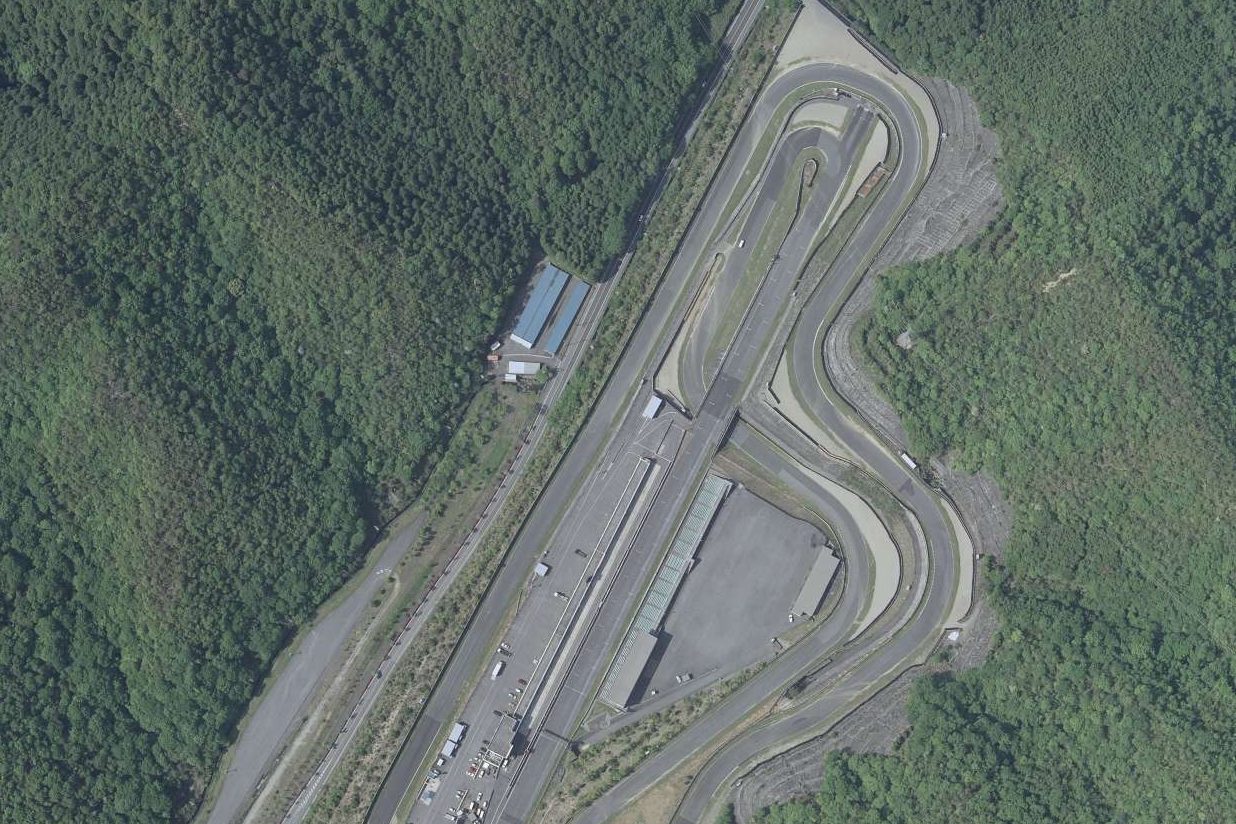
Central Circuit opened in September 1996 and is a JAF-certified circuit — JAF is Japan’s national motorsport authority, and it lists Central as a nationally certified permanent racing course. The course is 2,804 m, right-handed, 11–15 m wide, with 20 m of elevation change, a 677 m main straight and a flyover that passes under it. COME, one of the shops that runs events there, counts twelve corners: three left, nine right. Gates open at 7:30, running stops at 17:00, and the place is closed on Mondays — with the Tuesday taken instead when a Monday falls on a public holiday.
Admission is ¥1,000 per person for the whole day, free for junior-high age and under, and the official page notes it can change for events. That ¥1,000 is the cheapest way to stand at a Japanese drift day, and nobody stops you spending it.
Drifting happens in the car park, not on the road course
This is the part that surprises people. The regular drift day at Central is LiiMake DD’s Satomin Drift day (soukoukai — a run day a shop or club organises, rents the venue for and sells entries to). Its own pages are blunt about the venue: it is held on the car park behind the main stand, with pylons laid out to make courses. Not the 2.8 km circuit.
That sounds like a downgrade until you read the format. A day works through four layouts — donuts and figure-of-eight, a tightrope course, a mini course of six to eight pylons, then a full course of around twelve that changes every round — with two ten-minute donut slots reserved for people who cannot do a figure-of-eight yet. Roughly 25 cars, running 08:00 to 16:30 after a 07:50 briefing, group photo at 16:50, everyone out by 16:55. It has run 61 times since July 2016.
The car list they publish is the honest Kansai grassroots mix: FD3S and FC3S RX-7s, AE86, JZX100 Mark II and Chaser, S13, S14, S15, 180SX, R32 through R34, BRZ, Laurel, Supra, a Lancer Evo wagon, a pickup and a kei truck. Any drivetrain, automatic or manual. For the same scene on a different Kansai layout, our Meihan Sportsland guide covers the C course and its wall.
What gets you onto the drift day
- A driving licence — that is the only stated eligibility requirement, with no nationality clause
- A helmet: full face, or a jet helmet that covers your ears and the back of your head
- Seatbelts: three-point is accepted as well as four-point, and wearing it while running is compulsory
- Worn-in trainers or racing boots. Sandals are refused
- Cash for the gate — ¥1,000 for you, ¥1,000 for each adult or high-school-age passenger
- The consent form they send as a PDF about three days out, printed, filled in and brought with you
The circuit’s own running is a licence and a lapping slot
Buy running from the circuit itself and you get something different. The monthly time schedule splits the day into thirteen 30-minute slots from 8:30 to 16:50, labelled by vehicle class: four-wheel with plates, four-wheel without plates, bikes under and over 400 cc, formula, karts. It is a lapping timetable, and drift is not one of the categories on it. Days that an organiser has hired are marked as exclusive use instead — in August 2026 that is the 10th, 13th, 14th, 27th and part of the 30th.
To use those slots you need the circuit’s own four-wheel licence:
| Item | 2026 figure |
|---|---|
| Joining fee | ¥21,000 |
| Annual fee | ¥18,000 |
| Mutual-aid fee | ¥12,000 (cash only) |
| First-year total | ¥51,000 including tax |
| Running | ¥6,000 per 30-minute slot |
| Kit checked at the course | Licence, jet or full-face helmet, non-work gloves, long sleeves and trousers, four-point-or-better belts, tow hook recommended |
| Booking | Advance telephone booking only, on 0795-32-1241. Not held on event days |
The licence course is about two hours — classroom, then a led practical run — after which you can enter member slots the same day. And from year two the annual fee renews by Japanese bank direct debit, so the paperwork asks for your account details and your registered bank seal.
Three things that catch visitors out
The circuit closes every Monday, so a Monday drift plan is dead before it starts. Drift entries are capped and they close early — the 6 September 2026 Satomin Drift round was already marked full on 30 July. And if you damage circuit property, the organiser steps aside: you settle with the circuit directly, in cash, within a week of the estimate.
What it costs, two ways
| Route | 2026 cost | How it works |
|---|---|---|
| Watch a drift day | ¥1,000 gate, parking free | Turn up on a Satomin Drift date. Spectators and photographers are explicitly welcomed; they suggest 11:00–15:30 for a half-day visit |
| Drive the drift day | ¥10,000 per driver + ¥1,000 gate | LiiMake DD, on the car park. Two drivers sharing one car: ¥15,000 in the same group, ¥20,000 in separate groups |
| Drive the road course, grip | ¥7,000 / ¥14,000 / ¥18,000 + ¥1,000 gate | DOGFIGHTPRO’s autumn 2026 dates as listed on its own entry form — 19 Sep, 24 Oct, 7 Nov, 28 Nov, 29 Dec — for one, two or three 30-minute sessions. Pit ¥2,200, transponder ¥2,200, extra driver ¥2,200. No circuit licence asked for |
| Buy the circuit’s own slots | ¥51,000 + ¥6,000 per 30 min | Licence route. Phone booking, Japanese bank account and bank seal |
| Have it arranged | The organiser’s own published entry fee, plus the gate, plus a handling fee quoted per booking | We run the Japanese-language entry, the transfer and the paperwork. The entry and gate figures stay the organiser’s and the circuit’s own numbers |
The circuit has also hosted its own drift coaching day, GOODRIDE presents Central Drift School, at ¥10,000 with graded classes from never-drifted upwards. Its published rounds are 2023 and 2024 and no 2026 dates were listed as of 30 July 2026, so treat it as TBC. The entry method is worth knowing anyway, because it is the ceiling of difficulty here: download a form, fill it in, stamp it with a personal seal, post or fax it to an address in Kobe, then pay by transfer to a Japanese bank account.
The one step you cannot do from abroad
Here it is, plainly. Entry to the Satomin Drift day exists only inside a Japanese-language LINE conversation. You add their official LINE account, send your name, your car and what you want to practise in Japanese, wait for them to send you an entry form, fill that in, wait for them to send bank details, and pay by transfer to a Japanese account by their deadline — and if you go quiet for two days after the form, the entry is void. There is no English page, no card checkout and no international payment path. The circuit’s own site is Japanese-only too; the one English sentence we found anywhere in this chain is a line in DOGFIGHTPRO’s Instagram profile inviting track-day enquiries.
That last step is a Japanese message and a Japanese transfer
We make the LINE contact and the phone call, handle the entry and the payment, and send you back the timetable, course map and consent form in English. Send us the dates you are in Kansai and we will take on the LINE entry, the Japanese bank transfer and the station-to-circuit leg for Central Circuit, so the rural bus timetable stops being your problem.
Getting there without a car
The official access page names two rail options and shrugs: Nishiwaki-shi Station on the JR Kakogawa Line, which has a bus, and Tanikawa on the JR Fukuchiyama Line, which does not. It then names two nearby stops, Sakamoto-higashi and Kojiya, and links a bus timetable from 2022. Here is the current one, from Taka town’s own schedule revised 1 June 2026:
| Leg | Detail |
|---|---|
| Osaka to Nishiwaki | Shinki Bus’s Chugoku Highway Bus from Osaka Station, Shin-Osaka or Itami Airport to Nomura, in front of Nishiwaki-shi Station. Shinki describes the whole line as running every 30–60 minutes, so check which departures serve Nishiwaki |
| Nishiwaki-shi Station to Sakamoto-higashi | 38 minutes. Weekdays 4 buses: arrive 7:52, 10:48, 14:18, 16:13. Weekends and holidays 5 buses: arrive 7:38, 8:38, 12:18, 16:18, 18:18 |
| Coming back | Weekdays 9:54, 12:44, 16:48 and 18:35 from Sakamoto-higashi. Weekends and holidays 7:33, 9:54, 11:53 and 16:33 — that 16:33 is the last one |
| Kojiya-nishi | One bus a day each way, weekdays only. Not a plan |
| The last stretch | The organiser puts Kojiya and Kojiya-nishi at 2–2.2 km from the venue. The exact walk from Sakamoto-higashi is not published — TBC, checked 30 July 2026 |
| Taxi | About 12 km from Nishiwaki-shi Station. Three operators are based inside Taka town itself: Toban Kotsu 0795-32-0014, Hyogo Chuo Bus 0795-37-1080 in Shidehara, Marui Taxi 0795-35-0074. Fares are not published — TBC |
Read that return column again, because it decides your trip. On a weekday event the 18:35 gets you out comfortably. On a Sunday — the day drift runs — the last bus leaves Sakamoto-higashi at 16:33, and the day does not clear until 16:55. Public transport gets you in to a Sunday drift day; it does not get you home. Budget a taxi, or share a car.
By road it is simple: 25 minutes from Takinosha IC or Kasai IC on the Chugoku Expressway, with COME putting it at roughly 50 minutes from Ikeda IC and an hour from Suita IC on the Osaka side. One request from the organiser we will pass on: keep off the throttle on the approach roads. Revving is allowed in the drift area between 08:00 and 16:30 and nowhere else. This is farmland with houses on it, and the day exists because the neighbours tolerate it.
Is it worth building a trip around?
If you want maximum seat time with minimum Japanese, Ebisu is still the easier answer, and our guide to entering a Japanese drift track day lays out the general path. But Central is the Kansai venue where a first-timer gets supervised donut practice for ¥11,000 all-in, on a surface where mistakes cost tyres rather than bodywork, alongside people running the exact cars you are thinking of buying. Check the dates on our event and track calendar and compare venues in the track directory before you fix your route through Kansai.
Frequently asked questions
Can I just turn up at Central Circuit and drift?
No. The circuit's own paid running is sport running for its own licence holders, sold in 30-minute slots split by vehicle class (plated four-wheel, unplated four-wheel, bikes, karts, formula), and drifting is not one of the categories on the monthly schedule. Four-wheel drifting at Central happens on days a third party has hired the venue — in practice LiiMake DD's Satomin Drift day, on the car park behind the main stand.
Do I need the circuit licence to drive at Central Circuit?
Not for an organiser's day. The Satomin Drift day asks only for a driving licence, and DOGFIGHTPRO's grip track days take entries through a web form that never asks for a circuit licence number. You need the circuit's own licence — ¥51,000 in year one, then ¥6,000 per 30 minutes — only if you want to buy the circuit's own sport-run slots, and that route needs a phone booking in Japanese plus a Japanese bank account and a bank seal.
Can I get to Central Circuit without a car?
Yes, with effort. Shinki Bus's Chugoku Highway Bus runs from Osaka Station, Shin-Osaka and Itami Airport to Nomura, in front of Nishiwaki-shi Station, and a local bus covers Nishiwaki-shi Station to the Sakamoto-higashi stop in 38 minutes — four services on weekdays, five on weekends and holidays. Then it is a walk of roughly two kilometres, and on a Sunday the last bus back leaves Sakamoto-higashi at 16:33, before a drift day has finished packing up. A taxi from Nishiwaki-shi Station covers the same 12 km; three operators are based inside Taka town itself.
 Drifting in Kansai: Every Track Near Osaka & Kyoto (2026)
  Okuibuki Motor Park: Can Tourists Drift There? (2026 Guide)
  Suzuka Twin Circuit: Mie's Drift-Only D Course (2026)
  Meihan Sportsland: Can Tourists Drift Kansai's Home Track? (2026)