
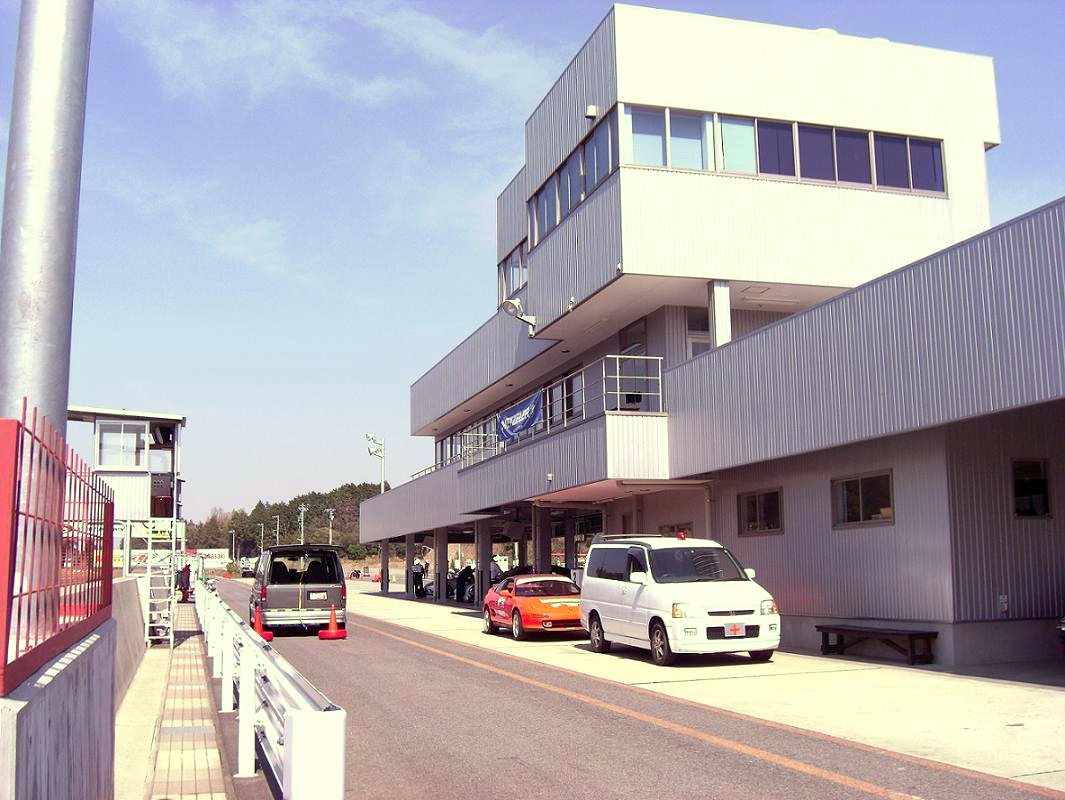
Suzuka Twin Circuit: Mie's Drift-Only D Course (2026)
The Rundown
- ¥3,000 puts you on a course built for nothing but drifting: ¥500 weekday gate admission plus ¥2,500 for a 30-minute slot booked in advance. A weekday morning block, 09:00–12:00, is ¥10,500 plus admission.
- Every booking is a telephone call in Japanese to 059-372-2401 by 16:00 the day before. The circuit states that it does not take reservations by e-mail and that nobody without a booking runs — members included.
- The desk checks a physical driving licence and refuses a photo on your phone. Whether a foreign licence or an International Driving Permit satisfies that check is not stated anywhere on the site. Ask before you book.
- You cannot aim at a date months out. Next month's timetable appears around the 10th and bookings open only after it does; on 5 August 2026 the public calendar showed ten more four-wheel days in August and nothing in September.
- No scheduled bus reaches the gate. The nearest station is Shimonoshō on the JR Kisei Main Line — about 2 km away straight-line, roughly 4 km by road — and the circuit's own event notices tell visitors to take a train and finish by taxi.
Contents
This is not the Suzuka you know. The Formula 1 track is a separate venue elsewhere in the same city. Suzuka Twin Circuit sits in the south-west corner of Suzuka, Mie, close enough to the boundary that its nearest railway station belongs to Tsu and its nearest bus route belongs to Kameyama. And it has something the famous circuit does not: an 820-metre course built for nothing but drifting.
Twenty-five minutes on it costs ¥2,500. The driving is the cheap part. Everything below was read off the official pages on 5 August 2026.
Suzuka Twin Circuit at a glance — checked 5 August 2026
What ¥2,500 actually buys
The D course is 820 m long, 10 to 14 m wide, eight corners, with a 185 m main straight and 32 pit spaces. It runs clockwise, and the circuit also advertises gyaku-mawari — reverse-direction days, the same course backwards. Its sister G course, 960 m, is for grip and timed laps; drifting lives on D and only on D.
Free running (フリー走行, the circuit’s own term for open practice sessions you buy by the slot) is sold in blocks off a fixed six-slot day: 09:00, 10:00, 11:00, then 13:00, 14:00, 15:00. Nothing runs between noon and one. An “hour” is 00 to 50 past — 50 minutes of real running. A “30 minutes” is either 00–25 or 25–50, so it is 25 minutes of real running. The D course takes about 25 cars in an hour slot, which is why it is cheaper than G’s 12-car limit.
| D course, main driver | Booked ahead | On the day | Member |
|---|---|---|---|
| Weekday, 30 min | ¥2,500 | ¥3,000 | ¥2,000 |
| Weekday, 1 hour | ¥4,000 | ¥5,000 | ¥3,000 |
| Weekday, 3 hours (09:00–12:00 or 13:00–16:00) | ¥10,500 | ¥13,500 | ¥7,500 |
| Weekend/holiday, 30 min | ¥3,000 | ¥3,500 | ¥2,500 |
| Weekend/holiday, 1 hour | ¥5,000 | ¥6,000 | ¥4,000 |
| Weekend/holiday, 3 hours | ¥13,500 | ¥16,500 | ¥10,500 |
| Second driver sharing one car, weekday 3 hours | ¥6,000 | ¥9,000 | ¥4,500 |
Add gate admission — ¥500 on a weekday, ¥1,000 at weekends and on public holidays, for anyone of high-school age and above. So the cheapest published way onto a drift-only course here is ¥3,000 all in, on a weekday, booked ahead. There is no second-driver rate on 30-minute slots, and timing transponders are not used on D at all.
The one step you cannot take from abroad
Free running here is kanzen yoyaku-sei — fully reservation-based. Bookings and cancellations are taken by telephone only, on 059-372-2401, reception 9:00 to 16:00, up to 16:00 the day before. If that day is a closed day, the deadline moves back to the day before that. The circuit states plainly that it does not accept reservations by e-mail, and repeats in its monthly notices that anyone without a booking cannot run — members included. Cancel late and it may charge you.
There is no English version of the site. There is no booking form. There is one phone number, and it is answered in Japanese.
We make that call
Send us the window you are in Japan and we will ring reception in Japanese, ask whether your licence is accepted, hold a D-course slot on a date that exists, and confirm it back to you in writing. If the last four kilometres do not work out on the day, we will arrange that leg and come with you. Actual costs plus a handling fee, quoted as one total before anything is booked. Suzuka Twin and the Nagoya circuits with us — what we arrange.
What the desk checks
Eligibility for four-wheel free running is one line: 18 or over, holding a driving licence. At the desk they inspect the physical card. A photo on your phone is explicitly refused, and if you left it in the hotel you do not run.
Nothing on the site says whether a foreign licence or an International Driving Permit satisfies that check. That is not a yes and it is not a no — our licence and IDP guide explains why the answer varies venue by venue in Japan. What the site does describe is a side door: people who hold no licence may be allowed to run on condition of joining as a member, which needs an identity document in original form — a My Number card or a health insurance card are the examples given — and ¥13,000 a year for four wheels, cash, arranged by phone beforehand.
Two details in your favour. Membership and the gate-pass card both state that no hanko is needed — the personal seal that stands in for a signature in Japan, and a wall at plenty of other circuits. And a passport appears exactly once in the rules: as acceptable ID for the ¥5,000 gate-pass card that gets your friends in free. Not for membership, and not for running.
Two answers that only exist on the phone
Whether your licence counts, and whether the date you want is running, are both unpublished. Get them in the same call, before you book flights around a track day. The same trap catches people at other Kansai venues — see how entry works at Central Circuit.
You cannot aim at a date three months out
The monthly timetable is published around the 10th for the following month, and reservations for that month open only once it appears. That is the whole planning horizon: about seven weeks, at best.
Read on 5 August 2026, the public calendar showed four-wheel free running on 6, 8, 9, 11, 12, 15, 16, 17, 18 and 28 August — and not one day in September. September was already filling with private hire bookings, which are planned months ahead. August’s closed days were the 5th, 10th, 14th, 19th, the summer shutdown from the 24th to the 27th, and the 31st.
So the sequence runs backwards from how you plan a holiday: pick the flexible week first, then get the date confirmed from Japan. Our event and track calendar tracks what else falls near your dates.
What the marshals check before you go out
- Your physical driving licence. A photo on your phone is refused
- Helmet: full face or jet. Half-caps are refused
- Gloves: racing gloves, or work gloves with grip. Fingerless gloves are refused
- Long sleeves and long trousers — no skin showing at cuffs or hems. Arm covers are fine
- Trainers, driving or racing shoes. Sandals, heels and Crocs-style shoes are refused
- Cash. Membership and the optional sports insurance are cash-only in the circuit's own words; whether cards work for running fees is not stated
- Anyone riding along as a passenger dresses to the same standard
On the car: everything from a competition car to a road-registered one is welcome, but slick tyres and formula cars are banned, an open car run with the roof open needs a real roll bar or cage (a fashion bar will not do), and the noise limit is 105 dB, measured at 70 per cent of peak-power revs from one metre back. A straight-through exhaust with no catalyst is refused outright. If you are driving in on public roads, the rules also ask that the car is not modified — noise included — in ways that annoy the neighbours on the way. Nothing on the site offers rental cars, so you bring one.
Getting there without a car
The circuit’s access page gives an address, a phone number and three expressway junctions: 25 minutes from Suzuka IC, 20 minutes from Kameyama IC, 20 minutes from Seki IC. No station, no bus, no walking time. So we went to the transport operators instead — Kameyama City’s published timetable and its open-data feed, valid 24 December 2025 to 31 January 2027, and Mie Kotsu’s Chusei depot feed, valid 1 April to 31 December 2026.
| Leg | What actually exists |
|---|---|
| Nearest station | Shimonoshō, JR Kisei Main Line (in Tsu city) — about 2 km straight-line, roughly 4 km by road |
| Nearest junction station | Kameyama, JR Kansai and Kisei Main Lines — about 9 km by road |
| Cheapest scheduled bus | Kameyama City community bus, southern route, flat ¥200 (¥100 for over-65s and for primary and junior-high pupils), stops at Shimonoshō Station, Shimonoshō-ekiguchi and Deya-Kōminkan-mae |
| Days it runs | Monday to Saturday. No Sundays, no public holidays, closed 1–3 January |
| Useful times | Kameyama Station 09:15 → Deya-Kōminkan-mae 09:47; back at 12:21 or 14:16; Shimonoshō Station 07:40 → Kameyama 08:06, and 17:45 → 18:11 |
| Other route bus nearby | Mie Kotsu route 52 (Mukumoto line), Tsu Station ↔ Science City, ¥610 from Tsu; weekdays 07:43 → Anotsudai-4-chōme 08:08, back HOWA Park 17:30 → Tsu 18:00 |
The catch is geography, not timetabling. Those bus stops look close on a map — one and a half to two kilometres out in a straight line — but the road loops around the hills, so the nearest is about five kilometres from the gate by road. No published footpath connects them and we have not walked it, so treat the walking distance as not established. The Kameyama timings say it anyway: the last service back leaves at 14:16, and running does not finish until 16:00.
Two things we checked rather than assumed. Kameyama’s noriai shared taxi, which does go door to door, is open only to registered residents of the city. And Suzuka City’s own C-BUS does come closer than we first recorded: its Shiroko–Hiratachō line stops at Miyake-bashi (三宅橋) in Miyake-chō, ¥300 from Kintetsu Shiroko Station (07:02 → 07:29 is the first bus; 17:18 and 18:28 are the last two back to Shiroko). Suzuka City’s own timetable and open-data feed (valid 15 September 2026 to 31 March 2027) confirm it, checked on 30 September 2026. The stop is about 1.6 km from the circuit in a straight line and about 2.6 km by road on OpenStreetMap routing, roughly 35 minutes on foot along a country road with no footpath we have confirmed. Some of that line’s early and late journeys do not run at weekends and holidays, so check the red times on the timetable.
The honest answer is the one the circuit itself gives. In its 2026 Formula Drift notices it tells anyone without an advance parking ticket to take a train to the nearest station and come the rest of the way by taxi. Named operators either side, from the prefectural taxi association’s member list: Kameyama Kōtsū (0595-82-0618), Kosuge Taxi (0595-82-2238) and Suzuka Taxi (059-378-0118). Metered fares for that run are not published — TBC.
Ordering that taxi is a Japanese phone call as well, from a rank that will not be waiting at Shimonoshō when you walk out. It is the same last step as the booking above, and it is the part we take on with you: the call to reception, the call to the taxi office, and the ride to the gate on a day the bus cannot cover.
Watching instead
Suzuka Twin is Round 2 for all three tiers of Formula Drift Japan, and in 2026 that meant three separate weekends here in May: FD Japan on 16–17 May, FDJ2 on 23–24 May, FDJ3 on 31 May. All of them are behind us as of August 2026, and 2027 dates are not published yet — TBC.
The pricing, though, is the friendliest thing about this venue for an overseas fan. For FDJ2 the gate took ¥3,500 per person for a day ticket, sold on the day only; for FDJ3 it was ¥3,000. No advance sale, no convenience-store terminal, no Japanese payment account — cash at the gate, and the circuit asks you to bring the right change. Junior-high age and above need a ticket. Car parking is the opposite: advance-only at ¥1,500, and without that ticket you cannot bring a car in at all.
One more date worth watching: the circuit’s hire calendar has 20 September 2026 blocked out for Drift Total no Twin Circuit de Suzuka, both D and G courses for the full day. The name is Portuguese, the same booking ran here on 24 August 2025, and everything else — entry, spectating, fees — is set by the organiser and appears nowhere on the circuit’s site. TBC.
Is it worth a day of your trip?
If your trip already runs through Kansai or Nagoya, yes. Three thousand yen for 25 minutes on a purpose-built drift course, or ¥11,000 for a whole weekday morning, is about as low as the barrier gets — and unlike venues where drifting only happens on an organiser’s day, here it is a product you buy directly. What it demands back is flexibility: one phone call in Japanese, one unresolved question about your licence, one calendar that will not show you September until mid-August, and a last four kilometres that ends in a taxi. For the wider picture before you pick a venue, start with our guide to getting on track in Japan as a foreigner.
Frequently asked questions
Can I just turn up at Suzuka Twin Circuit and drift?
No. Free running is fully reservation-based and reservations are taken by telephone only, on 059-372-2401, up to 16:00 the day before — or two days before if the day in between is a closed day. The circuit says in its own monthly notices that anyone without a booking cannot run, members included, and that it does not accept reservations by e-mail. If a slot happens to be left it will sometimes take you on the day, but at the higher same-day rate: ¥3,000 instead of ¥2,500 for a weekday 30 minutes.
Will a foreign licence or an International Driving Permit get me on track?
Not stated. The published requirement for four-wheel free running is that you are 18 or over and hold a driving licence, and the desk checks the physical card — a photo on your phone is refused, and forgetting it means you do not run. Nothing on the site addresses foreign licences or International Driving Permits. There is a documented side door: the circuit says people without a licence may be allowed to run on condition of joining as a member, ¥13,000 a year for four wheels, cash, arranged by phone in advance. Ask which applies to you before you commit a day.
How do I reach Suzuka Twin Circuit without a car?
You finish by taxi. The circuit's access page lists expressway junctions only, and the nearest station is Shimonoshō on the JR Kisei Main Line, roughly 4 km away by road. Kameyama city's community bus southern route serves Shimonoshō station and passes within about 2 km straight-line of the circuit for a flat ¥200, but it runs Monday to Saturday only and its last service back leaves Deya-Kōminkan-mae at 14:16 — before running ends at 16:00. The closest bus stop of all is Miyake-bashi on Suzuka City's C-BUS Shiroko–Hiratachō line, ¥300 from Kintetsu Shiroko Station and about 2.6 km by road from the circuit, with the last buses back to Shiroko at 17:18 and 18:28 (checked 30 September 2026). The circuit's own Formula Drift notices tell visitors without a parking ticket to take a train to the nearest station and come by taxi.
 Drifting in Kansai: Every Track Near Osaka & Kyoto (2026)
  Okuibuki Motor Park: Can Tourists Drift There? (2026 Guide)
  Can You Drift at Suzuka Circuit? Rules, Fees, Alternatives (2026)
  Drifting in Tokai (2026): Five Venues Near Nagoya That Say Yes