
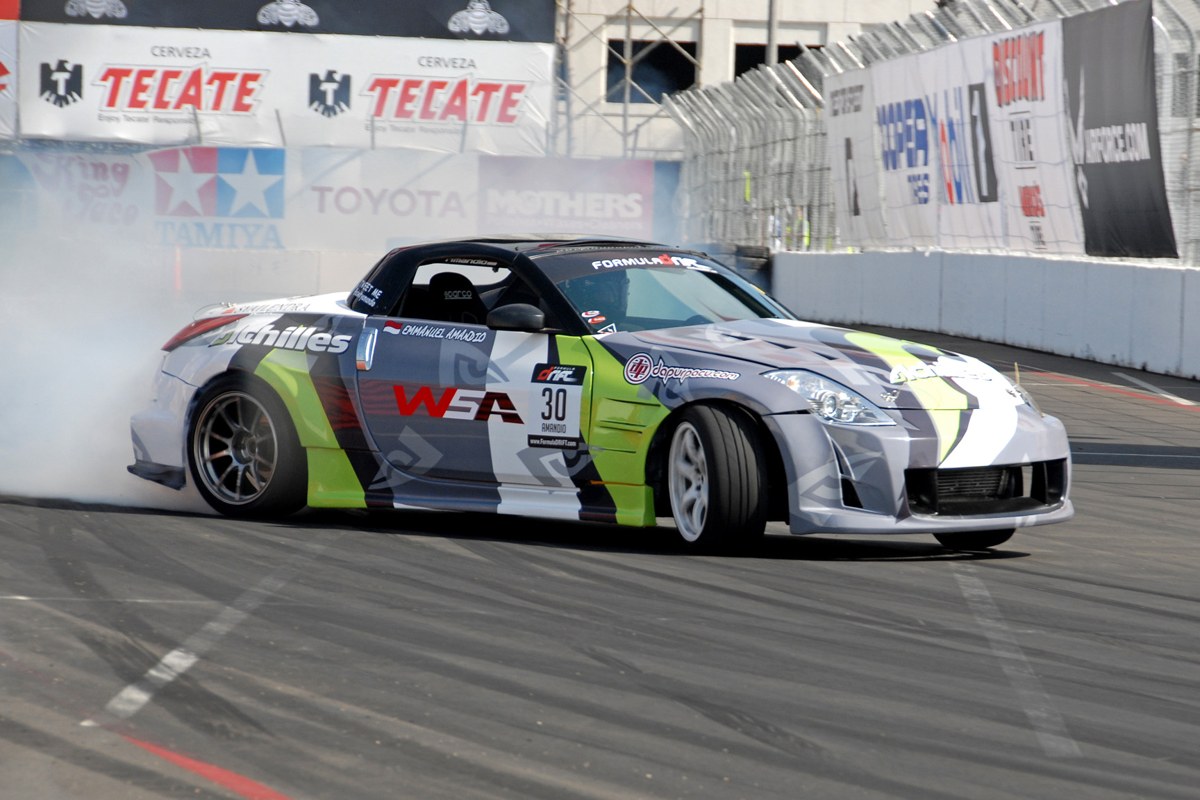
D1GP vs Formula Drift: Judging, Cars and Format Compared (2026)
The Rundown
- Formula Drift adds its numbers: Line 40 + Angle 40 + Style 20 = 100, and Line and Angle are scored entirely by telemetry from 2026.
- D1 multiplies its numbers: Speed (max 10.00) × Angle (max 10.00) + Transitions (0–3). The rulebook's own worked example is 9.8 × 9.7 + 0.5 = 95.56.
- A D1 solo score can legally exceed 100 — the maximum is 103 — while a Formula Drift qualifying score is capped at 100.
- Tandem is decided differently: Formula Drift uses a judges' majority vote, D1 adds up both runs and reruns the battle automatically if the totals are within 1 point.
- D1's minimum weight is 1,000 kg including the driver; Formula Drift PRO's is 2,700 lb (about 1,225 kg), so a D1 car can legally be around 225 kg lighter.
Contents
The two rulebooks at a glance
The honest answer to “what’s the difference between D1 and Formula Drift” is not culture or car choice. It is arithmetic. Formula Drift adds its scores together and caps them at 100. D1 multiplies them, and lets them go past 100. Formula Drift’s 2026 judging regulations set qualifying at Line 40 + Angle 40 + Style 20, with the first two generated entirely by telemetry; D1’s 2026 scoring standard scores a solo run as speed (max 10.00) × angle (max 10.00), plus up to 3 points for sharp transitions. Everything below comes from the two series’ own 2026 rulebooks, read on 14 September 2026.
How does Formula Drift score a run?
Three categories, one hundred points, and from 2026 only twenty belong to a human. Line and Angle are, in the rulebook’s words, “entirely automated scoring using the UDSM (Universal Drifting Scoring Method) Scoring system with Race Data Labs technology,” captured by a device placed on the car’s roof before it leaves the start line.
Line (40 points) is about filling zones. The car fills a zone with its body outline where a wall borders it, or with its wheelbase where nothing does. Beyond each zone sits a virtual “No-Go” area, and whatever you fill of that is subtracted, so overshooting is punished as explicitly as undershooting. The rulebook’s own worked example makes the system legible: zones filled 90%, 75%, 100% (but with 80% No-Go, netting 20%) and 50% average out to 58.75%, which scores 23.5 of the 40 points.
Angle (40 points) is the driver’s average angle across the whole course, scaled against a maximum that Formula Drift sets per track, per weekend, from the data the field itself generates. Style (20 points) is the only human judgement left, and the rulebook prints what earns and loses it: precise front-wheel control, big angle at consistent pace and heavy controlled throttle on one side; choppy throttle, shallow angle and handbrake over-use on the other.
How does D1 score a run?
D1 asks for high speed everywhere on course, sharp initiation and transition, a large stable angle, and staying inside the track. It combines the first three like this:
Score = (speed, max 10.00) × (angle, max 10.00) + (transitions, 0–3)
The 2026 scoring standard’s own example is 9.8 × 9.7 + 0.5 = 95.56. Because the two main terms multiply, being brilliant at one and mediocre at the other is punished far harder than in a series that adds. And because the ceiling is 10 × 10 + 3, the maximum is 103. D1’s series regulations confirm this is deliberate, stating that 100 points is the benchmark for a high score but that scores above 100 can be awarded.
That does not mean D1 ignores line and car control. It files them inside the two big buckets: proximity to designated clipping points sits inside the speed score, while handbrake over-use, shift mistakes and severe steering corrections sit inside the angle score. The transition points even carry an explicit reward for whether “a challenging quality was visible” in the run.
The measuring is done by DOSS (D1 Original Scoring System), introduced in 2013 because D1, which had judged subjectively since its first season, wanted a more objective method. DOSS splits the course into sectors and weights them differently: D1’s own explainer shows a five-sector run weighted 15% / 10% / 30% / 25% / 20%, so a big moment in the right corner is worth more than the same moment elsewhere. Formula Drift’s angle score is one average across the whole run.
D1 cars are literally built around this. Every entered car must carry a 40 mm ferritic stainless plate on the roof, on the centreline at the wheelbase midpoint, for the GPS antenna. Sponsor graphics give way to it, and it is checked at scrutineering.
Why tandem is decided in completely different ways
This is the second structural split, and the bigger one for anyone watching a bracket.
Formula Drift tandem is a vote. Judges compare across all four runs of a battle, explicitly not just lead-to-lead and chase-to-chase, and decide. If one judge picks driver A, one picks driver B and one calls One More Time, the absence of a majority triggers an automatic OMT rerun. Telemetry is present but advisory: the rulebook states the system “is not determining the winner of a battle; it is simply providing additional information that may assist in a judging decision.”
D1 tandem is arithmetic. Both cars are scored by DOSS exactly as in solo, and the driver whose combined score across run 1 and run 2 is higher wins. The chase car earns proximity points, 6 to 12 per course, awarded per sector by distance from the lead, and picks up a −2 “No Good Challenge” for failing to get close anywhere. D1’s own site describes the trap this creates better than any commentary could: close in without angle and you collect proximity points while your DOSS score sinks; protect your DOSS score by hanging back and you collect no proximity points. You have to do both.
Two D1 mechanisms have no Formula Drift equivalent at all. A tandem incomplete costs −30 points, and when fault is shared equally it is −15 from each driver, a system that can split blame between two cars where Formula Drift must resolve fault to an incomplete for one of them. And if the two totals finish within 1 point, D1 reruns the battle automatically. Same idea as OMT, except it fires on a number rather than on a judge’s feeling.
| D1 Grand Prix | Formula Drift PRO | |
|---|---|---|
| How solo scores combine | Multiplied: Speed × Angle + Transitions | Added: Line 40 + Angle 40 + Style 20 |
| Score ceiling | Can exceed 100 (max 103) | Capped at 100 |
| Angle measured | Per sector, sectors weighted differently | One average across the whole course |
| Standalone speed score | Yes, half the formula | No speed category at all |
| Tandem decided by | Higher combined two-run score | Judges’ majority vote |
| Rerun trigger | Totals within 1 point | No majority / One More Time |
| Telemetry in tandem | Scores both cars | Advisory only |
| Splitting fault | Yes, −15 each | No |
One caution before repeating any of this in a paddock argument. It is wrong to say “D1 rewards speed and Formula Drift rewards style,” because D1’s speed band contains line, D1’s angle band contains car control, and Formula Drift’s style band contains pace. The defensible version is narrower: D1 makes speed an explicit, named variable worth half the formula, and Formula Drift has no standalone speed score whatsoever.
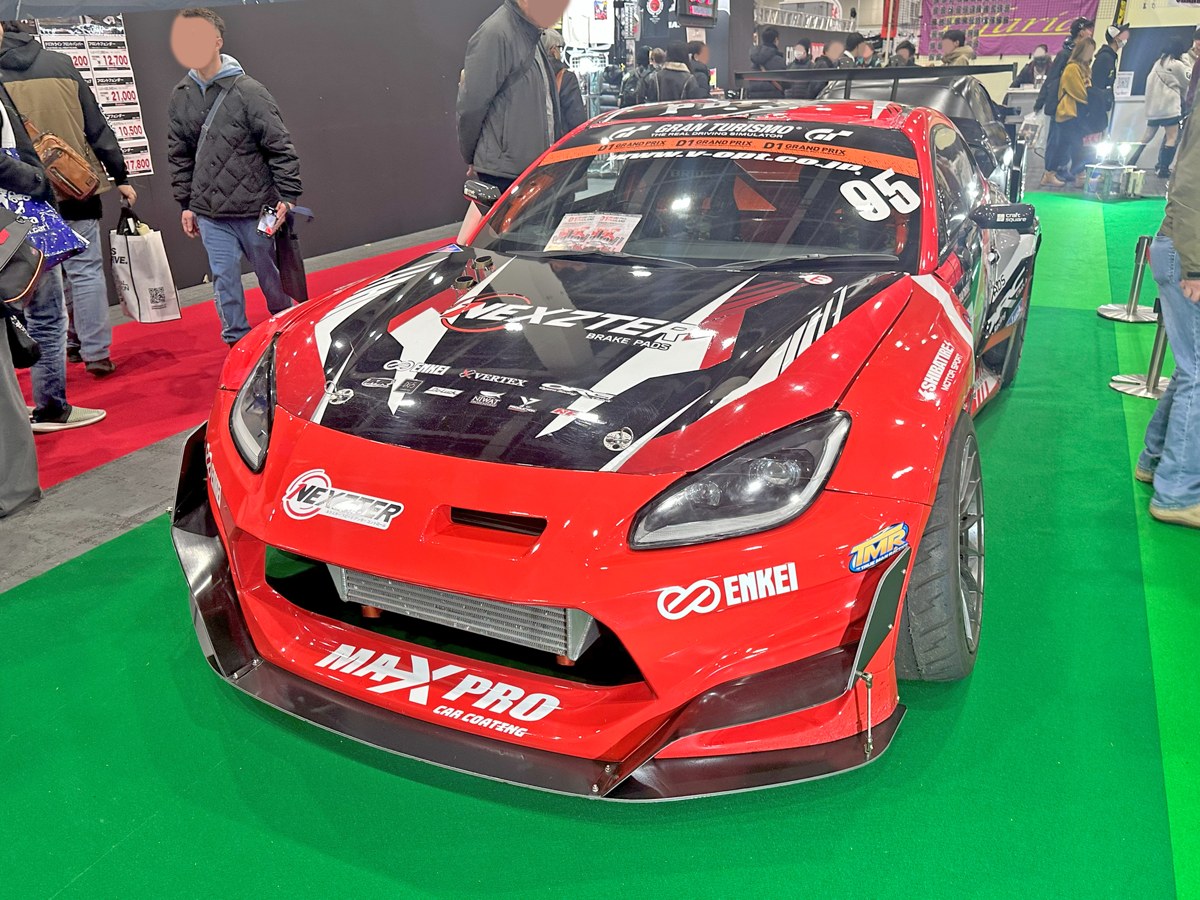
The cars are not built to the same rules either
Both series tie rear tyre width to weight, on very different ladders. Formula Drift PRO uses eight steps from 2,700 lb / 260 mm up to 3,400 lb / 330 mm, measured with the series’ own tool, which the rulebook says decides “regardless of the advertised sidewall size.” D1 uses two coarse steps split at 1,275 kg and regulates section width (282 mm or 302 mm), a different measurement of a different part of the tyre, so those numbers are not comparable.
The weights are comparable, and the gap is real. D1’s minimum is 1,000 kg including driver and equipment, with no weight or displacement classes at all. Formula Drift PRO’s floor is 2,700 lb, about 1,225 kg. A legal D1 car can be roughly 225 kg lighter than the lightest legal Formula Drift PRO car, part of why the two fields look different even when the chassis are the same.
Where D1 is stricter is tyre quantity. From the solo final onward the number of drive-wheel tyres is capped, they must all be one pattern and one size, and officials physically mark them. Run an unmarked tyre and the run’s score is void. Which brands each series actually allows is a separate question with a surprising answer: the two approved lists share no brand at all, and we lay both out, with Formula Drift Japan’s application system, in our drift tyre directory.
Same technology, opposite reasons
Both series now hand large parts of the job to machines, but they arrived from opposite directions, thirteen years apart.
D1 automated in 2013 to make a subjective sport fair, replacing the purely human judging it had used since its first season. Formula Drift automated in 2026 to go the other way: its president describes the system as automating “the objective aspects of the sport” in order to “give our judges the tools they’ve been asking for.” One series used machines to remove subjectivity. The other used them to concentrate it where humans are actually needed.
Their stated philosophies match. D1’s own description of itself puts coolness inside the definition of the sport, “a competition contested on the coolness of the drift, that is D1,” and its rules preamble names spectator appeal as part of what the sport is. Formula Drift’s judging regulations state the opposite emphasis: judging “is not concerned with vehicle model, vehicle build or the vehicle tires” and is limited to “the visual attitude and visual behavior of the vehicle on track.”
The two worlds are not sealed off. Formula Drift runs its own Japanese championship, several drivers hold entries in D1GP and Formula Drift Japan in the same season, and one of Formula Drift’s four competition judges, Robbie Nishida, is Japanese. The clearest bridge is Daigo Saito, D1GP champion in 2008 and 2016 and Formula Drift champion in 2012 as a rookie.
Which one should you watch?
For the machine-scored, sector-weighted version with two championship rounds in one weekend, that is D1: ten rounds across five weekends in 2026, including Ebisu on 25–27 September and Autopolis in October. For one round per weekend on American street courses, that is Formula Drift’s eight-round calendar. If you are choosing which to attend in Japan, we compared ticketing and venue access in D1GP vs Formula Drift Japan: which to watch, and the confirmed dates sit in the 2026 event calendar.
Getting to a D1 round is the part that catches people out
D1's 2026 venues include Ebisu and Autopolis, and neither has usable public transport on a race weekend. The schedule also runs across three days, so the useful question is which day to be there. That planning, and the Japanese-language side of it, is what we take on. Tell us your dates and we'll build the round into a trip that works.
Frequently asked questions
What is the difference between D1GP and Formula Drift?
They score the same sport with opposite arithmetic. Formula Drift's 2026 rulebook adds three categories — Line 40, Angle 40, Style 20 — to a hard cap of 100, with Line and Angle generated entirely by telemetry. D1's 2026 scoring standard multiplies speed (max 10.00) by angle (max 10.00) and then adds up to 3 points for sharp transitions, so a weakness in one dimension drags the whole score down. Tandem also differs: Formula Drift decides battles by a judges' majority vote, D1 by comparing the two drivers' combined scores.
Can a D1 drift score be higher than 100 points?
Yes. D1's 2026 series regulations state plainly that 100 points is the benchmark for a high score but that scores above 100 can be awarded, and the formula allows a maximum of 103 (10.00 speed × 10.00 angle + 3 transition points). A Formula Drift qualifying score cannot exceed 100, because its three categories add up to exactly that.
How does Formula Drift decide who wins a tandem battle?
By a vote of the judging panel across all four runs of the battle, not by a points total. Formula Drift's 2026 judging regulations state that if one judge votes for driver A, one for driver B and one for One More Time, the lack of a majority automatically triggers a One More Time rerun. Telemetry is explicitly advisory in tandem — the rulebook says the system is not determining the winner, only providing information to assist the judges.
Has any driver won both D1GP and Formula Drift?
Daigo Saito has. He won the D1 Grand Prix championship in 2008 and 2016, both confirmed in D1's official season history, and the 2012 Formula Drift USA championship in a Lexus SC430 — Formula Drift's own press release records him as the first series rookie ever crowned champion. As of September 2026 he is still racing in Japan, entered in both D1GP and Formula Drift Japan.
 D1GP vs Formula Drift Japan: Which to Watch? (2026)
  D1 Grand Prix 2026 Tsukuba Results: Yokoi Wins Rd.3 and Rd.4
  D1 Grand Prix 2026: A Spectator's Guide for Visitors
  D1 Grand Prix 2026 Aichi Results: Yokoi Wins Rd.1, Fujino Rd.2