
Steering Angle Kits and Knuckles: How Japan Adds Drift Lock (2026)
The Rundown
- Japan buys steering angle on a 4-rung ladder with official prices at every step: ¥6,655 rack adapters, ¥30,800 send-in knuckle modification, ¥44,000–79,500 replacement knuckles, and ¥285,780–495,000 full angle kits.
- The big kits claim big numbers officially: Cusco's S-chassis Drift Angle Kit states 65-degree-plus steering angle, and D-MAX and PBM claim about 70 degrees with their full front packages.
- More angle changes the car's character: owners consistently report quicker steering and weaker self-steer, and the steering rack becomes the part that breaks first.
- Nearly every knuckle sold in Japan is officially a competition part — Cusco prints outright that its kit is not shaken-compatible and not for public roads.
- The two cheapest quality routes (core-exchange and send-in modification) assume a Japanese address and a spare stock knuckle — and D-MAX says genuine stock knuckles are now scarce enough that it tools its own reproductions.
Contents
Steering angle in Japan — the ladder
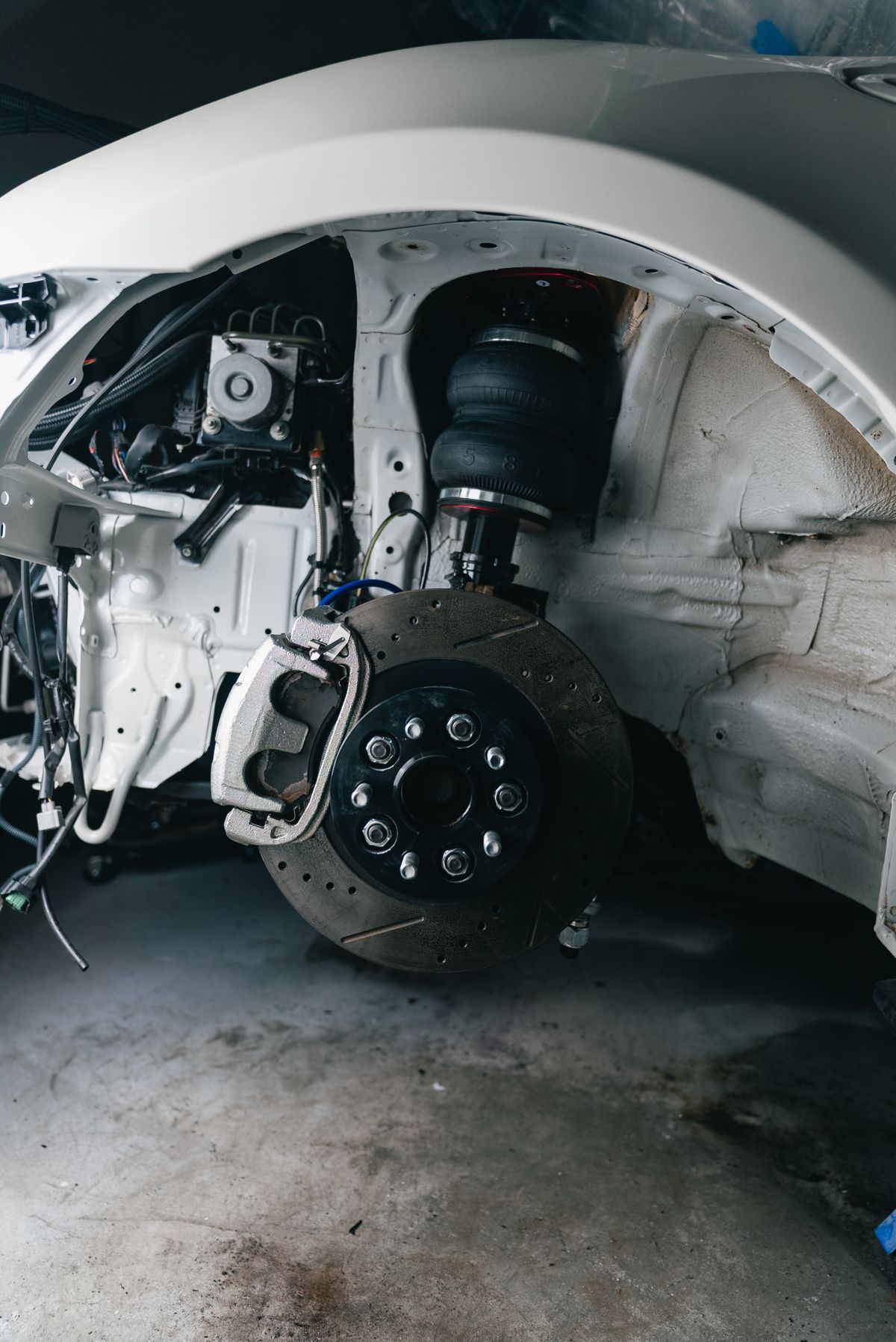
Watch any Japanese drift car at full lock — wheels folded sideways like a speedboat rudder — and you are looking at modified front knuckles. Japan sells that capability as a four-rung ladder with a price on every rung, each checked on the makers’ official pages on 10 September 2026: a ¥6,655 rack adapter, ¥30,800 send-in knuckle modification, cast replacement knuckles from ¥44,000, and complete engineered kits at ¥285,780–495,000 that officially claim 65 to 70 degrees of steering angle. This guide maps the ladder from the makers’ own pages and from Japanese owners’ install diaries on Minkara — including the parts that break, which the product photos never show.
How does more steering angle actually work?
The trick is leverage. The steering rack’s travel is fixed, so Japanese tuners shorten the knuckle’s steering arm — by cutting and repositioning the tie-rod mount, or replacing the knuckle entirely — and the same rack stroke turns the wheels further and faster. The classic route was kako-nakkuru (加工ナックル — a cut-and-welded modified stock knuckle); the modern era is cast, purpose-designed knuckles and full kits that move the rack, arms and tie rods as one engineered system. D-MAX’s own pages spell out the system logic: its roughly 70-degree figure applies only with its lower arms, strengthened tie rods and offset rack adapter fitted together, and its rack adapter page calls the adapter a required item on knuckle-swapped cars.
What does each rung cost?
| Rung | Product (official page) | Price (read 10 Sep 2026) |
|---|---|---|
| Rack adapter | D-MAX D1SPEC angle-up adapter — S13/S14/S15, A31, C33–C34, R32–R34 | ¥6,655 |
| Send-in modification | 326POWER Bancho knuckle — S-chassis, C35, FC3S/FD3S, AE86 (¥36,300 for R32–R34) | ¥30,800 |
| Replacement knuckle | D-MAX racing spec, S14/S15 pair, exchange basis | ¥44,000 (+¥38,500 without a core) |
| Replacement knuckle | Kazama cast short knuckle, 86/BRZ | ¥79,500 + tax |
| Angle kit | GP SPORTS G-MASTER 86 double short kit (light version ¥110,000) | ¥285,780 |
| Angle kit | Cusco Drift Angle Kit front, S13/S14/S15/180SX — official 65°+ | ¥385,000 (rear kit ¥495,000) |
| Angle kit | Wisefab S/Z-chassis kits via Do-Luck, the official Japan distributor | ¥495,000 (Z33 kit) |
Below all of that sits Yahoo Auctions, where anonymous one-off welded knuckles from unknown shops trade for around ¥20,000 — the cheap tier the cast-knuckle makers openly position against, since a weld you can’t trace is a weld you have to trust. General routes for getting any of this shipped are in our proxy and exporter guide.
What breaks: the side effects the box doesn’t mention
One S15 owner’s two-part install diary on Minkara reads like a syllabus for this whole subject. He chose 13 mm rack spacers over 14 mm because the bigger ones are known to blow steering racks; ran different-length tie-rod ends left and right to re-centre the steering; fitted over-centre stoppers on both sides because at full angle the front wheels can flip past their pivot and shudder mid-drift; and removed the front sway bar entirely to clear the new geometry. His verdict after the first drive was honest: the knuckle worked at any angle, and it exposed exactly how much he still had to learn.
The rack becomes the fuse
This is the pattern across makers and owners alike: D-MAX's own page warns its rack adapter can break some steering racks, and a Wisefab-equipped S15 in Japan logged repeated rack failures until its owner moved the steering member 20 mm forward. Japanese shops sell rack machining and relocation as a service for exactly this reason. Budget for the rack when you budget for the knuckle.
The subtler surprise is character. Across dozens of Minkara reviews the same two phrases recur: the steering gets much quicker, and self-steer gets weaker — the car stops flicking itself back and starts waiting for your hands. Owners of 326POWER’s Bancho knuckle — 27 reviews averaging 4.85, the highest satisfaction of any knuckle we found — describe exactly that trade as the appeal. It pairs naturally with the drivetrain choices we covered in the drift LSD guide: Japanese builds change these systems together.
Is any of this legal on Japanese roads?
The makers answer in print, and they don’t all agree. Cusco’s official release states its angle kit is a competition part — not shaken-compatible, not for public-road use. D-MAX prints a full competition-only disclaimer on every knuckle page. GP SPORTS, by contrast, marketed its cast G-MASTER knuckle for years as a shaken-legal model — the only one so labeled — until discontinuing it in June 2025, and Ikeya Formula publishes a legality column on its official price list, part by part: its S15 tie-rod ends are marked as meeting safety standards while the long competition tie rods are not. For an overseas buyer the practical reading is simple: treat everything on this page as competition hardware, and check your own country’s rules before bolting any of it to a road car.
The pro connection, meanwhile, is the sales pitch itself: Kazama’s cast 86 knuckle was developed with 2017 D1GP champion Fujino’s shop, and the knuckle Japanese shops are talking about in 2026 — the AGGRE unit — was designed from scratch by 2002 champion Ueo. You can watch what full-lock engineering looks like at competition speed on any D1 round this season.
Why buying these from abroad is harder than it looks
Here is the catch the price table hides: the two cheapest quality rungs are physically Japan-locked. D-MAX’s ¥44,000 knuckle is exchange-basis — send an unmodified genuine core or pay ¥38,500 extra. 326POWER and FINAL KONNEXION modify the knuckle you mail in, sender pays, about three weeks. All of it assumes a Japanese address, and donor stock knuckles are scarce enough that D-MAX now casts its own reproduction cores. The shops speak Japanese, the EC sites are Japanese-only, and the auction one-offs need a proxy plus a leap of faith on someone else’s welds.
The Japan-side legwork is the step we take on
We act as the Japanese address and hands: sourcing a clean donor core, running the exchange or send-in service with the maker in Japanese, checking what comes back against the order, and quoting purchase, handling and shipping as one total before you commit. Tell us your chassis and the angle setup you're after, and we'll price the whole route from Japan.
Frequently asked questions
How do drift cars get so much steering angle?
Mainly through the front knuckles: shortening the knuckle's steering arm means the same steering-rack travel turns the wheels further, which is why Japanese drifters run modified or replacement knuckles. Japan's market covers four tiers as of 2026 — rack-stroke adapters (about ¥6,655), send-in modification of stock knuckles (about ¥30,800), purpose-made cast knuckles (¥44,000–79,500 plus tax), and complete angle kits from ¥285,780, like Cusco's, which officially claims over 65 degrees for ¥385,000.
How much does a drift angle kit cost in Japan?
Official list prices read on 10 September 2026: D-MAX's rack adapter ¥6,655; 326POWER's Bancho send-in knuckle modification ¥30,800 for S-chassis, FC/FD and AE86; D-MAX's exchange-basis racing knuckle ¥44,000 a pair; Kazama's cast 86/BRZ short knuckle ¥79,500 plus tax; GP SPORTS' 86 double short knuckle kit ¥285,780; and Cusco's S-chassis front Drift Angle Kit ¥385,000, with the rear kit at ¥495,000.
Are angle-up knuckles street-legal in Japan?
Mostly no, by the makers' own printed words: Cusco states its Drift Angle Kit is a competition part, not shaken-compatible and not for public-road use, and D-MAX and 326POWER print similar competition-only disclaimers. The exceptions in print have been GP SPORTS' cast knuckle, marketed as a shaken-legal model until it was discontinued in June 2025, and Ikeya Formula's tie-rod parts, which carry a per-product legality column on the official price list.
What breaks when you add steering angle?
The steering rack, first and most often. D-MAX's own product page warns its ¥6,655 rack adapter can break some racks, a documented S15 owner chose 13 mm spacers because 14 mm units are known to blow racks, and a Wisefab-equipped S15 in Japan logged repeated rack failures until the owner relocated the steering member. Owners also report needing over-centre stoppers, front sway-bar removal and wheel or tension-rod clearance changes.
 2-Way vs 1.5-Way LSD for Drifting: What Japan Actually Runs (2026)
  Can You Ship a Roll Cage from Japan? Sizes, Rules & Costs (2026)
  Import Duty on JDM Drift Parts from Japan: US, UK, AU, NZ, CA (2026)
  What ジャンク Means on Yahoo! Auctions: Drift Parts Listing Terms (2026)