
How Tsuiso Battles Are Judged in Japan: Line, Angle, Style
The Rundown
- A weekend uses two formats: tanso (solo runs) builds the bracket, tsuiso (chase battles) decides the winner. They are scored differently.
- Formula Drift Japan publishes exact weights in its 2026 rulebook: line 35 points, angle 35, style 30. A perfect solo run is 100.
- D1 Grand Prix does not score that way at all. Since 2013 it has used DOSS, a machine scoring system that measures speed, angle and angle stability, with judges adding and subtracting points on top.
- Lead and chase are judged against different targets, which is why the faster-looking car often loses.
- "One More Time" is not a reward for a close battle. It means the three judges could not reach a majority.
Contents
Japanese drift judging is written down, and the two major series write it down differently. Formula Drift Japan’s 2026 judge regulation splits a solo run into 100 points, weighted line 35, angle 35 and style 30, while D1 Grand Prix has scored runs with its DOSS machine system since 2013 and lets judges add and deduct on top. Every weighting, deduction and format below was read off Formula Drift Japan’s published 2026 rulebooks and D1’s own scoring and competition pages on 27 July 2026.
Two cars come past you door to door, both sideways, both loud, both apparently perfect. The tower announces a winner. The crowd around you reacts like the result was obvious. To you it was a coin toss.
It was not. Both series publish enough of their criteria that you can learn to score a corner yourself in about ten minutes. Here is what is actually being measured.
Two formats in one weekend
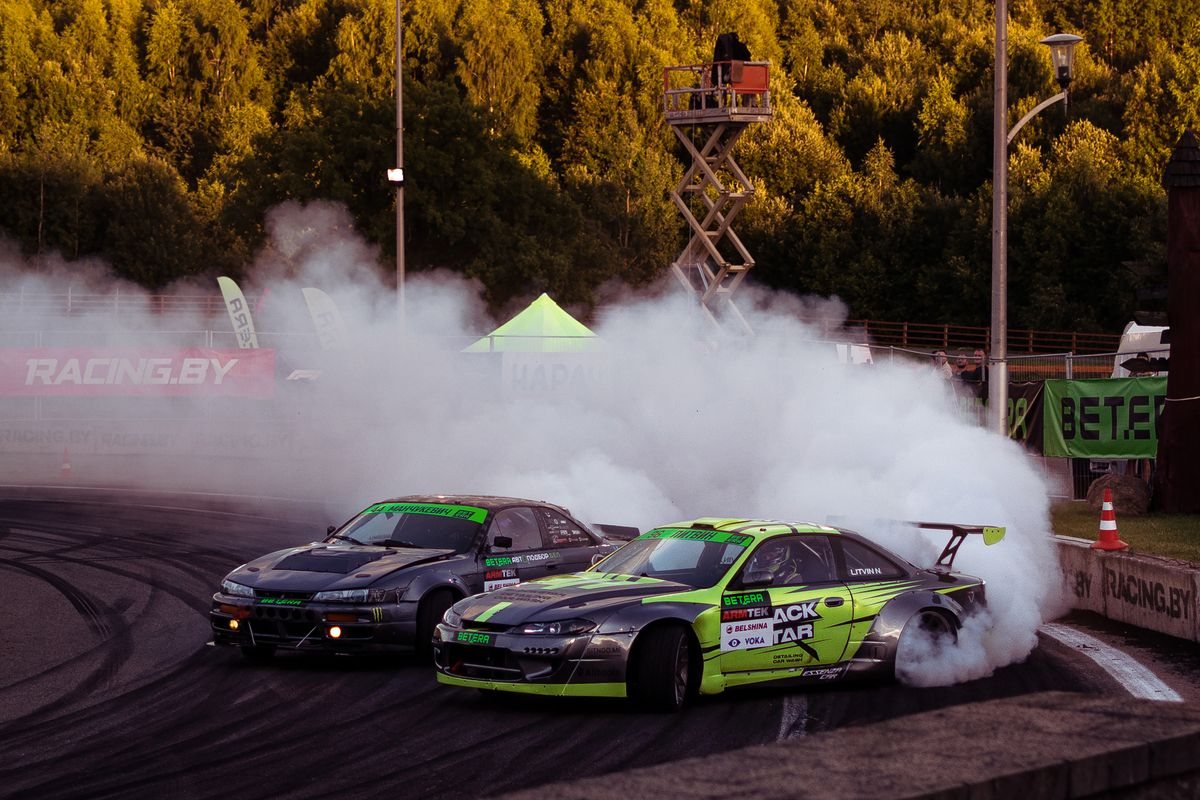
Tanso (単走 — solo run) is one car alone on the judged section. It sets the running order and builds the bracket. Tsuiso (追走 — chase run) is two cars together, and it decides the trophy. Every Japanese competition weekend uses both, in that order.
In Formula Drift Japan the solo phase is qualifying: two non-consecutive runs each, taken in reverse championship order so the series leader goes last, with the top 32 advancing to the tandem bracket.
D1 Grand Prix abolished its solo qualifying session in 2019. What remains is the tanso final: every entered driver runs twice, the top 16 go through to the chase tournament, and the solo results carry championship points of their own — 20 for first down to 1 for sixteenth.
Why the solo runs matter more than they look
In D1 the top eight from the solo final are guaranteed the lead position in their first chase run. Qualifying well is not just about surviving the cut — it buys you the easier role in the battle, and it saves tyres in a series with a tyre allocation.
What the judges actually score
Formula Drift Japan is the more transparent of the two. Its 2026 judge regulation, version 1.1, dated 9 March 2026, sets three criteria adding to a 100-point run.
| Criterion | 2026 points | What it means |
|---|---|---|
| Line | 35 | The rear of the car through the outside zones and touch-and-go areas, and the front of the car attacking the inside clipping points |
| Angle | 35 | Holding a deep angle from the initiation point all the way to the finish |
| Style | 30 | Split into commitment and fluidity — how positively and how cleanly the car is driven |
Line and angle are broken down sector by sector along the course, a change the rulebook dates to 2022. Style is judged across the whole run, start line to finish line.
The deduction lists are the useful part, because they name what looks fine at 200 metres and costs real points up close. Angle is marked down for a double initiation, for a wobble — the angle dipping and coming back — for wall contact and for missing a zone or a clip. Commitment is marked down for lifting off the throttle before initiation, for starting the drift after the last initiation point, and for a timid approach to the wall. Fluidity is marked down for a slow initiation or transition, and for adding angle in small steering corrections rather than one committed input. That last one is the single most useful thing to know: if a driver saws at the wheel to build angle, a judge is deducting while the crowd is cheering.
D1 does it differently. Since 2013 it has scored runs with DOSS, its own machine scoring system, which converts speed, angle, angle stability and the sharpness of transitions into numbers. The judged section is split into four or five weighted sectors that add up, and since 2019 the course also carries designated zones the car must pass through. Human judges then apply deductions to the machine’s figure.
| D1 deduction | Points |
|---|---|
| Missing a designated zone | −1 to −3 |
| Double initiation or drift understeer at initiation | −5 |
| One or two wheels off course | −2 |
| Three or four wheels off course | −5 |
Read D1's numbers as a system, not as this weekend's settings
Unlike Formula Drift Japan, D1 does not publish a downloadable judging rulebook. Its public explainer pages describe the system as it has stood since the 2019 changes — the competition page was last updated in April 2025, the scoring page in March 2020. The sector weightings in particular are set per course, and the only worked example D1 publishes is a 2019 round. Treat the percentages you see quoted anywhere as an illustration, not as this round's numbers.
Lead versus chase: two different jobs
This is the part that makes results feel arbitrary until someone explains it. Each battle is two runs with the roles swapped, and the judges compare both lead runs against each other and both chase runs against each other — not the two cars against one scale.
The lead car
- Drive as close as possible to a 100-point qualifying run
- Produce a lead that can actually be followed
- Do not use a line, angle or style designed to escape the chase car
- Judged with the same deductions as a solo run
The chase car
- Initiate with the lead, not after it
- Stay close for as long as possible
- Match the lead's angle — or better it
- Mimic the lead's line and transitions, and keep drifting past the finish
Two consequences follow. A lead driver who simply drives away is not rewarded for it — Formula Drift Japan’s rulebook lists an unfollowable lead as a fault. And the chase car is not asked to copy a bad lead run: if the lead’s angle is poor, the rulebook says judges do not want it mimicked, and improving on it is an advantage. The sporting regulation adds one hard line — the chase car’s front wheels must not get ahead of the lead car’s front wheels, and a driver who does that is penalised.
D1 puts a number on proximity. The chase car starts from its own DOSS score, then judges add closeness points sector by sector, worth 6 to 12 points depending on the course. Get dropped completely and earn none of them and you can be given a no good challenge, worth −2. That builds the trap that makes D1 battles readable: close in with no angle and you take proximity points but a low DOSS score; back off to drive your own tidy line and you take DOSS but no proximity. Neither wins.
How a run gets zeroed
Some runs are voided outright rather than deducted from. In Formula Drift Japan an incomplete run scores nothing for a spin — including one after the finish line — for drifting the opposite way to the corner, for a bonnet, hatch, boot or door coming open mid-run, and for putting three or more tyres off course. Straightening kills a qualifying run outright. In a tandem battle the list grows to include avoidable or unsportsmanlike contact, a chase driver who deliberately stops chasing, and an illegal pass. Passing is legal only in a narrow window: the lead must be off line or off course, and the pass must come on the inside, at an inside clipping point. Done properly, the chase car becomes the lead — and the car that was passed takes the incomplete.
One More Time
Three judges work each Formula Drift Japan round. When their votes do not produce a majority — one for each driver, one for OMT — the battle runs again, and keeps running until a majority appears. The rulebook is blunt that OMT is not a compliment: it is not meant for a badly executed battle, and judges keep the right to declare a winner in a battle full of mistakes. A driver called back has two battles’ worth of time to get back to the line, or six minutes out of the pits on the last pairing of a ladder.
D1 uses different logic. Up to the Best 16, a drawn battle goes to whoever scored higher on DOSS in their lead run. From the Best 8 there is one re-run, and if that still does not separate them, the lead-run DOSS comparison decides it.
The two systems side by side
| D1 Grand Prix | Formula Drift Japan | |
|---|---|---|
| Basis of the score | DOSS machine scoring since 2013, judges add and deduct | Three human judges, one per criterion in qualifying |
| Published weighting | Per-course sector percentages, not published for 2026 | Line 35 / angle 35 / style 30 |
| Solo phase | Tanso final, all entrants, top 16 advance | Qualifying, up to two runs, top 32 advance |
| Chase bracket | 16 drivers | 32 drivers in FDJ and FDJ2, 16 in FDJ3 |
| Proximity | Scored, 6–12 points by course | Judged, not scored as a separate number |
| Tie resolution | Lead-run DOSS, then one re-run from Best 8 | OMT until a majority is reached |
| Public rulebook | Explainer pages only | Full PDF rulebooks, updated in-season |
| Protests | Not addressed on the public pages | Abolished from 2024, following the US series |
Choosing which to see first? The D1 spectator guide and the Formula Drift Japan guide cover the remaining 2026 rounds, and the calendar has the dates.
What to watch for from the bank
Five things you can now see
- The initiation point. Find the standing pylons. The car must already be sideways as it passes the last one — starting the drift after it is a deduction.
- The rear of the car in the outside zone. Line is judged on where the back of the car goes, not where the nose points.
- A wobble. Angle dipping and recovering mid-corner is a deduction in both series, however smooth it looks from a distance.
- The steering hands. One committed input scores; small sawing corrections to build angle do not.
- Where the chase car's front wheels are. Level with or ahead of the lead car's front wheels is a penalty, not bravery.
Reading the scoring is easier from the bank than from a stream
The parts that stop people seeing a round in person are the Japanese-only ticket systems, the gate times and knowing which bank actually looks onto the judged section. Send us the round you want to see and we take that side of it: how we get you to a Japanese drift round, from tickets to the bank you watch from.
Watch one corner for a whole session with that list and the results stop being a coin toss. The vocabulary comes with it — the terms the commentary leans on are in our Japanese drift glossary, and shinsa (審査 — judging) is the word to listen for when the tower goes quiet and the crowd does not.
Frequently asked questions
Why did the car that looked faster and smokier lose?
Because speed and smoke are not scored on their own. Formula Drift Japan's 2026 judge regulation splits 100 points into line (35), angle (35) and style (30), and explicitly deducts for a wobble, for a double initiation, and for adding angle in small steering corrections. D1's DOSS system likewise rewards angle stability, not drama. A tidy, committed run beats a spectacular untidy one in both series.
What does OMT (One More Time) actually mean?
Each Formula Drift Japan round is worked by 3 judges. If their votes do not produce a majority, one for driver A, one for driver B and one for OMT, the battle is re-run until a majority is reached, and a driver called back gets 2 battles' worth of time to return to the line, or 6 minutes out of the pits on a ladder's last pairing. The 2026 judge regulation, version 1.1 dated 9 March 2026, states plainly that an OMT call is not meant for a poorly executed battle: judges keep the right to declare a winner when a battle contains multiple mistakes.
Is a run ever scored zero?
Yes, and it happens often. Under Formula Drift Japan's 2026 regulations a run that would otherwise be scored out of 100 points is ruled 'incomplete' and scores 0 for a spin, for drifting the wrong way relative to the corner, for putting 3 or more tyres off course, for a bonnet or door opening mid-run, for avoidable contact, and for an illegal pass. Straightening, meaning losing the drift entirely, also voids a qualifying run. D1 Grand Prix instead deducts from the DOSS figure, for example −5 for a double initiation or for 3 to 4 wheels off course.
 Who Drifts on ORIGIN Labo.? The Maker's 29 Drivers and 2026 Results
  Drift Masters vs D1GP: What Separates Europe and Japan (2026)
  When Did Drifting Start in Japan? A Dated Timeline, 1970s to 2026
  Tsuiso, Dorisha, Matsuri: How to Speak Japanese Drift