
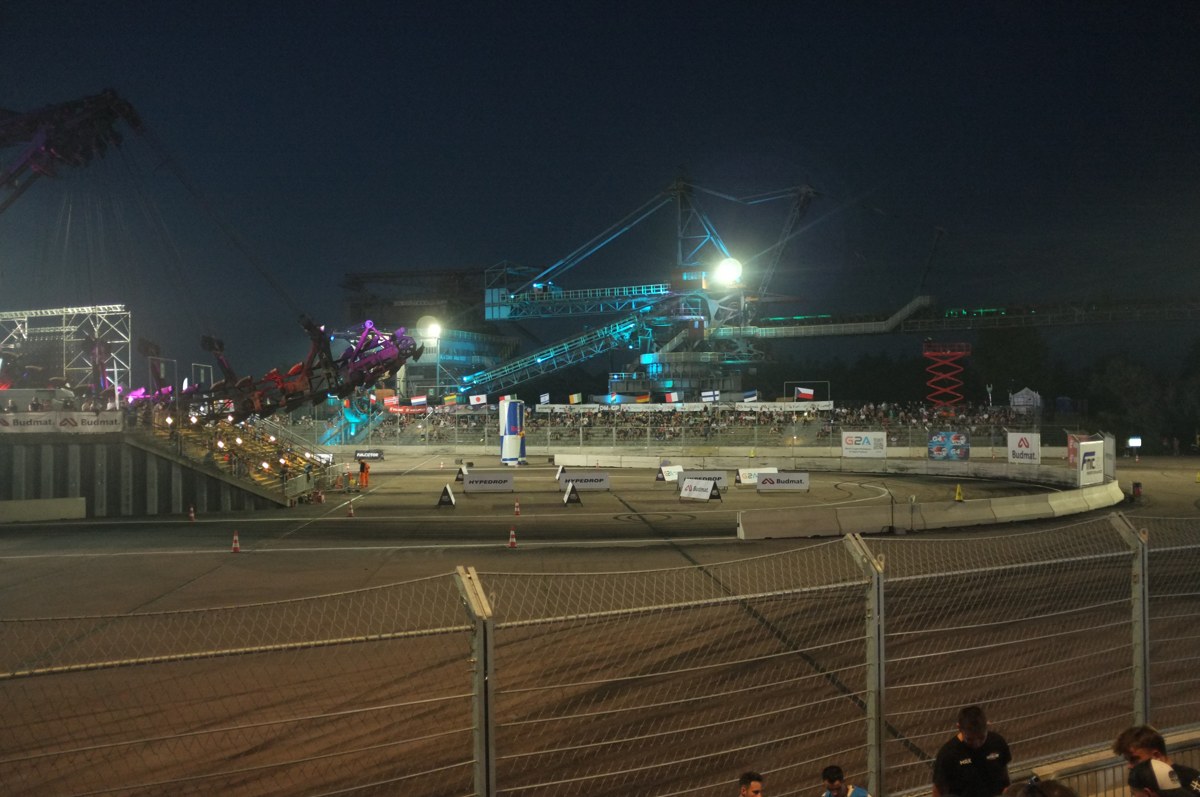
Drift Masters vs D1GP: What Separates Europe and Japan (2026)
The Rundown
- Drift Masters qualifying is additive and judged by eye: Line 60 + Angle 20 + Style 20 = 100, split across three judges. D1 multiplies speed by angle and measures it with the DOSS telemetry system.
- Europe's grid is a BMW grid: 40 of the 82 drivers on the 2026 Drift Masters scoresheet, about 49%, drove BMWs. Not one BMW-based car sits in D1GP's 2026 top 15.
- Paweł Korpuliński won the 2026 Drift Masters title in a Nissan S14 with 509 points, his first, by a 35-point margin.
- Four Japanese drivers have scored Drift Masters points since 2023, including Naoki Nakamura's 9th in 2023 and 11th in 2025, while no European Drift Masters driver appears on D1GP's 2026 entry list.
- Drift Masters publishes its prize money (€10,000 per round win, €25,000 for the season); D1GP publishes none.
Contents
Europe and Japan, side by side
Drift Masters and D1 Grand Prix are the two championships that most overseas drift fans end up choosing between, and they are built on opposite instincts. Europe’s series trusts its judges; Japan’s trusts its sensors. Drift Masters scores qualifying additively by eye at Line 60 + Angle 20 + Style 20, split across three judges. D1 multiplies speed by angle and measures the run with DOSS, a telemetry system every car is required to carry. Everything below comes from the two series’ own 2026 rulebooks and official standings, read on 14 September 2026.
How does Drift Masters score a run?
Two non-consecutive qualifying runs, in reverse championship order, scored out of 100 and added up: Line 60, Angle 20, Style 20, with Style splitting into initiation 5, fluidity 10 and commitment 5. Half points are allowed, so a 47.5 out of 60 for line is a normal score.
What is unusual is how the work is divided. Drift Masters does not have one panel scoring everything. Judge 1 scores the 60-point line. Judge 2 scores the 60-point line as well, plus the 5 commitment points. Judge 3 scores angle, initiation and fluidity. The two line scores are then averaged. Line is worth three times what angle is worth, which tells you plainly what the series rewards.
The rulebook is unusually direct about what qualifying is for: it “is supposed to establish what a good lead will look like in tandem.” A fast, shallow run that simply escapes the chase car is explicitly what the judges do not want.
The battle format is a Top 32 bracket, two runs with lead and chase swapped, and the higher qualifier picks whether to lead or chase first. Two details have no Japanese equivalent. No vehicle service is allowed between run 1 and run 2, with rear tyres required to do both runs on pain of disqualification. And only one OMT can be called per battle; if that still does not separate the drivers, judges go back to runs 1 and 2, and qualifying position can be used as a last resort.
Where D1 goes the other way
D1’s solo run is scored as speed (max 10.00) multiplied by angle (max 10.00), plus up to 3 points for sharp transitions. The rulebook’s own worked example is 9.8 × 9.7 + 0.5 = 95.56, and because the terms multiply rather than add, a weakness in one drags down the other. The measuring is done by DOSS, introduced in 2013, which splits the course into weighted sectors rather than averaging the whole run.
The practical difference for a spectator is which questions are arguable. In Europe, a close battle is a judging discussion. In Japan, it is a number: D1 decides tandem on the two drivers’ combined scores and automatically reruns the battle when they finish within 1 point. We broke the Japanese system down in detail, alongside the American one, in D1GP vs Formula Drift: judging, cars and format compared.
The two grids look nothing alike
This is the difference you notice before any rulebook. Counting every driver on the official 2026 Drift Masters scoresheet gives 40 BMWs out of 82 cars, about 49%. The most common individual chassis are the E46, the E36 and the various M2s, with Nissan second at 24% and Toyota third at 18%. There is also a Volvo 745, an Opel GT and an Alfa Romeo on the sheet.
Japan’s top class is a different world. No BMW-based car appears in D1GP’s 2026 top 15, where the running is done by GR86s, S15s, S14s, a JZX100, an RPS13 and an A90 Supra. Europe drifts what Europe has in its scrapyards, and so does Japan. That is most of the explanation.
| Drift Masters | D1 Grand Prix | |
|---|---|---|
| Solo scoring | Line 60 + Angle 20 + Style 20, added | Speed × Angle + transitions, multiplied |
| Who scores it | Three judges, split by task, half points allowed | DOSS telemetry, judges add penalties |
| Rounds in 2026 | 7, all in Europe | 10 across 5 weekends in Japan |
| Full-season grid | Capped at 37, plus wildcards | 41 on the 2026 driver list |
| Dominant marque | BMW, about 49% of the field | GR86, S15, S14, JZX and RPS13 |
| Prize money | Published: €10,000 a round win, €25,000 the title | Not published |
| Season entry | €7,000 flat | ¥660,000 for Rd.1–8, plus Rd.9/10 |
The traffic only runs one way
Here is the part nobody writes about. Four Japanese drivers have scored Drift Masters points since 2023. Naoki Nakamura ran full seasons in 2023 and 2025, finishing 9th with 204 points and 11th with 197, taking a third place at Sweden in 2023 and another at the Warsaw finale in 2025, in front of the biggest crowd of the European year. Daigo Saito took a wildcard at Mondello Park in 2025. So did Hiroya Minowa, who was 16 at the time. Ryusei Akiba scored in 2024.
Going the other way, there is nothing. No European Drift Masters driver appears on D1GP’s 2026 entry list, which we checked against both the official driver introduction page and the 2026 ranking tables. The only non-Japanese name there is a Thai driver.
Japan does export, but it exports the format rather than the drivers: D1-branded championships run in Thailand, Malaysia, China and Indonesia in 2026, while Drift Masters has not held a round outside Europe in any season it publishes.
And Europe treats Japanese credentials as currency. Drift Masters’ own press material for the 2025 Warsaw finale gives Nakamura a full biography citing his D1 Grand Prix titles in 2021 and 2024 and his three D1 Street Legal titles, which is the European series citing the Japanese one as a qualification. His story is in our Naoki Nakamura profile. One nice detail from those two profiles: the same GR86 shell is listed by Drift Masters as a 900 hp 2JZ car and by D1 as a 7.4-litre LSX V8. Different engine, different continent, same body.
What each series is willing to tell you
The money is the clearest cultural split. Drift Masters publishes everything: €10,000 for a round win, €6,000 and €4,000 for second and third, €25,000 for the season title, and a flat €7,000 season entry. D1’s regulations confirm that round and series prizes exist and are set by finishing position, but print no figures at all, while publishing entry fees down to the yen.
Read that next to the grid sizes and the picture makes sense. Drift Masters caps its full-season grid at 37 and lets wildcards top it up, which is how 82 drivers from 31 nations ended up on the 2026 scoresheet. It is a series built to be entered from anywhere in Europe and to advertise what you can win back. D1 is a domestic championship that licenses its name abroad.
If you are choosing which to travel for, the 2026 event calendar has the Japanese dates, and the practical advantage is structural: D1 runs two championship rounds in a single weekend, so one trip can cover what would take two flights in Europe.
Ebisu is the round most people fly in for
D1GP's Rounds 5 and 6 run at Ebisu Circuit in Fukushima on 25–27 September 2026, across three days, at a mountain venue with no usable public transport on a race weekend. Working out which day to be there and getting to the gate is the part that stops people. Tell us your dates and we'll build the Ebisu weekend around them.
Frequently asked questions
What is the difference between Drift Masters and D1GP?
Drift Masters scores qualifying additively and by eye: Line 60 + Angle 20 + Style 20 to a total of 100, divided between three judges, with half points allowed. D1 Grand Prix multiplies speed (max 10.00) by angle (max 10.00) and adds up to 3 points for transitions, and measures it with DOSS, a mandated GPS telemetry system. Drift Masters has no equivalent machine-scoring system, so Europe's championship is the more human-judged of the two.
Who won the 2026 Drift Masters championship?
Paweł Korpuliński of Poland, driving a Nissan S14, with 509 points across the seven-round season. It was his first Drift Masters title and he won it by 35 points from Conor Shanahan of Ireland on 474, with Piotr Więcek third on 468. Shanahan won the Red Bull Drift Masters Grand Finale event itself at Warsaw's PGE Narodowy on 13 September 2026.
Do Japanese drivers compete in Drift Masters?
Yes. Naoki Nakamura contested full seasons in 2023 and 2025, finishing 9th with 204 points and 11th with 197 points, with a third-place podium in each. Daigo Saito and Hiroya Minowa took wildcard entries in 2025, and Ryusei Akiba scored in 2024. As of the 2026 season no Japanese driver is on the Drift Masters entry list, and Nakamura is racing in Japan instead.
Has Drift Masters ever held a round in Japan?
No. Every round of every season Drift Masters publishes on its own site, covering 2023 through 2026, was held in Europe: Italy, Spain, Ireland, Finland, Latvia, Germany, Sweden and Poland. Traffic runs the other way instead. D1 licenses its format abroad, with D1-branded series running in Thailand, Malaysia, China and Indonesia in 2026.
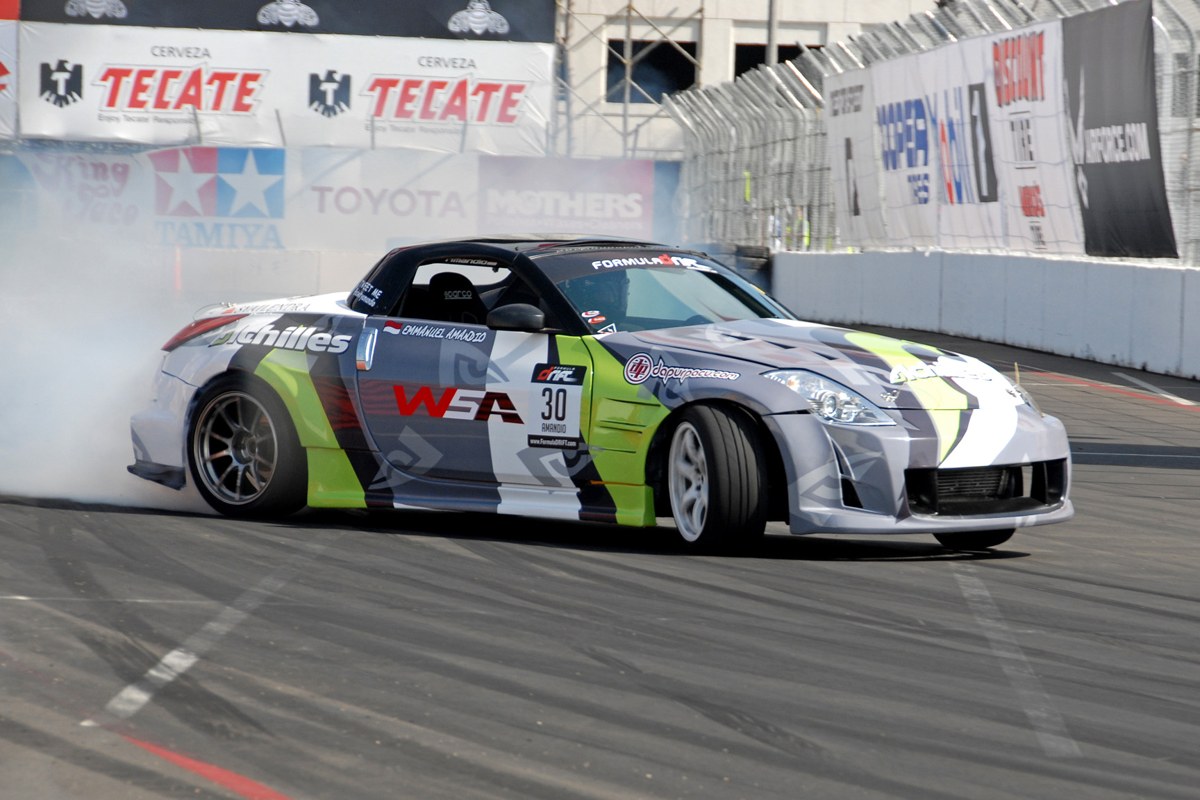 D1GP vs Formula Drift: Judging, Cars and Format Compared (2026)
  Naoki Nakamura: From Team Burst to Double D1GP Champion (2026)
  Japan's Drift Media: What to Read & Watch Before Your Trip
  Touge: Where Drifting Was Actually Born