
Tsuiso, Dorisha, Matsuri: How to Speak Japanese Drift
The Rundown
- Tsuiso (追走) — the chase run — is the heart of Japanese drifting and the word this site is named after.
- Dorisha (ドリ車) just means 'drift car', and using it correctly instantly marks you as someone who did homework.
- Matsuri means festival; a drift matsuri is an open-course festival, not a competition.
- Sōkōkai (走行会) is the word that unlocks the calendar: privately-run track days, which is how most drifting in Japan happens.
- Touge (峠) means mountain pass — the origin of the sport, honoured today on purpose-built 'touge' courses like Ebisu's.
Contents
A dozen Japanese words unlock most of what is happening around you at a circuit, and 4 of them decide what you can actually do on the day: tsuiso (追走), sōkōkai (走行会), matsuri (祭り) and kashikiri (貸切). Ebisu Circuit (Fukushima) runs its matsuri 3 times a year and calls its skid pads Kuru Kuru Land, and the course names and competition formats below were checked on the official pages on 21 July 2026.
You can attend a Japanese drift event knowing zero Japanese and have a great day. But those words unlock the schedule, the paddock chatter, and the reason everyone suddenly runs to the fence. Here they are, from people who use them every week.
The core vocabulary
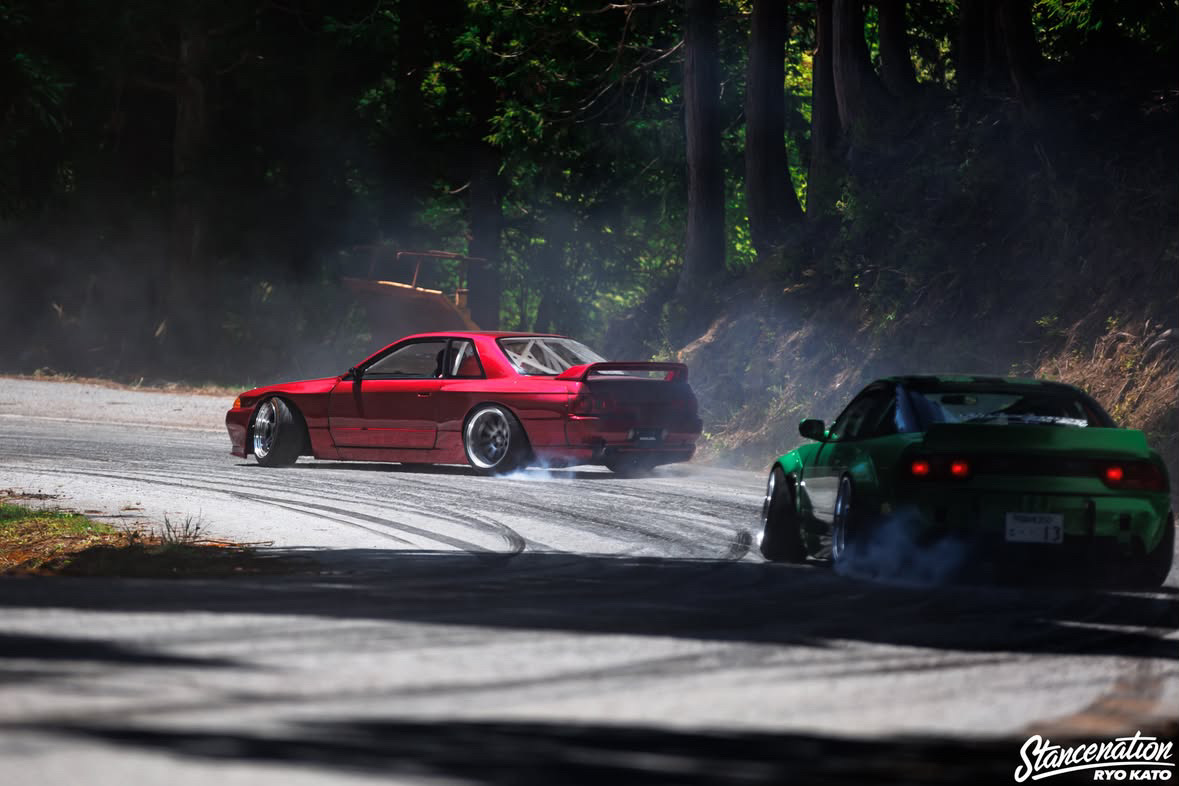
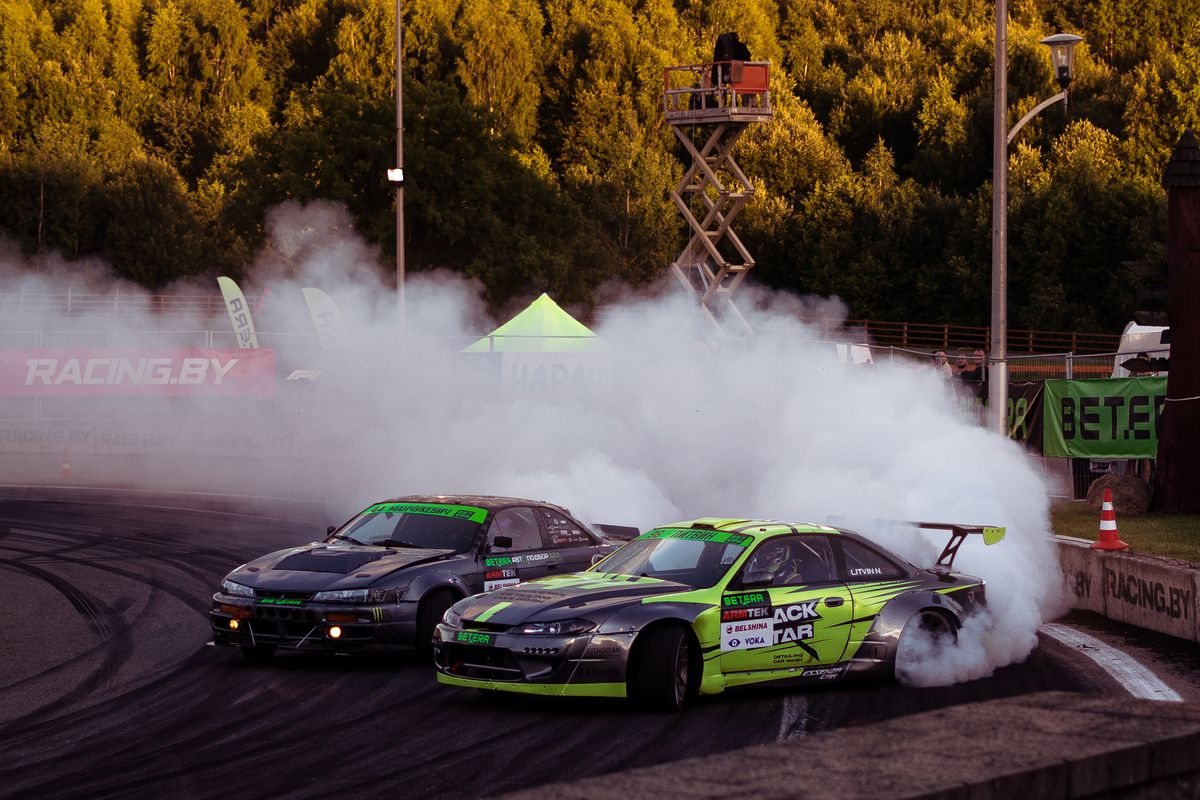
Tsuiso (追走) — chase run. Two cars, one line: the lead sets the pace, the chase fills the mirrors. In pro competition (D1, Formula Drift Japan) tsuiso is the tandem battle phase that decides the podium. At a grassroots level it’s not judged at all — it’s just the best thing you can do in a drift car, and the reason this site carries the name. What the judges are actually looking at in a competition tsuiso is broken down in how tsuiso battles are judged.
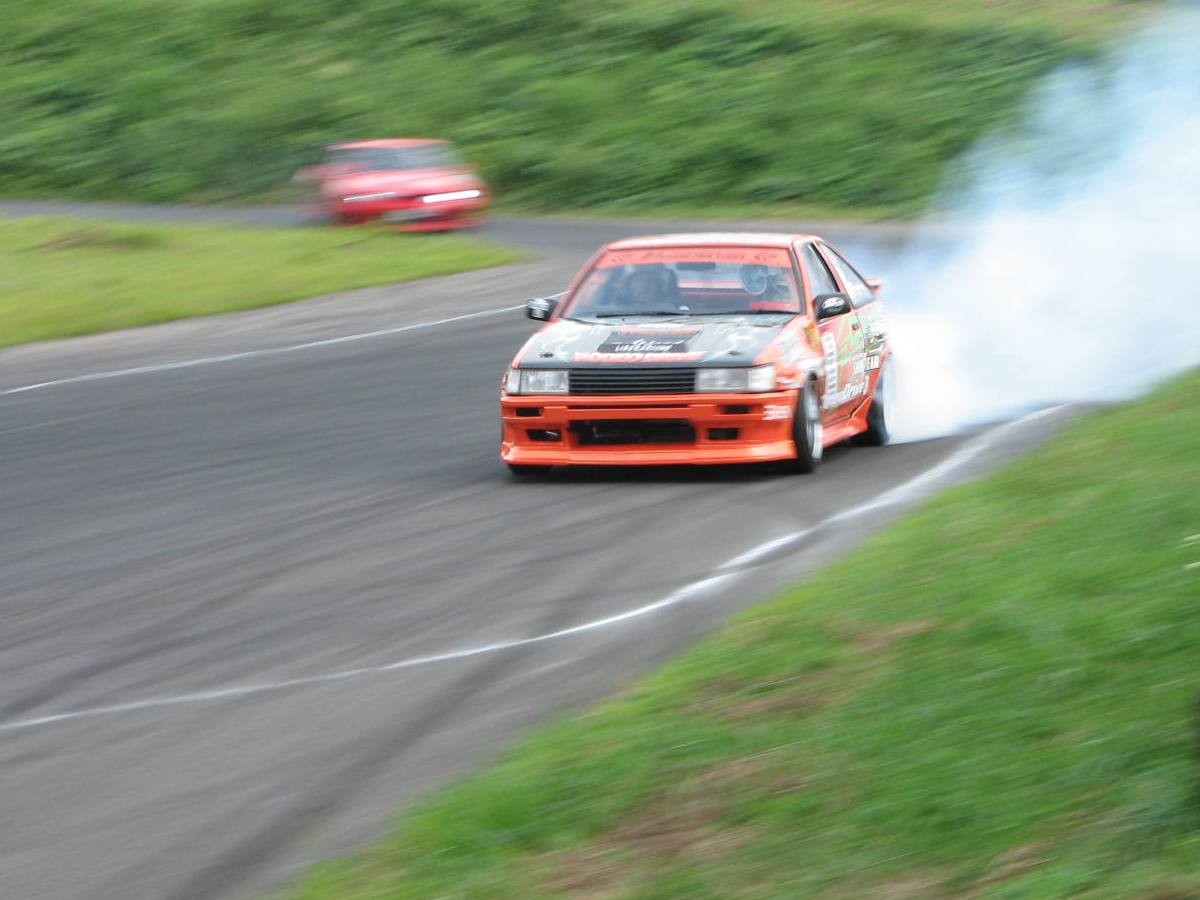
Dorisha (ドリ車) — drift car. Dori from “drift”, sha (車) meaning car. A dorisha isn’t a model of car; it’s a state of preparation — knuckles, diff, hydro, cage, gutted interior optional.
Matsuri (祭り) — festival. A drift matsuri opens every course at once and runs day into night. No judges, no timetable anxiety. Ebisu’s three-a-year matsuri are the most famous events in grassroots drifting anywhere, and the entry fees, deadlines and English paperwork are in our Ebisu Drift Matsuri first-timer’s guide.
Sōkōkai (走行会) — a privately-organised track day. This is the single most useful word on this list, because it’s how most drifting in Japan actually happens: a shop or crew rents the circuit and sells entries. When a Japanese calendar says 走行会, that’s a day you can potentially join.
You’ll see the word used in exactly that way by the circuits themselves. Here is Motorland SP in Aomori announcing a sōkōkai that an outside team, Cheeseburger Racing, was putting on at its track.
"Sunday 1 September 2024 — CBR track day! CBR (Cheeseburger Racing) are holding a track day at Motorland SP. Everybody come!"
2024 9月1日(日) CBR走行会 開催!! モーターランドSPにてCBR(チーズバーガーレーシング)走行会開催で〜す! みんなきてね〜!
View the original post ↗Touge (峠) — mountain pass. Where the sport was born, in an era the scene treats as history rather than an instruction manual. The word survives on purpose-built courses — Ebisu’s Touge course recreates the narrow, committed rhythm of a mountain road, legally. For the era behind the word, our chapter on where touge drifting and the hashiriya era began on Japanese mountain roads follows drift culture in Japan from the passes to the circuits it runs on today.
The paddock layer
Manji (蛮字-style weaving) — the side-to-side weaving drift you’ll see on straights, named for the zig-zag shape. Show, not speed.
Furidashi / shinsa (振り出し / 審査) — initiation and judging. You’ll hear shinsa at competitions: the judged run. Furidashi — the moment the car is thrown — is what the judges scrutinise first.
Kuru Kuru (くるくる) — “round and round”. Ebisu’s skid pads are literally named Kuru Kuru Land: where everyone’s first donuts happen.
Renshū (練習) — practice. A 練習会 (renshūkai) is a practice-focused day, usually the most beginner-friendly listing on any calendar.
Kashikiri (貸切) — private hire. On a schedule, it means the track is booked; don’t turn up expecting to run.
One word unlocks the calendar
Sōkōkai (走行会) is the term to memorise first. Most drifting in Japan is not run by circuits — it is run by private organisers who rent the track and sell entries, and each organiser takes entries its own way, by web form, by email, sometimes by fax, always in Japanese. Working out which of those days will take a visitor, and getting the entry accepted, is the part we take on: what we arrange on a Japanese drift day, region by region.
Our calendar of Japanese drift events lists the confirmed 2026 rounds with their fees and the day each entry window shuts, which is the same information a Japanese calendar buries in 走行会 listings.
The full list, A to Z: 104 terms you will actually meet
The ten words above are the ones that carry meaning. The list below is the rest of what you will hear in a paddock, read on a circuit’s Japanese entry form, or see in a Yahoo Auctions listing, each in one line. Romanisation is the plain kind (so, not sō), kanji or katakana in brackets, and where a word has a drift-specific sense that differs from the dictionary, the drift sense is the one given. Added 3 October 2026.
On track and in the judges’ box
- Atooi (後追い): the chase car in a tsuiso battle; the lead car is the senko (先行). A battle is two runs with the roles swapped.
- Besuto 16 / besuto 8 (ベスト16/8): the knockout bracket stages, top 16 and top 8.
- Deguchi (出口): corner exit; iriguchi (入り口) is the entry.
- DOSS: D1 Grand Prix’s machine scoring system, which measures speed, angle and line against the judges’ human score.
- Furikaeshi (振り返し): the transition, snapping the car from one direction of drift to the other between linked corners.
- Hakuryoku (迫力): impact or presence; a judging word for speed, angle and commitment seen together.
- Hikyori (飛距離): literally flight distance; how far and how deep a car carries the drift from initiation.
- In-beta (インベタ): hugging the inside line; auto (アウト) is the outside.
- Kakudo (角度): drift angle. Kireskaku (切れ角) is steering lock, the angle the front wheels can turn.
- Kansei drift (慣性ドリフト): inertia or feint drift, started with weight transfer rather than the handbrake.
- Keisoku (計測): timing or measurement; a keisoku sokō (計測走行) is a timed run.
- Kesshō (決勝): the final; yosen (予選) is qualifying.
- Kurattchi keri (クラッチ蹴り): clutch kick, snapping the clutch to break traction.
- Kurippu (クリップ): clipping point; a zōn (ゾーン) is an outer clipping zone the judges want the rear to fill.
- One more time (ワンモアタイム): a tsuiso battle re-run after the judges cannot separate the two cars.
- Rain (ライン): the line through a corner, in the same sense as any racing driver uses it.
- Saido (サイド): the handbrake, from side brake; yuatsu saido (油圧サイド) is a hydraulic handbrake.
- Shinsa (審査): judging; the shinsa-in (審査員) are the judges. A shinsa-ku (審査区間) is the judged section of the course.
- Tanso (単走): a solo run, judged on its own; the first stage of any competition before the tsuiso bracket.
At the gate, the office and the inn
- Choi-nori (ちょい乗り): a short taster session, a handful of laps, sold by some circuits to first-timers.
- Dōjō (同乗): riding as a passenger; dōjō hoken (同乗保険) is the compulsory passenger insurance.
- Furī sōkō (フリー走行): free running, open track time with no organiser session structure.
- Genkin kakitome (現金書留): registered cash mail, a Japan Post service some organisers still accept for entry fees.
- Hanko / inkan (ハンコ/印鑑): a personal seal, used instead of a signature on some Japanese forms.
- Hashiri-hōdai (走り放題): unlimited running for the day, the all-you-can-drift ticket.
- Kaiin (会員): member; a raisensu (ライセンス) is a circuit’s own licence, needed for free running at some venues.
- Kashikiri (貸切): exclusive hire of the whole course; sen’yū (占有) means the same on some circuits’ calendars.
- Kokusai menkyo (国際免許): an International Driving Permit; menkyo (免許) is a driving licence.
- Kusa-dori (草ドリ): grassroots drifting, the amateur end of the scene and most of its events.
- Minshuku (民宿): a family-run inn, the usual bed near a rural circuit; an onsen (温泉) is a hot spring.
- Padokku (パドック): paddock; a pitto (ピット) is a pit garage, often sold separately at a matsuri.
- Seiyakusho (誓約書): the pledge or waiver form signed before running.
- Sōkō-ken (走行券): a run ticket; a waku (枠) is a time slot on the day’s schedule.
- Taiken sōkō (体験走行): an experience or taster drive, often in the venue’s own car with an instructor.
- Uketsuke (受付): reception, where you sign in; the word also means the entry period for an event.
The car and the parts listing
- Būsuto appu (ブーストアップ): raising boost on the standard turbo, the first power step on an SR or JZ.
- Buhin-dori (部品取り): parts donor; a listing with this word is selling a car or engine for its parts.
- Defu (デフ): the differential; a kikaishiki LSD (機械式LSD) is a mechanical limited-slip, and 2-way is the drift preference.
- Eāro (エアロ): an aero kit; a GT uingu (GTウイング) is a rear wing on stands.
- Furubake (フルバケ): a fixed-back full bucket seat; a semibake (セミバケ) reclines.
- Genshā setto (現車セッティング/現車合わせ): ECU tuning done on the car itself, on a dyno or the road.
- Gyōhan (業販): trade price, what a shop pays a maker; the opposite of retail.
- Hachiroku (ハチロク): the AE86 Corolla Levin and Sprinter Trueno, from the digits 8 and 6.
- Hikitori gentei (引き取り限定): collection only; the seller will not ship.
- Hontai kakaku (本体価格): the body price of a car, before fees; shiharai sōgaku (支払総額) is the on-the-road total a Japanese buyer pays.
- Ichi-hachi-maru (180): the 180SX, read digit by digit; a Shirubia (シルビア) is a Silvia and the S-shashi (Sシャシ) is the S-chassis family.
- Ichi-jei / ni-jei (1J/2J): the 1JZ and 2JZ engines; esu-āru (SR) is the SR20 and āru-bī (RB) the Skyline sixes.
- Janku (ジャンク): junk, sold as not working or untested.
- Jitsudō (実動): running when removed; the word that separates a tested engine from an untested one in a listing.
- Junsei (純正): OEM, factory parts; shagai (社外) is aftermarket.
- Kōnin (公認): an officially certified modification, recorded on the registration; kōnin-zumi (公認済み) means already certified.
- Masshō (抹消): deregistration; yushutsu masshō (輸出抹消) is the export deregistration that starts a car’s journey abroad.
- Nakkuru (ナックル): the steering knuckle; a modified one adds steering angle.
- Nōmaru (ノーマル): stock, unmodified.
- Noseka-e (載せ替え): an engine swap; kansō (換装) is the same word in the listing.
- Oni-kyan (鬼キャン): extreme negative camber, demon camber.
- Ōru pen (オールペン): a full respray.
- Ōbā fendā (オーバーフェンダー): bolt-on fender flares; a waido bodi (ワイドボディ) is the full conversion.
- Rikusō (陸送): inland car transport by truck; eigyōsho-dome (営業所止め) is depot hold, collect it from the carrier’s branch.
- Rōru kēji (ロールケージ): a roll cage; a rōru bā (ロールバー) is the lighter bolt-in bar.
- Shakōchō (車高調): coilovers, from height-adjustable suspension.
- Shaken (車検): the roadworthiness inspection; shaken-tsuki (車検付き) is a car with inspection remaining.
- Shūfukureki (修復歴): repair history, the dealer’s declaration of structural accident repair; nashi (なし) means none.
- Sileighty / Onevia (シルエイティ/ワンビア): a 180SX with the Silvia front end, and the reverse.
- Tābin (タービン): a turbocharger; tābin kōkan (タービン交換) is a turbo swap.
- Tsuika mētā (追加メーター): extra gauges.
- Tsuraichi (ツライチ): wheels sitting flush with the fender edge.
- Zenki / chūki / kōki (前期/中期/後期): early, mid and late model within one generation; the kōki S14 and S15 carry the most value.
Why this matters beyond vocabulary
Japanese drift culture runs on signals of respect: the greeting to the organiser, the tidy pit, the correct word at the correct moment. None of it requires fluency. All of it requires noticing. Learn these words and you stop being a tourist at the fence — you become a guest who was expected.
Frequently asked questions
What does tsuiso actually mean?
追走 combines 追 (chase) and 走 (run): a chase run, 2 cars on track together. In competition it is the tandem battle phase that decides the podium, with the lead and chase cars judged on line, angle and proximity: D1 Grand Prix runs a 16-car tsuiso bracket after its solo final, and Formula Drift Japan cuts to a top 32. At grassroots level nothing is judged at all and tsuiso just means running together, which is what everyone is really there for (formats checked on the series' own pages on 21 July 2026).
Is it rude to use Japanese drift slang as a foreigner?
The opposite: used accurately and without showing off, it reads as respect. The 12 or so words in this glossary, tsuiso, dorisha, sōkōkai, matsuri, touge and kashikiri among them, are the ones you will hear at any Japanese circuit, and using 1 of them correctly at the right moment lands better than a whole rehearsed sentence. Mispronunciation is forgiven instantly; genuine interest is the currency.
What's the difference between a matsuri and a normal track day?
A sōkōkai (走行会) is a structured track day with run groups, usually run by a private organiser who has rented the circuit. A matsuri (祭り) opens multiple courses at once, runs day into night and has no timetable pressure: Ebisu Circuit (Fukushima) holds 3 a year, and entry to one of its drift matsuri is ¥20,000 in advance against ¥25,000 on the day, with spectating at ¥2,500 for the whole weekend. Think of it as a festival with cars instead of food stalls.
 How Tsuiso Battles Are Judged in Japan: Line, Angle, Style
 Japan's Drift Media: What to Read & Watch Before Your Trip
 Touge: Where Drifting Was Actually Born
 When Did Drifting Start in Japan? A Dated Timeline, 1970s to 2026