
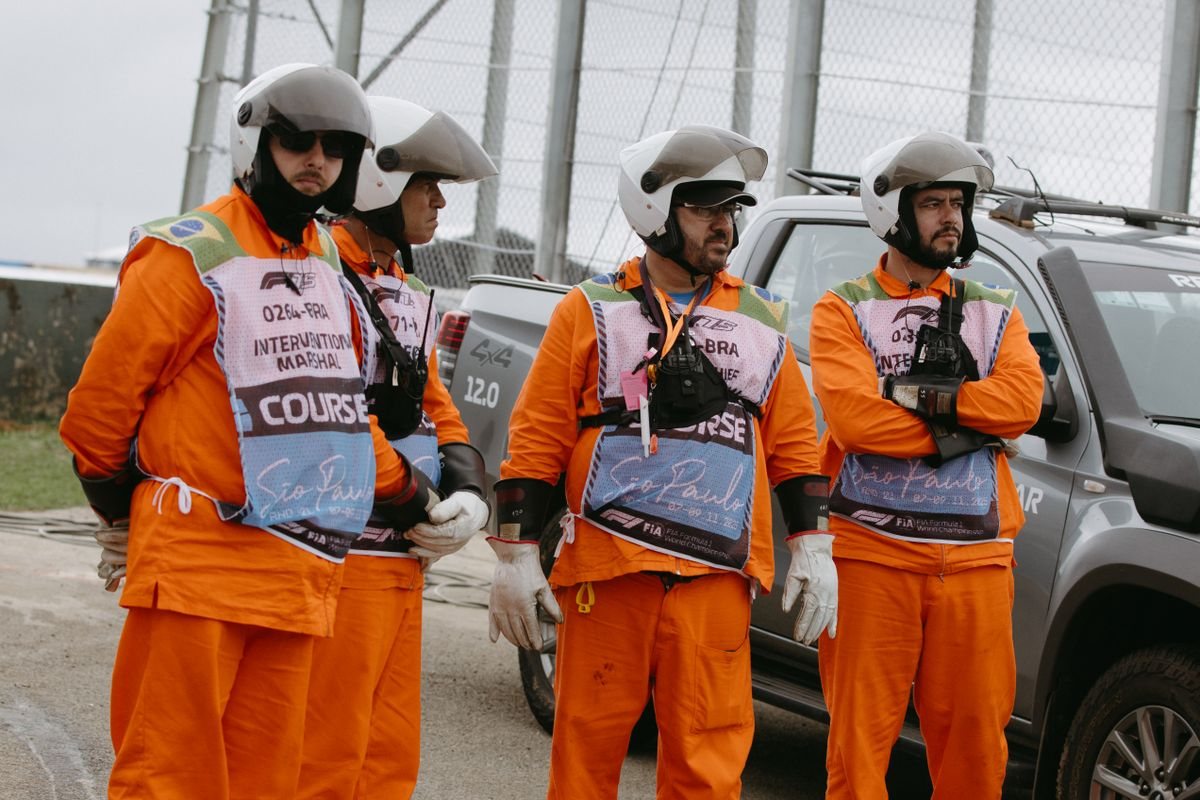
Flags, Meetings & Pit Rules at a Japanese Drift Day (2026)
The Rundown
- The desk turns more foreign drivers away than the track does. Suzuka Twin checks your physical licence at sign-on and states in writing that a photo saved on your phone is not accepted.
- Noise is the most common hard stop. Nikko publishes 105 dB, measured from inside the paddock and from the judges' box, and bans a car for after-fire even when the meter reads under.
- The drivers' meeting is a real gate, not a formality — one Central Circuit drift day sets it at 07:50 and states plainly that every driver must attend. It runs in Japanese.
- Blue flags may not exist on your day. Tsukuba's official four-wheel flag chart says the blue flag is not used in member running and only sometimes on private-hire days.
- Drivers get into Ebisu free while spectators pay ¥1,700, and a full day of drift on Course 4 is ¥8,500 — ¥5,500 from 1 December to 31 March.
Contents
Three published rules end more foreign drivers’ days than the track ever does. Nikko Circuit (Tochigi) sets 105 dB and bars a car judged loud on after-fire even when the meter reads under it, Suzuka Twin Circuit (Mie) checks your physical licence at the desk and states that a photo on your phone is refused, and on an organiser-run day such as the Satomin drift day at Central Circuit (Hyogo) the 07:50 drivers’ meeting is compulsory and runs in Japanese.
You have the date, the entry and the flights. What is keeping you awake is the first hour: a desk you cannot read, a briefing in a language you do not speak, and a marshal waving something at you on lap two.
Here is what those Japanese circuits actually publish about it, read off their own pages on 6 August 2026.
The shape of the day
The desk is where foreign drivers actually get stopped
Suzuka Twin Circuit is the bluntest published example. Four-wheel free running is for licence holders aged 18 and over, the licence is checked at the running reception, and the page states that you must show the real thing — a photo saved on your phone is refused. Forget the card and you do not run, whatever you have paid. Bookings there are by telephone only; the site says email reservations are not accepted at all.
The written pledge is the second step. A seiyakusho (誓約書 — an indemnity you sign) is standard, and the form tells you how seriously it is taken: Ebisu’s own 2026 EDS entry paper carries a participation pledge that must be signed and sealed with a personal stamp, with a guardian’s name and seal for anyone under age. It commits you to long sleeves, long trousers, trainers, racing gloves, a helmet that is not a half-cap, a four-point belt, a fire extinguisher on board and the driver’s window fully shut. Organisers do the same in miniature — the Satomin drift day at Central Circuit has drivers agree six clauses before entry, including that damage is settled in cash within a week and entry fees are never refunded.
Then the meeting. The Satomin timetable is the clearest published one: gate 07:30, drivers’ meeting 07:50, running 08:00 to 16:30, and it says outright that the running method is explained there so every driver must attend. That meeting is in Japanese. So is the pledge.
The two steps you cannot do alone — and we can
Everything else on a Japanese drift day is doable with a phrasebook and good manners. The sign-on pledge and the drivers' meeting are not: they are the two places where a rule is stated once, in Japanese, and you are held to it all day. Ebisu is the exception worth knowing — its EDS series publishes an English entry form and English series guidelines alongside the Japanese ones. Everywhere else we checked publishes Japanese only. We are in Japan and we can come with you: translate the meeting live, fill in the pledge with you, and settle the licence, noise and passenger questions with the desk in Japanese before you commit. Send us your venue and dates: what we handle on a Japanese drift day, from the sign-on pledge to the meeting.
Flags: learn the chart, then check whose chart it is
Tsukuba Circuit publishes a four-wheel flag chart written specifically for member running and private hires — which is what a sōkōkai (走行会 — a rented track day) is. It is the clearest one any Japanese circuit puts in public.
| Flag | Japanese | What it demands of you right now |
|---|---|---|
| Yellow, waved twice | 黄旗 二本振動 | A car or a driver is still on the track. Slow to a speed you can avoid at, be ready to stop. No overtaking |
| Yellow, waved once | 黄旗 一本振動 | Stopped car off the racing surface. Slow, watch the corner. No overtaking |
| Yellow, held still | 黄旗 静止 | Incident nearly cleared. Still no overtaking |
| Green | 緑旗 | Yellow zone lifted past that post; also used as the signal to go out |
| Red | 赤旗 | Running is stopped. Return to the pits with maximum care |
| Oil | オイル旗 | Oil, dirt or debris on the surface — it is slippery |
| White | 白旗 | A slow vehicle ahead, including recovery vehicles |
| Orange ball | オレンジボール | Your car has a fault. Get it off the track and into the pits |
| Black + your number | 黒旗 | Bad conduct, missing equipment or a fault. Come in immediately |
| Chequered | チェッカー | Session over, no overtaking. Watch for a double chequer |
| Blue | 青旗 | Faster car behind. Not used in member running; sometimes used on private-hire days |
That last row is the point. Flags are not identical everywhere, and there is no national drift-day flag standard you can memorise once. Tsukuba’s own chart warns that JAF-sanctioned competition is handled differently. Organisers strip the set down further: GARAGE-R, which runs track days at Tsukuba, Mobara, Nikko and Fuji Short, publishes just three for free running — yellow, red and chequered — and adds that pit-in instructions for a car fault come from the platform in front of the pits, using your number and a flag. Which is why you memorise your number.
And the honest gap: Ebisu’s drift free-run page publishes no flag chart at all. Its published rules are conduct rules — no running the wrong way including on pit road, no unnecessary slowing or stopping on course, check behind and use the pit-road side when you go out, indicate before you come in, windows shut, helmet on and strapped. If a car is stuck out there, running stops until it restarts or is recovered. Not published, so ask on the day.
Out-lap, in-lap, and the bit nobody explains
The published discipline around a session is narrow and worth rehearsing before you go. GARAGE-R’s rules give the fullest version. Your first lap after going out is for checking the car and the surface, because your tyres are cold; you hold the outside line until you are past turn two so the cars already running can see you; and there is no overtaking on the sighting lap. Coming in, you signal from before the last corner and run down the pit-lane side, then crawl through the pit lane itself watching for people crossing on foot. Ebisu says the same in its own words — check behind before you go out, use the pit-road side, indicate before you pit in, and never cross the course.
Two more that catch visitors. Running a way that does not match the class you entered is banned outright, and the example printed is drifting in a grip class. And if you stop out there, the clock does not stop with you: recovery and oil clean-up time counts inside your session, so the ten minutes spent lifting your car off the grass are ten minutes of the running you paid for.
The thing that ends your day before it starts
Noise. Nikko Circuit's own front page sets 105 dB, measured from inside the paddock and from the judges' box, and says a car over it is barred from running — then adds that even a car reading under 105 dB is barred if after-fire or anti-lag is judged loud. It also bans running with the bonnet removed, and bans burnouts. Suzuka Twin sets 105 dB too and publishes the exact method: warm, neutral, held at 70% of maximum revs for five seconds and snapped shut, meter roughly a metre away, 45 degrees behind the tailpipe, same height. Ebisu's drift pages give 120 dB as a guide and refuse straight-through exhausts. Bring the silencer insert. There is no appeal at the desk.
What a day actually costs
Everything below was re-read on 6 August 2026.
| Venue | To get in | To run | Other required cost |
|---|---|---|---|
| Ebisu, Course 4 (drift) | Free for drivers; ¥1,700 adult spectator, ¥1,200 child | ¥8,500 full day, ¥5,000 half. Winter (1 Dec–31 Mar) ¥5,500 / ¥3,500 | Insurance included in the run fee |
| Ebisu, Course 5 (adds West) | as above | ¥10,000 full day, ¥6,500 half | as above |
| Suzuka Twin, D course (drift) | ¥500 weekday, ¥1,000 weekend/holiday | Weekday 1 hr ¥4,000 booked / ¥5,000 same day; 3 hrs ¥10,500. Weekend 1 hr ¥5,000 / ¥6,000; 3 hrs ¥13,500 | Phone booking by 16:00 the day before |
| Nikko, four-wheel sport running | Included | ¥2,500 per 20-minute session incl. timing; last session ¥2,000 | Circuit licence ¥10,000 new (incl. ¥4,000 insurance), ¥5,000 renewal |
| Central Circuit | ¥1,000 per person | ¥6,000 per 30 minutes | Four-wheel licence ¥51,000 to join (¥21,000 + ¥18,000 + ¥12,000) |
| Satomin drift day, Central Circuit | ¥1,000 per participant | ¥10,000 per driver | Bank transfer after the entry form |
One caveat on that Nikko row: the fee sheet is the scan the circuit links from its own four-wheel timetable page today, and it carries a December 2020 date. It is what Nikko publishes, so treat the figures as current but confirm them when you book.
Two cash traps in there. Central Circuit takes a card for the joining and annual fees but its ¥12,000 mutual-aid fee is cash only; Suzuka Twin’s ¥13,000-a-year four-wheel membership is cash only as well. Ebisu’s afternoon tickets only go on sale at 11:00, and no venue above refunds for weather or a broken car.
What the desk checks, and what to have on you
- Your physical driving licence. Suzuka Twin states a phone photo is not accepted. Our licence and IDP guide covers which document you need before you fly
- Helmet, full-face or jet. Half-caps are refused at Ebisu, Suzuka Twin and Central Circuit alike
- Gloves that cover fingertips and wrists — fingerless is refused; grippy work gloves pass at Suzuka Twin
- Long sleeves, long trousers, laced shoes. No skin at cuffs or ankles. Crocs, sandals and heels are named and banned
- A tow hook fitted, or carried in the car if it is the detachable type — and know where it screws in
- An empty cabin. Loose items out, necklaces and rings off, driver's window shut
- Tape for the battery positive terminal and any glass lenses, per Ebisu's safety rules
- Cash. Several of the fees above are cash-only, and damage is settled in cash
The unwritten half
Ebisu has published a notice about manners because customers complained: people drifting in the paddock, and people carrying on running while a stuck car sat on the course. The page warns that drift free running could stop being offered if it continues. Take both literally — the paddock is where families walk, and a stuck car means everyone lifts.
The rest is the same tidiness that surprises every visitor. Take your rubbish and your dead tyres home; Ebisu and Nikko both put that in writing. Smoke only in the marked area. Crawl in the pit lane and the paddock. At Nikko, photography of participants or their cars without permission is prohibited across the site, and general spectators are restricted — so do not bring a crowd or a long lens without asking first. Under-16s are kept out of the pit lane and the sign-board platform on GARAGE-R days. And if you spin off, leave the car, keep your helmet on and get behind the barrier; working on the car beside the track is banned outright.
None of this is designed to catch you out. It is the same set of habits the whole paddock already has, written down in a language you do not read yet. Our track day entry guide covers the booking half, and the calendar has the confirmed 2026 dates.
Frequently asked questions
What actually happens if I miss the drivers' meeting?
At an organiser-run drift day you do not run. The published timetable for the Satomin drift day at Central Circuit puts the gate at 07:30 and the drivers' meeting at 07:50, and states that the running method is explained there and every driver must attend. Circuit-run free running works differently — Ebisu's drift free-run page has no meeting on it at all, because you buy a ticket and go out inside a fixed 09:00–16:00 window. The rule of thumb: if a private organiser has rented the track, there is a meeting and it is compulsory; if you are buying a circuit's own free-run ticket, ask at the desk what the signal to go out is.
Is my exhaust going to fail the noise check?
It depends on the venue, and the gap is wide. Nikko sets 105 dB and measures from inside the paddock and from the judges' box, and its own page says a car judged loud on after-fire or anti-lag is refused even if the meter reads under 105. Suzuka Twin also sets 105 dB but publishes the method: engine warm, in neutral, held at 70% of maximum revs for at least five seconds and then snapped shut, with the meter about a metre from the tailpipe, 45 degrees behind it, at the same height — and straight pipes without a catalyst are banned outright. Ebisu's drift free-run page gives a guide figure of 120 dB and refuses straight-through or obviously loud exhausts. Fit the silencer insert.
Can I take a friend in the passenger seat?
Only through the desk, and the penalty for skipping it is severe. Suzuka Twin restarted passenger running in February 2024: the driver declares it when paying, receives a run ticket marked as carrying a passenger, and the passenger comes to the office in person to fill in and sign a passenger application form, with a guardian's signature if they are under 18. Minimum height is 140 cm and the passenger wears the same kit as the driver, gloves aside. Carry someone without that paperwork and the circuit bans both of you from the day onwards. At Ebisu, passengers must be insured — bought at the entrance gate — and wear the driver's full kit.
 Noise Limits, Kit and Car Rules at Japanese Drift Tracks (2026)
  Are You Insured If You Crash at a Japanese Drift Track? (2026)
  How to Enter a Japanese Drift Track Day as a Foreigner (2026)
  Masashi Yokoi: Three-Time D1GP Champion Chasing a Fourth (2026)