
Keiichi Tsuchiya: The Drift King's Real Record (2026)
The Rundown
- Keiichi Tsuchiya, born 30 January 1956 in Nagano, built his name on six straight wins in the 1984 Fuji Freshman Race in an AE86, per his own official biography.
- He won the GT2 class at Le Mans in 1995 in a Honda NSX with Akira Iida and Kunimitsu Takahashi, finishing 8th overall — confirmed on the ACO's own site.
- His best Le Mans result was 2nd overall in 1999 in the Toyota GT-One, across seven starts between 1994 and 2000.
- His official site says he launched the D1 Grand Prix in 2001 and served as its chief judge; D1's own 2026 news page calls him the founder of drift competition.
- As of September 2026 he is team director of the #16 ARTA MUGEN Super GT car, which gave him his first GT500 win as a director at Suzuka on 23 August 2026.
Contents
Keiichi Tsuchiya at a glance
Keiichi Tsuchiya (土屋圭市) is the most-searched name in drifting, and most of what circulates in English about him is slightly wrong. He did not win Le Mans outright, and the McLaren F1 GTR was not his 1995 car. What he did do is win the GT2 class at Le Mans in 1995 in a Honda NSX, finish 2nd overall in 1999, take six consecutive wins in the 1984 Fuji Freshman Race in an AE86, and then spend a decade building the competition that turned Japanese street drifting into a judged sport. Everything below comes from his own official site, the ACO’s records and the series’ own pages, checked on 14 September 2026.
Where the Drift King actually came from
His official biography tells the origin story plainly. As a boy in Nagano he rode a moped all the way to Fuji Speedway to watch racing, and there he saw Kunimitsu Takahashi — the one driver on the grid who was sliding the car through corners. His site calls that sight the origin of everything he became. With little circuit access and no money, he practised on mountain passes and snowy winding roads, funding racing himself.
He debuted in the Fuji Freshman Race in 1977. Seven years later came the season that made the legend, and the car that carried it.
What he really did with the AE86
Six straight wins from the 1984 season opener. That is the line in his own biography, and it is the foundation of everything the AE86 has become in drift culture. The car was slower than the turbocharged Skylines it raced against; the driving was what closed the gap.
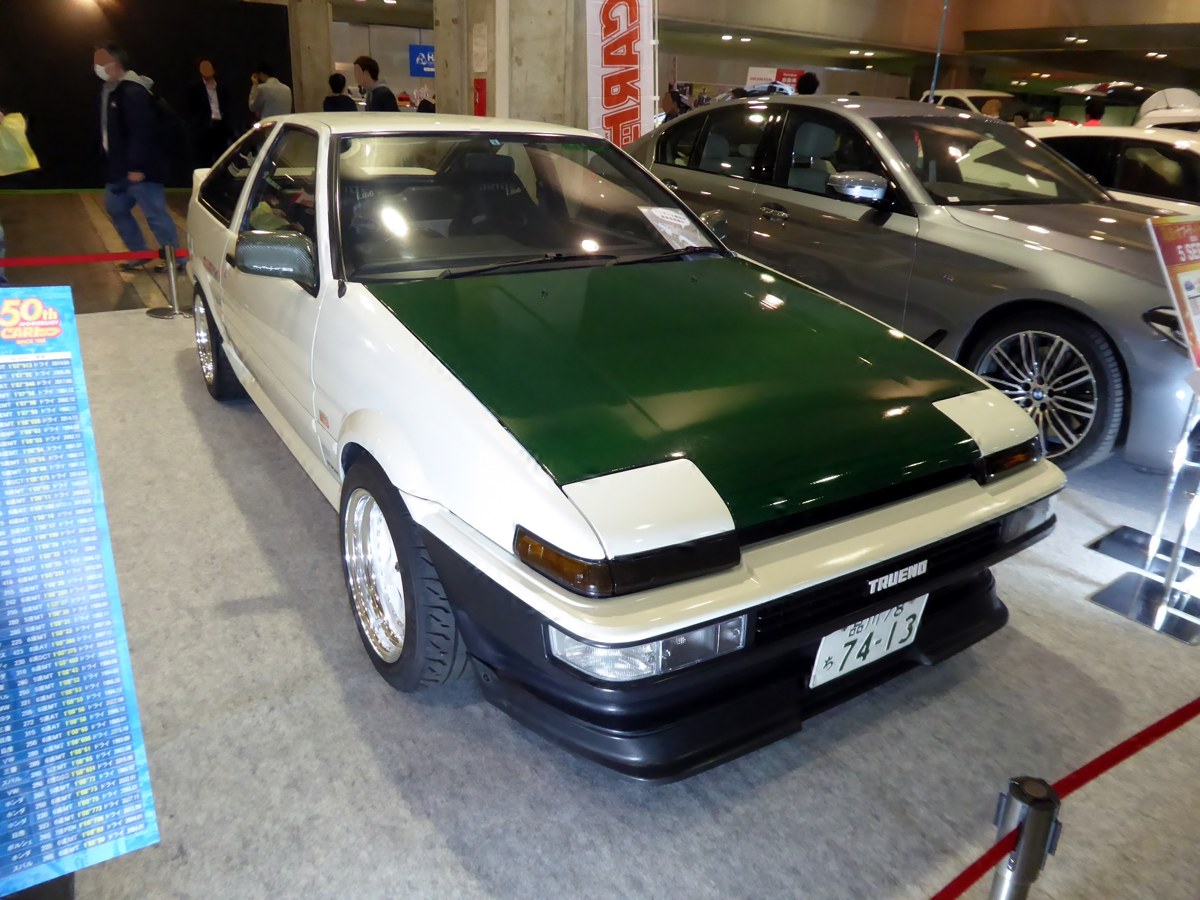
He still has one. The green-bonneted Sprinter Trueno pictured above is the E-AE86 he personally owns, photographed at Osaka Auto Messe. In an interview published by Toyota UK he described it as a 1986 car with a 1.8-litre engine making 180 bhp, and said he still drove it on the road. His explanation of why the car made him better is the most quoted thing he has ever said about driving:
“In a way, if you drive a good car, you become a worse driver. The ABS and electronic controls take care of a good car and cover up your mistakes. But that’s not the case with the 86. You can’t even make a single error with this car.”
If you want the same chassis, our AE86 price guide covers what Truenos and Levins actually cost in Japan now, and the AE86’s D1 record covers what the car went on to do in competition.
The racing record people get wrong
Tsuchiya started the Le Mans 24 Hours seven times between 1994 and 2000, five of them consecutively.
| Year | Car | Class | Result |
|---|---|---|---|
| 1994 | Honda NSX, Kremer Honda Racing | GT2 | 18th overall |
| 1995 | Honda NSX, Team Kunimitsu | GT2 | 8th overall, 1st in class |
| 1996 | Honda NSX, Team Kunimitsu | GT2 | 16th overall, 3rd in class |
| 1997 | McLaren F1 GTR, Team Lark McLaren | GT1 | DNF (accident) |
| 1998 | Toyota GT-One, Toyota Motorsport | GT1 | 9th overall |
| 1999 | Toyota GT-One, Toyota Motorsports | GTP | 2nd overall |
| 2000 | Panoz LMP-1 Roadster S, TV Asahi Team Dragon | LMP900 | 8th overall |
The 1995 class win is on the ACO’s own site, which lists the GT2 winner as the Honda NSX of Tsuchiya, Akira Iida and Kunimitsu Takahashi — the same Takahashi he had watched as a boy, by then his team owner. The ACO notes it as Honda’s first and only GT2 victory. By his own account he started that race from the pits and passed thirty cars on the way to the class win.
The 1999 second place is the one that still stings: the Toyota GT-One was beaten after a late high-speed puncture. His site describes it as the best Le Mans finish by an all-Japanese trio.
What he built after racing
This is the part that matters most to anyone reading this site. His own race-career page records, for 2001, that he launched the D1 Grand Prix, and his biography says he served as its chief judge, framing the achievement as moving Japan’s street racers off public roads and onto circuits. He left D1 in 2010 and started Drift Muscle with Option founder Daijiro Inada, which was renamed Drift Kingdom in 2018 and held its final round at Fuji Speedway on 22 December 2019.
D1’s own institutional history names no founder at all, which is worth knowing before you repeat anything. But D1’s own news page from April 2026, announcing him as special guest at the series’ 25th-anniversary round, calls him “a legend who built history as the founder of drift competition.” Asked which driver grew most under his series, he named Hideyuki Fujino, who went on to win the 2017 D1 championship in a 180SX.
The other thing he built was the teaching. Best Motoring’s Drift Bible laid out the six ways to initiate a slide, demonstrated in an AE86, S13 and S14 Silvia and an SW20 MR2, and for a generation of fans outside Japan an imported tape or DVD was the only way to learn any of this. The official Best MOTORing channel now hosts an English-subtitled remaster:
He is also the reason a lot of people found drifting at all: he appears in The Fast and the Furious: Tokyo Drift as one of the fishermen watching Sean practise, and per Hagerty he drove the red Evo stunt car himself. On Initial D, Bandai Channel’s staff credits list him as supervisor (監修) alongside the Hot Version editorial department, and the manga is widely described as loosely based on his career.
Where he is now
Still in the paddock, on the pit wall. Autobacs Seven’s own announcement of ARTA’s 2026 Super GT line-up lists him as team director of the #16 ARTA MUGEN, running the new Honda HRC PRELUDE-GT with Tomoki Nojiri and Ren Sato. That car won Round 5 at Suzuka on 23 August 2026 — Ren Sato’s first Super GT win, and Tsuchiya’s first GT500 win as a director.
Away from Super GT he runs the DRIFT KING TELEVISION YouTube channel, has presented a Friday morning show on interfm since 3 April 2026, still appears irregularly on Best MOTORing and VIDEO OPTION including a recurring AE86 feature, and lent his initials to Hyundai’s IONIQ 5 N DK Edition, launched in Japan on 1 October 2025.
Seventy years old, and the most reliable way to see him is still to turn up at a Japanese circuit. The 2026 event calendar lists what is running and when.
Seeing the cars he made famous, in person
The AE86 is still on D1 entry lists and still runs at the grassroots circuits, but those days are advertised in Japanese on circuit pages that change without notice, and the venues are mostly unreachable without a car. Finding the right weekend and getting you to the gate is what we do. Tell us your dates and we'll find the days worth building a trip around.
Frequently asked questions
Who is Keiichi Tsuchiya?
Keiichi Tsuchiya (土屋圭市), born 30 January 1956 in Nagano Prefecture, is the Japanese racing driver known worldwide as the Drift King. He made his name with six consecutive wins in the 1984 Fuji Freshman Race in a Toyota AE86, went on to a professional career including a Le Mans GT2 class win in 1995 and 2nd overall in 1999, and his own official site states he launched the D1 Grand Prix in 2001 and served as its chief judge.
Did Keiichi Tsuchiya win Le Mans?
He won his class, not the race. In 1995 he took the GT2 class in a Honda NSX with Akira Iida and Kunimitsu Takahashi for Team Kunimitsu, finishing 8th overall, which the ACO's own site records as Honda's first and only GT2 win at Le Mans. His best overall result was 2nd in 1999 in the Toyota GT-One. He drove a McLaren F1 GTR at Le Mans in 1997, not 1995, and that car retired.
Why is Keiichi Tsuchiya called the Drift King?
The nickname dates to the mid-1980s, when he was sliding an underpowered AE86 past far more powerful turbocharged cars in Japanese touring car racing. His official biography traces the style to watching Kunimitsu Takahashi slide a car at Fuji as a boy, and to years of practice on mountain roads before he could afford circuit time. He later formalised the technique in Best Motoring's Drift Bible instructional series.
What is Keiichi Tsuchiya doing now?
As of September 2026 he is team director of the #16 ARTA MUGEN car in Super GT, with drivers Tomoki Nojiri and Ren Sato in a Honda HRC PRELUDE-GT, per Autobacs Seven's own announcement of the 2026 line-up. That car won Round 5 at Suzuka on 23 August 2026, his first GT500 victory as a director. He also runs the DRIFT KING TELEVISION YouTube channel and has presented a Friday morning radio show on interfm since 3 April 2026.
 Naoki Nakamura: From Team Burst to Double D1GP Champion (2026)
  Daigo Saito: The Drifter Who Won Both D1GP and Formula Drift (2026)
  How Tsuiso Battles Are Judged in Japan: Line, Angle, Style
  Japan's Drift Media: What to Read & Watch Before Your Trip