
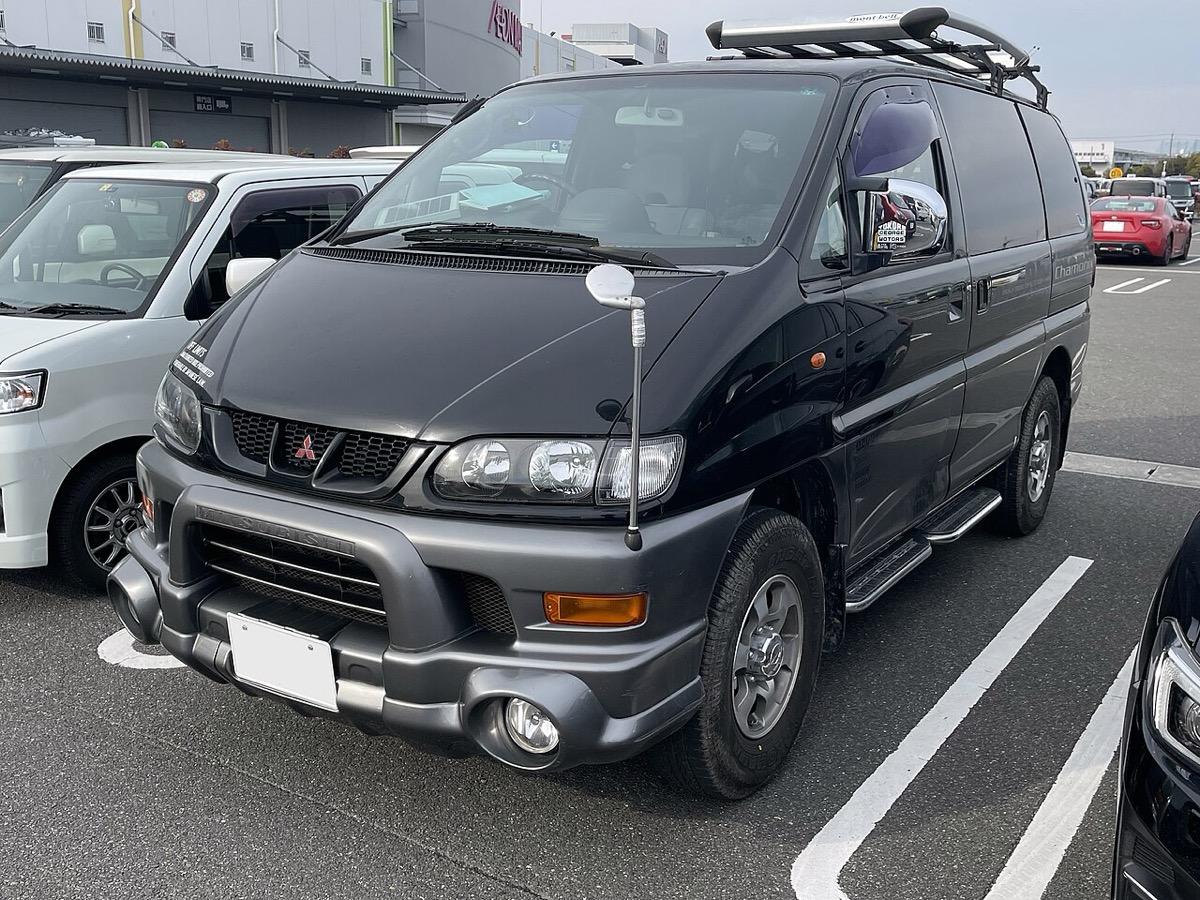
Mitsubishi Delica Space Gear for Sale in Japan: Prices (2026)
The Rundown
- Our full count of Goo-net's Delica Space Gear listings on 5 November 2026 read 73 vans for sale in Japan. 72 showed a price and 1 was price on request.
- The 72 priced Space Gears asked a median of ¥1,428,000 (about $8,900 at ¥160 to the dollar), from ¥358,000 to ¥2,550,000, with the middle half between ¥1,130,000 and ¥1,735,000.
- Goo-net's and Carsensor's catalogues list the Delica Space Gear from May 1994 to January 2007, with codes running from PA to PF: 2.8-litre diesel 4WDs are PD8W, PE8W and PF8W, and the 3.0-litre V6 petrol 4WDs are PD6W and PF6W.
- 39 of the 72 priced vans were listed as 2001 or older, the model years that can clear the US 25-year line in November 2026; every Space Gear is past Canada's 15-year line (rules checked on the official pages on 13 November 2026).
Contents
Delica Space Gear in the Japanese market at a glance
A Mitsubishi Delica Space Gear costs a median of ¥1,428,000 (about $8,900) at Japanese dealer retail, as of 5 November 2026. That is the middle of 72 priced Space Gears in our full count of Goo-net listings that day, which ran from ¥358,000 to ¥2,550,000; it is the dealer’s body price in Japan, before export, shipping and your country’s import duties. To buy one from abroad you need someone in Japan to find the van, inspect it and handle the export paperwork; the model history and the US and Canadian import rules below were checked on the official and catalogue pages on 13 November 2026.
The Space Gear is the 1994 to 2007 Delica: a one-box people carrier on a ladder-frame 4WD chassis, which Goo-net’s catalogue describes as built on the previous Pajero’s platform. It is the Delica most people abroad picture when they hear the name, with the high roof, the bull bar and the 2.8-litre diesel.
How much is a Delica Space Gear in Japan right now?
We read every Delica Space Gear listing on Goo-net, both pages, on 5 November 2026. 73 vans were for sale. 72 showed a body price; the other one was price on request (応相談), so it is not in the numbers. The listed years ran from 1994 to 2006.
| Point in the 72 priced vans | Asking price (body only) | Roughly in US dollars |
|---|---|---|
| Cheapest | ¥358,000 | $2,200 |
| Lower quarter | ¥1,130,000 | $7,100 |
| Median | ¥1,428,000 | $8,900 |
| Upper quarter | ¥1,735,000 | $10,800 |
| Dearest | ¥2,550,000 | $15,900 |
Dollar figures use ¥160 to the dollar. The year tells you little: some of the dearest vans in the count are 1990s diesels, and some of the cheapest are 2005 and 2006 vans. Rust, the history of the engine and how far the van has been modified decide the price.
That asking price is only the first part of what you pay. Here is how the total builds up:
| Price tier | What it covers | Where the number comes from |
|---|---|---|
| Japan asking price | The dealer’s body price for the van: ¥1,130,000 to ¥1,735,000 for the middle half, ¥1,428,000 median | Our Goo-net count, 5 Nov 2026 |
| Landed cost | The van, plus export costs in Japan (deregistration, inland transport to the port), ocean shipping and the import duties and taxes in your country | Actual costs plus our fee; we quote that total for the van you pick before anything is bought |
The count is a snapshot. For a live look, the newest Delica Space Gears listed in Japan this morning are on our daily listings page, and opening a row there shows a rough landed band for six destinations. The month-by-month Delica figure next to the Land Cruiser, Supra and GT-R is on our iconic JDM car prices page.
Retail is the ceiling, not the floor. A dealer’s price includes reconditioning and a margin, and plenty of Delicas change hands underneath it at Japan’s trade auctions and in private sales. We do not put a number on “below retail”, because it depends on the van in front of us that week.
Diesel or V6, 2WD or 4WD: what did Mitsubishi build?
Goo-net’s catalogue lists the Space Gear from May 1994 to January 2007, and Carsensor’s catalogue gives the same production span. At launch the catalogue lists four engines: a 3.0-litre V6 with 24 valves, 2.8-litre and 2.5-litre four-cylinder diesel turbos, and a 2.4-litre four-cylinder petrol. The 4WD models use Mitsubishi’s Super Select 4WD, which the catalogue describes as a four-mode system that runs from two-wheel drive to full-time 4WD and a low-range mode for rough ground.
| Japanese model code | Drive | Engine (Goo-net catalogue) | Wheelbase |
|---|---|---|---|
| PD8W, PE8W | 4WD | 2,835 cc four-cylinder diesel turbo, 140 PS; named as the 4M40 in the July 1997 entry | Standard, 2,800 mm |
| PF8W | 4WD | 2,835 cc diesel turbo | Long, 3,000 mm |
| PD6W | 4WD | 2,972 cc V6 petrol, 185 PS | Standard |
| PF6W | 4WD | 2,972 cc V6 petrol | Long |
| PD4W | 4WD | 2,350 cc four-cylinder petrol; 1994 to 1996 entries | Standard |
| PA4W, PB4W, PC4W | 2WD (rear drive) | 2,350 cc four-cylinder petrol, 145 PS | Standard and long |
| PA5W, PB5W, PC5W | 2WD (rear drive) | 2,476 cc four-cylinder diesel turbo; 1994 to 1998 entries | Standard and long |
| PB6W | 2WD (rear drive) | 2,972 cc V6 petrol; 1994 to 1996 entries | Standard |
Two dates matter for buyers. The 2WD versions disappear from the catalogue after the June 2000 entry, so a 2002 or later Space Gear is a 4WD. And the diesel 4WD lasts to the April 2004 entry; from the October 2004 entry the catalogue lists only the 3.0-litre V6 petrol. A Space Gear listed as 2005 or 2006 is very likely a petrol car, so check the model code on the papers if a seller calls it a diesel.
Most diesel 4WDs in the catalogue are automatics, with a column-shift 4-speed. A 5-speed manual diesel 4WD appears in the entries up to July 1997; the 2WD long-body 10-seater also had a 5-speed manual.
Aero roof
- The lower roof, about 1,965 mm tall on 4WDs
- PD8W diesel or PD6W petrol in later entries
- Fits more car parks and garages
High roof
- Over 2 m tall, about 2,060 mm
- PE8W diesel or PD6W petrol in later entries
- Most standing room inside
Crystal Light roof
- Five glass panels in the roof
- Standard on the Super Exceed grade
- The only roof on the 4WD long body
Chamonix (シャモニー) is the name you will see most often. It began as a special edition on the diesel XG, and Goo-net’s June 1999 entry turns it into a regular grade, with built-in twin fog lamps, a helical limited-slip differential, a three-gauge meter and cold-climate equipment. The Active Field Edition, listed from January 2005, is a later special based on the Chamonix high roof. The roof heights above come from the 2002 and 2004 catalogue entries.
Can you import a Delica Space Gear to the US or Canada?
| Country | Rule (official page, read 13 Nov 2026) | What it means for a Space Gear |
|---|---|---|
| United States | Vehicles under 25 years old must meet all US safety standards | Vans built by November 2001 are past the line now; 39 of the 72 priced vans in our count are listed as 2001 or older |
| Canada | Vehicles over 15 years old are not regulated at import under the Motor Vehicle Safety Act | Every Space Gear qualifies |
United States. CBP’s importing page says that, as a general rule, motor vehicles less than 25 years old must comply with all applicable US safety standards, and that the importer files DOT form HS-7 and EPA form 3520-1. The line runs by the month the van was built, so a late-2001 Space Gear can be a different answer from an early-2001 one. Our 25-year rule guide explains how to read the build date. The same CBP page lists a 2.5% base duty for cars and 25% for trucks, but since 24 July 2026 USTR’s Section 301 action (heading 9903.05.49) lifts goods made in Japan with a base rate under 12.5% to 12.5% in total, so a Japanese-built passenger van pays 12.5% and a truck still pays 25% (checked in the US tariff schedule on 16 November 2026). CBP decides at entry how a vehicle is classified, so ask a licensed customs broker about the exact van before you buy. EPA’s page says its provision for vehicles over 21 years old expects an engine identical to the original, so a swapped engine needs a conversation with EPA first. The paperwork at the US end is in importing a drift car to the USA.
Canada. Transport Canada says vehicles older than 15 years are not regulated at import under the Motor Vehicle Safety Act. The same page warns that some provinces will not license right-hand-drive vehicles, and every Japanese-market Space Gear is right-hand drive, so check with your province first.
For Australia and the UK, see importing a drift car to Australia, the UK and Canada.
What should you check on a 20- to 30-year-old Space Gear?
The listing titles in our count show what Japanese sellers expect buyers to ask about:
- Rust underneath. These are 4WD vans that often lived in snow country, and titles mention cold-climate spec (寒冷地仕様) on several cars. The frame, the floor, the sills and the sliding-door runners matter far more than the paint.
- The diesel and its belt. Several titles say the timing belt has been changed (タイミングベルト交換済). On a 4M40 diesel, ask for the receipt, and look for smoke and noise on a cold start.
- Lifted or stock. Lift kits, all-terrain tyres, overfenders, grille guards and ladders are common. One van in the count is a long Super Exceed registered as a camper (8ナンバー), with a mini kitchen. Modifications can raise or lower the price, and a lift changes what the van needs to pass at home.
- Which van it really is. Check the model code on the papers against the table above. A 2005 or 2006 van sold as a diesel needs a second look at the papers, and so does a 2WD wearing 4WD badges. Some vans in the count are wheelchair conversions (福祉車輌), which change the interior completely.
- Repair history. Goo-net shows a repair-history field (修復歴, shuufukureki) on each listing. A “yes” is not a reason to walk away, but it is a reason to look underneath.
You cannot judge any of this from listing photos, and you do not have to fly to Japan to do it. We inspect the van on the ground in Japan and send you a video and photo walk-through: the underbody, the frame, the engine bay and a cold start. You decide after you have seen it. If the van is at auction, our guide to reading a Japanese auction sheet explains the grades and repair marks.
How do you buy a Delica from Japan if you live abroad?
The whole route, from deposit to your port, is in our step-by-step import process guide. For a Space Gear it looks like this:
Steps 1 and 4 are where a buyer abroad gets stuck. Japanese dealers decide whether to deal with an exporter at all, and membership of Japan’s dealer auctions needs a Japanese used-vehicle dealer licence, so a lot of Delicas change hands where you cannot bid. Export deregistration is then done in Japan with the owner’s documents, and you cannot finish the Japanese side yourself from overseas; our export deregistration guide explains why.
That is the part we take on for you
Have us find a Delica Space Gear in Japan, film the walk-through and handle the export paperwork. Tell us diesel or petrol, the roof, the seats and the build year you need for your country; we search dealers, auctions and private sellers, send you candidates with underbody, frame and cold-start footage, and quote one total, actual costs plus our fee, before anything is bought.
Comparing 4x4s? Our Land Cruiser 80 and 70 buyer’s guide uses the same count, and is importing a JDM car from Japan still worth it? puts the numbers side by side. If you are coming to Japan anyway, the circuit days we follow are on our drift calendar.
Frequently asked questions
How much does a Mitsubishi Delica Space Gear cost in Japan in 2026?
At Japanese dealer retail, a Mitsubishi Delica Space Gear asked a median of ¥1,428,000 (about $8,900 at ¥160 to the dollar) in TSUISO's full count of Goo-net listings on 5 November 2026. That covers 72 priced vans listed as model years 1994 to 2006, from ¥358,000 to ¥2,550,000, with the middle half between ¥1,130,000 and ¥1,735,000; one more was price on request. These are dealer body prices in Japan, before export paperwork, shipping and import duties in your country.
Can I import a Delica Space Gear to the United States?
Only an older one. US Customs and Border Protection states that, as a general rule, motor vehicles less than 25 years old must comply with all applicable US safety standards, and the importer files DOT form HS-7 and EPA form 3520-1. The Delica Space Gear was built from May 1994 to January 2007, so in November 2026 vans built up to November 2001 are past the 25-year line and later ones are not yet. In TSUISO's 5 November 2026 count, 39 of the 72 priced Space Gears in Japan were listed as 2001 or older. Duty on a Japanese-built passenger vehicle is 12.5% of the price in total since 24 July 2026: CBP's page lists the 2.5% base rate for cars, and USTR's Section 301 action (heading 9903.05.49) lifts goods made in Japan to 12.5% in total. Trucks pay 25%, and CBP decides how a vehicle is classified at entry, so ask a licensed customs broker about the exact van (rules read on 13 November 2026, the 12.5% checked in the US tariff schedule on 16 November 2026).
Can I import a Delica Space Gear to Canada?
Yes, every Mitsubishi Delica Space Gear. Transport Canada's page, read on 13 November 2026, says vehicles older than 15 years are not regulated at import under the Motor Vehicle Safety Act. The Space Gear went out of production in January 2007, so all of them are past 15 years. The same page warns that some provinces will not license right-hand-drive vehicles, and the Japanese-market Space Gear is right-hand drive, so check with your province before you buy.
What is the difference between a PD8W, PE8W and PD6W Delica Space Gear?
They are Japanese model codes for the 4WD Mitsubishi Delica Space Gear in Goo-net's catalogue, read on 13 November 2026. PD8W and PE8W are the 2,835 cc four-cylinder diesel turbo on the standard 2,800 mm wheelbase; in the 2002 and 2004 catalogue entries PD8W is the lower aero-roof body and PE8W the taller high-roof and Crystal Light bodies. PF8W is the long-wheelbase diesel. PD6W is the 2,972 cc V6 petrol on the standard wheelbase, and PF6W the long-wheelbase petrol. Goo-net's 1997 entry names the diesel as the 4M40.
 Mitsubishi Lancer Evolution for Sale in Japan: Prices & Import (2026)
 Toyota Land Cruiser 80 & 70 for Sale in Japan: Prices (2026)
 Subaru Impreza WRX STI (GC8/GDB) for Sale in Japan: Prices (2026)
 Toyota Century GZG50 V12 for Sale in Japan: Prices, How to Buy (2026)