
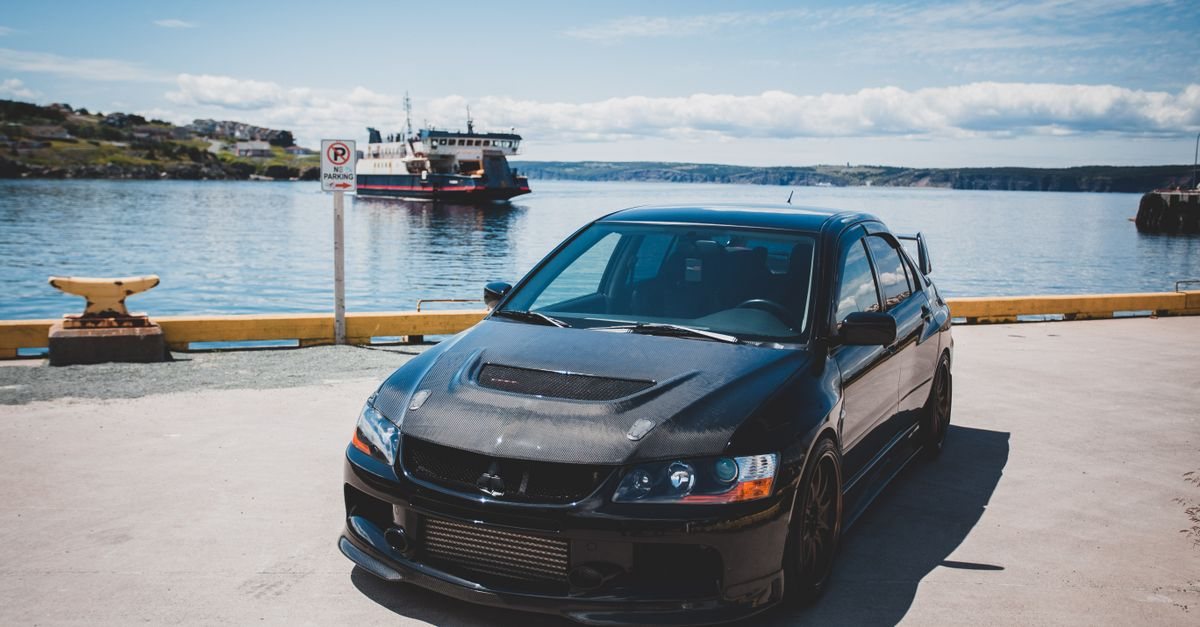
Mitsubishi Lancer Evolution for Sale in Japan: Prices & Import (2026)
The Rundown
- Our full count of Goo-net's Lancer Evolution listings on 5 November 2026 read 188 cars: 4 Evo I to III, 24 Evo IV to VI, 67 Evo VII to IX and 93 Evo X.
- Median asking prices by generation: ¥3,795,000 for the Evo IV to VI (22 priced cars), ¥4,185,000 for the Evo VII to IX (64 priced) and ¥3,148,000 for the Evo X (93 priced), about $23,700, $26,200 and $19,700 at ¥160 to the dollar.
- Japanese catalogues give the chassis codes as CD9A (Evo I), CE9A (II and III), CN9A (IV), CP9A (V and VI), CT9A (VII to IX) and CZ4A (X). Evo I to IX use the 2.0-litre 4G63 turbo; the X uses the 4B11.
- In November 2026 every Evo I to VI is past the US 25-year line, and so are Evo VIIs built by November 2001: 18 of the 64 priced VII to IX were listed as 2001 cars. No Evo X is old enough for the US yet (rules checked on the official pages on 14 November 2026).
Contents
Lancer Evolution in the Japanese market at a glance
A Mitsubishi Lancer Evolution VII to IX costs a median of ¥4,185,000 (about $26,200) at Japanese dealer retail, as of 5 November 2026, and an Evo X a median of ¥3,148,000 (about $19,700). Those are the middles of 64 and 93 priced cars in our full count of Goo-net listings that day; an Evo IV to VI asked a median of ¥3,795,000 (about $23,700). The model history and the US and Canadian import rules below were checked on the catalogue and official pages on 14 November 2026.
The Evo is Mitsubishi’s rally-bred four-door: a Lancer body with the turbocharged 2.0-litre 4G63 and full-time 4WD, later with the electronic diff controls Mitsubishi called AYC and ACD. Ten numbered versions were built over four generations, and the price and the import answer change a lot from one to the next.
How much is a Lancer Evolution in Japan right now?
We read every Lancer Evolution listing on Goo-net, all four pages, on 5 November 2026. That was 188 cars. We split them by the generation in the listing title, then by year. A handful were price on request (応相談, ou-soudan), so they are not in the numbers.
| Generation (listed years) | Listed | Priced | Cheapest | Lower quarter | Median | Upper quarter | Dearest |
|---|---|---|---|---|---|---|---|
| Evo I–III (1994–1995) | 4 | 3 | ¥2,699,000 | see note | ¥2,899,000 | see note | ¥3,919,000 |
| Evo IV–VI (1996–2000) | 24 | 22 | ¥2,270,000 | ¥2,933,000 | ¥3,795,000 | ¥5,840,000 | ¥11,500,000 |
| Evo VII–IX (2001–2007) | 67 | 64 | ¥2,420,000 | ¥3,380,000 | ¥4,185,000 | ¥5,956,000 | ¥11,960,000 |
| Evo X (2007–2016) | 93 | 93 | ¥1,520,000 | ¥2,425,000 | ¥3,148,000 | ¥3,974,000 | ¥9,500,000 |
Asking prices are body only. With only three priced Evo I to III cars, quarters say nothing, so the table shows the three prices. No car listed as a 1992 or 1993 model (the Evo I years) was for sale that day.
In US dollars at ¥160 to the dollar:
| Generation | Lower quarter | Median | Upper quarter |
|---|---|---|---|
| Evo IV–VI | $18,300 | $23,700 | $36,500 |
| Evo VII–IX | $21,100 | $26,200 | $37,200 |
| Evo X | $15,200 | $19,700 | $24,800 |
Two things stand out. The spread inside the IV to VI and VII to IX groups is wide: the dearest cars ask over ¥11 million, while the cheapest ask under ¥2.5 million. And the Evo X is the cheapest way into an Evo in Japan, with half of the 93 priced cars under ¥3,148,000.
That asking price is only the first part of what you pay:
| Price tier | What it covers | Where the number comes from |
|---|---|---|
| Japan asking price | The dealer’s body price, for example ¥3,380,000 to ¥5,956,000 for the middle half of Evo VII to IX | Our Goo-net count, 5 Nov 2026 |
| Landed cost | The car, plus export costs in Japan (deregistration, inland transport to the port), ocean shipping and the import duties and taxes in your country | Actual costs plus our fee, with the total quoted up front for the car you pick |
The month-by-month Evo figures next to the Supra, Skyline GT-R and RX-7 are on our iconic JDM car prices page. If you want the numbers side by side with shipping, read is importing a JDM car from Japan still worth it?
Retail is the ceiling, not the floor. A dealer’s price includes reconditioning and a margin, and plenty of Evos change hands below it at Japan’s trade auctions and in private sales. We do not put a number on “below retail”, because it depends on the car in front of us that week.
Evo I to X: which chassis code, engine and years?
The table comes from Carsensor’s production dates and Goo-net’s grade pages, both read on 14 November 2026.
| Version | Chassis code | Built (Carsensor) | Engine and power (Goo-net) |
|---|---|---|---|
| Evo I | CD9A | Oct 1992 to Dec 1993 | 4G63 turbo, 250 PS |
| Evo II | CE9A | Jan 1994 to Jan 1995 | 4G63 turbo, 260 PS |
| Evo III | CE9A | Feb 1995 to Jul 1996 | 4G63 turbo, 270 PS |
| Evo IV | CN9A | Aug 1996 to Dec 1997 | 4G63 turbo, 280 PS |
| Evo V | CP9A | Jan 1998 to Dec 1998 | 4G63 turbo, 280 PS |
| Evo VI | CP9A | Jan 1999 to Dec 1999 | 4G63 turbo, 280 PS |
| Evo VI Tommi Makinen Edition | CP9A | Jan 2000 to Jan 2001 | 4G63 turbo, 280 PS |
| Evo VII (GT-A from Feb 2002) | CT9A | Feb 2001 to Dec 2002 | 4G63 turbo, 280 PS |
| Evo VIII and VIII MR | CT9A | Jan 2003 to Feb 2005 | 4G63 turbo, 280 PS |
| Evo IX and IX MR | CT9A | Mar 2005 to Dec 2006 | 4G63 MIVEC turbo, 280 PS |
| Evo X | CZ4A | Oct 2007 to Mar 2016 | 4B11 MIVEC turbo, 280 or 300 PS by catalogue entry, 313 PS on the Final Edition |
A few catalogue notes that matter when you read adverts:
- AYC and ACD. Carsensor’s catalogue says the Evo IV added AYC (Active Yaw Control), which splits drive between the rear wheels, and the Evo VII added ACD (Active Centre Differential), an electronically controlled centre diff.
- The wide body. The Evo V gained overfenders, taking the width to 1,770 mm, plus Brembo calipers and a front helical limited-slip differential, according to Carsensor.
- The only automatic before the X. The Evo VII GT-A (February 2002) paired a retuned engine with a 4-speed automatic, the first automatic Evo in Carsensor’s catalogue.
- The VIII MR and IX. Carsensor lists an aluminium roof panel and Bilstein dampers on the VIII MR, and MIVEC variable valve timing on the Evo IX engine.
- The Evo X. Goo-net’s catalogue lists a 5-speed manual or the 6-speed twin-clutch “TC-SST”, and the S-AWC system that controls drive and braking at each wheel. The Final Edition of August 2015 was a 1,000-car run at 313 PS.
GSR
- The equipped road grade
- Recaro seats in the catalogue descriptions
- Heavier, with more comfort equipment
RS
- The competition base grade
- Simplified equipment, lighter on paper
- Sold as a base for motorsport builds
GT-A and Evo X SST
- Two-pedal versions
- GT-A: 4-speed automatic, 2002
- Evo X: 6-speed twin-clutch
Goo-net’s Evo X entries describe the RS as the motorsport base with simplified equipment, at 1,420 kg against 1,530 kg for the manual GSR. Carsensor describes the Evo IV the same way: a well-equipped GSR with Recaro seats, and the RS for competition.
Which Evos can you import to the US or Canada in 2026?
| Country | Rule (official page, read 14 Nov 2026) | What it means for an Evo |
|---|---|---|
| United States | Vehicles under 25 years old must meet all US safety standards | Evo I to VI: yes. Evo VII: only cars built by November 2001. Evo VIII, IX and X: not yet |
| Canada | Vehicles over 15 years old are not regulated at import under the Motor Vehicle Safety Act | Evo I to IX: yes. Evo X: only cars built by November 2011 |
In our 5 November 2026 count, all 3 priced Evo I to III and all 22 priced Evo IV to VI were past the US line, and 18 of the 64 priced Evo VII to IX were listed as 2001 cars.
Don't get caught out
The line runs by the month the car was built, not the year on the advert. An Evo VII listed as a 2001 car can be built in February 2001 or in December 2001, and only the first is past 25 years in November 2026. Check the build date on the papers before you pay.
United States. CBP’s importing page says that, as a general rule, motor vehicles less than 25 years old must comply with all applicable US safety standards, and that the importer files DOT form HS-7 and EPA form 3520-1. EPA’s page says its provision for vehicles over 21 years old expects an engine identical to the original, so a 4G63 with a swapped head or a different engine needs a conversation with EPA first. Our 25-year rule guide explains how to read the build date, and the import eligibility calendar shows the month each Evo from IV to IX crosses the line. The US paperwork is in importing a drift car to the USA.
Canada. Transport Canada says vehicles older than 15 years are not regulated at import under the Motor Vehicle Safety Act, and that age is set mainly by the month and year of manufacture. The same page warns that some provinces will not license right-hand-drive vehicles. Japanese-market Evos are right-hand drive, so check with your province first. For Australia and the UK, see importing a drift car to Australia, the UK and Canada.
What should you check on a used Evo from Japan?
An Evo was built to be driven hard, and many in Japan have been. These are the questions that decide whether a car is worth its price:
- Which Evo it really is. Check the chassis code and grade on the papers against the table above. A CP9A can be a V, a VI or a Tommi Makinen Edition, and a CT9A can be a VII, VIII or IX; the papers and the build date tell you which.
- GSR or RS. An RS that started life as a competition base may have a roll cage, a stripped interior or missing equipment. That suits some buyers and not others.
- Stock or modified. Turbo upgrades, tuned ECUs, coilovers and aftermarket intercoolers are common. Modifications can raise or lower the price, and for a US import an engine that is no longer the original matters (see the EPA note above).
- Repair history. Goo-net shows a repair-history field (修復歴, shuufukureki) on each listing. A “yes” is not a reason to walk away, but it is a reason to look underneath.
- The two-pedal cars. A GT-A or an Evo X with the twin-clutch box is a different car to drive and to service from a manual; make sure that is what you want.
You cannot judge any of this from listing photos, and you do not have to fly to Japan to do it. We inspect the car on the ground in Japan and send you a video and photo walk-through: the underbody, the frame, the engine bay and a cold start. You decide after you have seen it. If the car is at auction, our guide to reading a Japanese auction sheet explains the grades and repair marks.
How do you buy an Evo from Japan if you live abroad?
The whole route, from deposit to your port, is in our step-by-step import process guide. For an Evo it looks like this:
Steps 1 and 4 are where a buyer abroad gets stuck. Japanese dealers decide whether to deal with an exporter at all, and membership of Japan’s dealer auctions needs a Japanese used-vehicle dealer licence, so many Evos change hands where you cannot bid. Export deregistration is then done in Japan with the owner’s documents, and you cannot finish the Japanese side yourself from overseas; our export deregistration guide explains why.
That is the part we take on for you
Have us find a Lancer Evolution in Japan, film the walk-through and handle the export paperwork. Tell us the generation, the grade, manual or two-pedal, and the build month your country needs; we search dealers, auctions and private sellers, send you candidates with underbody, frame and cold-start footage, and quote one total, actual costs plus our fee, before anything is bought.
Comparing other 1990s icons? Our Toyota Supra JZA80 buyer’s guide and R34 Skyline GT-R buyer’s guide use the same count. If you are coming to Japan anyway, the circuit days we follow are on our drift calendar.
Frequently asked questions
How much does a Mitsubishi Lancer Evolution cost in Japan in 2026?
It depends on the generation. In TSUISO's full count of Goo-net listings on 5 November 2026, the median dealer asking price was ¥3,795,000 (about $23,700 at ¥160 to the dollar) for the Evo IV to VI (22 priced cars), ¥4,185,000 (about $26,200) for the Evo VII to IX (64 priced cars) and ¥3,148,000 (about $19,700) for the Evo X (93 priced cars). Only 3 priced Evo I to III were listed, at ¥2,699,000, ¥2,899,000 and ¥3,919,000. These are body prices at Japanese dealers, before export paperwork, shipping and your country's import duties.
Which Lancer Evolution can I import to the United States in 2026?
As of 14 November 2026, the Evo I to VI and early Evo VIIs. US Customs and Border Protection states that, as a general rule, motor vehicles less than 25 years old must comply with all applicable US safety standards, and the importer files DOT form HS-7 and EPA form 3520-1. Carsensor's catalogue lists the Evo I to VI as built from October 1992 to January 2001, so all of them are past 25 years. The Evo VII went into production in February 2001, so a VII built by November 2001 is past the line and a later one is not. The Evo VIII, IX and X (built 2003 to 2016) are not yet 25 years old. In TSUISO's 5 November 2026 Goo-net count, 18 of the 64 priced Evo VII to IX were listed as 2001 cars.
Can I import a Lancer Evolution X to Canada?
Only an early one, as of 14 November 2026. Transport Canada says vehicles older than 15 years are not regulated at import under the Motor Vehicle Safety Act, with age set mainly by the month and year of manufacture. Carsensor lists the Evo X (CZ4A) as built from October 2007 to March 2016, so an Evo X built by November 2011 is past 15 years and a later one is not. Every Evo I to IX is past 15 years. Japanese-market Evos are right-hand drive, and Transport Canada warns that some provinces will not license right-hand-drive vehicles, so check with your province before you buy.
What chassis code is each Lancer Evolution generation?
According to Goo-net's Japanese catalogue, read on 14 November 2026: the Evo I is CD9A, the Evo II and III are CE9A, the Evo IV is CN9A, the Evo V, VI and Tommi Makinen Edition are CP9A, the Evo VII, VIII and IX are CT9A, and the Evo X is CZ4A. The Evo I to IX use the 1,997 cc 4G63 four-cylinder turbo (with MIVEC on the IX); the Evo X uses the 1,998 cc 4B11 MIVEC turbo. All are full-time 4WD sedans in these catalogue entries.
 Mitsubishi Delica Space Gear for Sale in Japan: Prices (2026)
 Subaru Impreza WRX STI (GC8/GDB) for Sale in Japan: Prices (2026)
 Toyota Century GZG50 V12 for Sale in Japan: Prices, How to Buy (2026)
 Toyota Land Cruiser 80 & 70 for Sale in Japan: Prices (2026)