
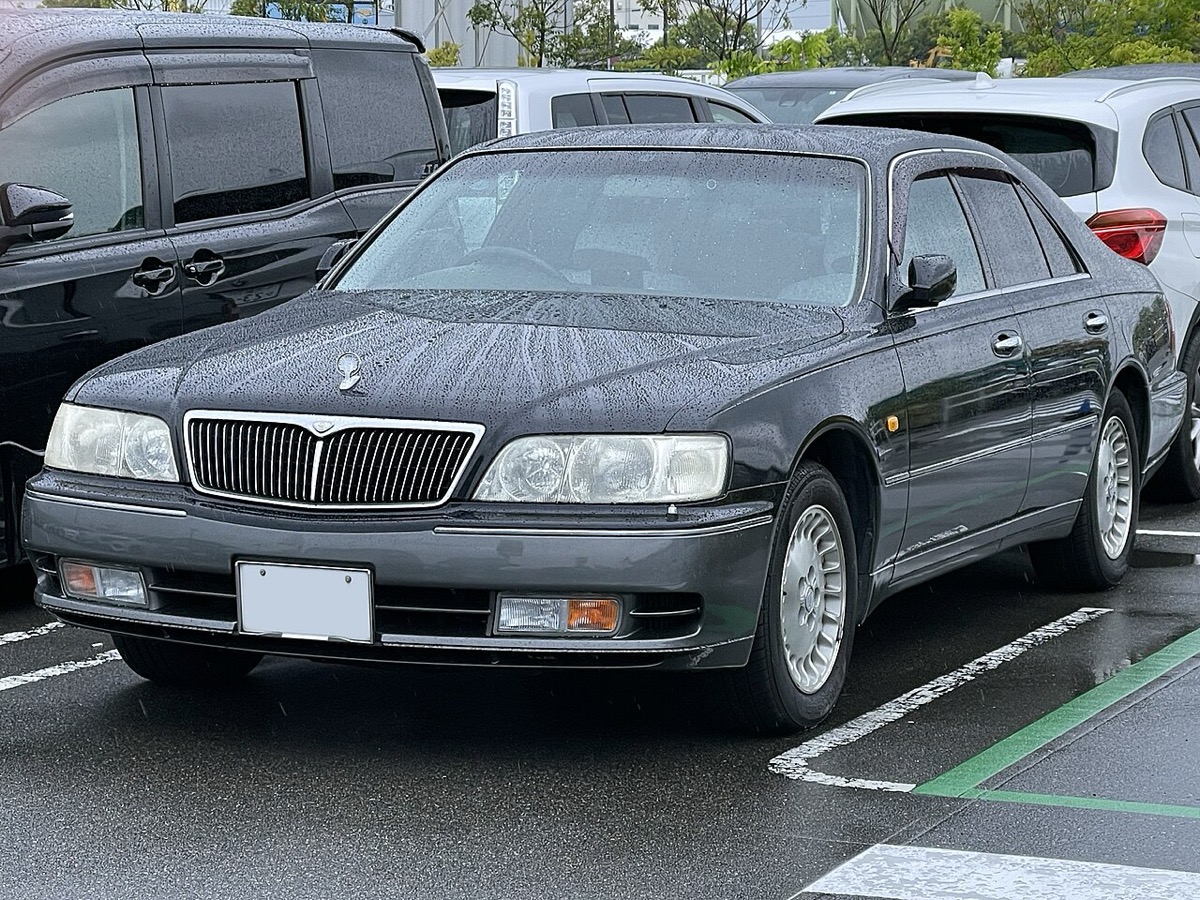
Nissan Cima Y32 & Y33 for Sale in Japan: Prices & Guide (2026)
The Rundown
- Goo-net listed 82 Nissan Cimas of these two generations when we read it on 16 November 2026: 56 third-generation Y33 cars and 26 second-generation Y32 cars.
- Median asking prices were ¥1,338,000 for the Y33 (54 priced cars, about $8,400 at ¥160 to the dollar) and ¥2,000,000 for the Y32 (24 priced cars, about $12,500). The older car is the dearer one.
- Nissan's company history, read on 22 November 2026, puts the Cima FY32 in August 1991 and the FY33 in June 1996. Both offer a 4.1-litre VH41DE V8 of 270 PS or a 3.0-litre V6 turbo (255 PS in the Y32 from September 1993, 270 PS in the Y33), all with a four-speed automatic.
- The chassis code tells you the car: FGY is the V8, FGNY the four-wheel-drive V8, FGDY the top V8 grade (the 41LX, with hydraulic active suspension as standard on the Y33), and FPY32 or FHY33 the V6 turbo.
- For the US, every Y32 and Y33 Cima is past the 25-year line as of November 2026: Japanese catalogues list Y33 production to December 2000. Duty on a Japanese-built passenger car is 12.5% in total since 24 July 2026.
Contents
Nissan Cima Y32 and Y33 in the Japanese market at a glance
A Nissan Cima in Japan costs about ¥1.34 million for a third-generation Y33 and about ¥2.0 million for a second-generation Y32. Those are the medians of the priced cars in our Goo-net listings snapshot of 16 Nov 2026, when 56 Y33s and 26 Y32s were listed. For the US, every car in both generations is now more than 25 years old. Model facts and import rules were checked on the official and catalogue pages on 22 Nov 2026.
The Cima is Nissan’s big rear-drive saloon of the bubble years, and one of the standard bases for VIP style, or bippu: a large sedan sat low on wide wheels. This guide covers the two generations you will actually find in numbers, shows what the money buys, and explains how a buyer outside Japan gets one. The first generation, the Y31, appears here only as history.
How much is a Nissan Cima in Japan right now?
We read every Y32 and Y33 listing on Goo-net’s type-code pages on 16 November 2026. These are dealer body prices, before export costs. Cars listed as price on request are left out.
| Point in the market | Y33 (1996–2000) | Y32 (1991–1996) |
|---|---|---|
| Listed | 56 | 26 |
| With a price | 54 | 24 |
| Cheapest | ¥489,000 ($3,100) | ¥780,000 ($4,900) |
| Lower quarter | ¥1,180,000 ($7,400) | ¥1,459,000 ($9,100) |
| Median | ¥1,338,000 ($8,400) | ¥2,000,000 ($12,500) |
| Upper quarter | ¥1,570,000 ($9,800) | ¥2,550,000 ($15,900) |
| Dearest | ¥3,288,000 ($20,600) | ¥3,330,000 ($20,800) |
Dollar figures use ¥160 to the dollar. The newer car is the more common and the cheaper one. Half of the priced Y33s sat between ¥1.18 million and ¥1.57 million, a narrow band. The Y32 is scarcer and spreads wider. Here are real listings from the same read:
| Listing | Year | Mileage | Asking price |
|---|---|---|---|
| Y33 30L, V6 turbo, sold as-is with no servicing or warranty, recorded accident repair | 1996 | 196,000 km | ¥489,000 |
| Y33 30LV, late model, lowered on coilovers, 19-inch WORK wheels, twin-exit exhaust | 1999 | 90,000 km | ¥1,338,000 |
| Y33 30L, V6 turbo, factory wheels | 1996 | 116,000 km | ¥1,360,000 |
| Y33 41TR-X, V8, sunroof, factory wheels | 1997 | 110,000 km | ¥1,920,000 |
| Y33 30LV with a six-speed manual from a 350Z (Z33), registered as modified, coilovers, 18-inch WORK wheels | 1997 | not stated | ¥3,288,000 |
| Y32 Type III Limited, V8, service records and handbook | 1991 | 80,000 km | ¥1,650,000 |
| Y32 Touring G Package, V6 turbo, full repaint, 18-inch wheels | 1994 | 54,000 km | ¥2,349,000 |
| Y32 Touring G Package, V6 turbo, one owner, factory 15-inch wheels | 1994 | 55,000 km | ¥3,060,000 |
| Y32 Type III Limited, V8, factory coil springs and factory 15-inch wheels | 1991 | 70,000 km | ¥3,170,000 |
All but the first are listed with no recorded accident repair. The table shows how this market works. The cheapest Y33 is sold as a project base with dents and a repair record. The dearest is someone’s finished build with a manual gearbox swap. On the Y32 side, the money goes to originality: one owner, factory wheels, factory springs.
What is on sale this week is on our JDM VIP cars for sale page, which refreshes from the Japanese listings every morning. The wider VIP section starts at JDM VIP by TSUISO.
A 1991 "Cedric Cima" is probably not a Y32
One of the 26 cars on the Y32 pages is titled Cedric Cima, the first generation's name, with a 3.0-litre engine and a 1991 registration. The Y32 was V8-only until September 1993, so a 3.0-litre car from 1991 points to a late Y31. Read the chassis code on the listing, not the page it is filed under.
Which Cima should you look for: Y32 or Y33?
| Y32 | Y33 | |
|---|---|---|
| Listed by Nissan’s company history | August 1991 (FY32) | June 1996 (FY33) |
| Production (Carsensor) | Aug 1991 – May 1996 | Jun 1996 – Dec 2000 |
| V8 | VH41DE, 4,130 cc, 270 PS | VH41DE, 4,130 cc, 270 PS |
| V6 turbo | VG30DET, 2,960 cc, 255 PS, from September 1993 | 2,987 cc, 270 PS (engine code: see below) |
| Gearbox | Four-speed automatic | Four-speed automatic |
| Drive | Rear; four-wheel drive (S-four) from September 1992 | Rear; four-wheel drive (S-Four) from September 1997 |
| Length × width | 4,930 × 1,780 mm; 4,945 mm from September 1993 | 4,970 × 1,820 mm |
| Wheelbase (Carsensor) | 2.82 m | 2.83 m |
| Weight (Goo-net) | 1,640–1,840 kg | 1,620–1,890 kg |
The first Cima, the Y31, was launched in January 1988 as the Cedric Cima and Gloria Cima. Nissan’s Heritage Collection page calls it Japan’s first car with a twin-cam V6 turbo, the VG30DET of 255 PS, and says the top Type II Limited had electronically controlled air suspension. That car was a pillarless hardtop.
The Y32 changed the recipe. Goo-net’s catalogue describes a four-door sedan with a centre pillar in place of the hardtop, and a 4.1-litre twin-cam V8 of 270 PS driving the rear wheels. Carsensor adds that the Cima became a model line of its own with this generation. Four-wheel drive arrived in September 1992. In September 1993 the V6 turbo came back as the Touring series, along with a new grille and bumpers.
The Y33 is a size up again. Goo-net’s catalogue says the 1996 car added the sportier Grand Touring series, with a wider grille, blacked-out headlamp inners and spoilers, and fitted dual front airbags, side airbags and ABS as standard. Four-wheel drive was added in September 1997. The September 1998 facelift brought a new grille, active head restraints and an engine immobiliser; Japanese adverts call these later cars 後期 (kōki, late model). The catalogue also notes a version with what it calls the first radar-sensor distance-keeping cruise control on a Japanese car. Nissan’s release of 11 January 2001 put the next Cima on sale the following day.
One detail the catalogues do not agree on is the Y33’s V6 turbo. Goo-net’s catalogue text names it the VG30DET, the same code as the Y32’s engine. Carsensor’s grade pages list the engine type as VQ30DET. Both give 2,987 cc and 270 PS. We found no Nissan page that settles it, so we give both and confirm the code on the car’s model plate.
If you want the Toyota answer to the same question, see our Toyota Celsior UCF10, UCF20 and UCF30 buyer’s guide. For a turbo straight six in a four-door, there is the Toyota Aristo JZS161 and JZS147 buyer’s guide. How the Cima sits among the other VIP bases is on our best VIP base cars page.
What do the Cima grade names and chassis codes mean?
Nissan changed the grade names between the two generations, so an advert only makes sense once you know which system it uses. The names and codes below are as Goo-net’s catalogue lists them.
Y32 (1991–1996)
- FGY32: V8. Type I, Type II Limited, Type III Limited; later Limited
- FGDY32: V8. The Limited L grades
- FGNY32: V8 with four-wheel drive, the S-four grades
- FPY32: V6 turbo, the Touring grades (from September 1993)
Y33 (1996–2000)
- FGY33: V8. 41L, 41LV, 41TR-X, 41LV-Z
- FGDY33: V8. 41LX, hydraulic active suspension standard
- FGNY33: V8 with four-wheel drive, 41LV S-Four
- FHY33: V6 turbo. 30T, 30L, 30TR, 30LV
On a Y33 the number is the engine (41 for the 4.1 V8, 30 for the 3.0 turbo). The catalogue explains the letters: L marks the luxury Limited series and T the Grand Touring series. A VIP package with extra rear-seat equipment was an option on the 41LX, 41LV and 30LV.
Suspension is the part to read carefully. Carsensor says the Y32 replaced the first car’s air suspension with hydraulically controlled active suspension, and Goo-net’s Y32 text says active suspension could be chosen. Neither says in the text we read which Y32 grades had it, so we treat that as not officially stated and confirm it on the car. For the Y33, Goo-net is specific: hydraulic active suspension is standard on the 41LX, and the other grades use struts at the front and a multi-link rear.
What should you check on a Cima before you buy?
The listings themselves show where cars differ:
- Suspension as fitted. Factory active suspension, factory springs, or coilovers. One 1991 Type III Limited in our read is advertised on its factory coil springs. Two of the Y33s in our table are on coilovers.
- Which engine. The 3.0 cars are turbocharged and the 4.1 cars are not. Japanese listings show displacement as 3000cc or 4100cc, which is the quickest way to tell.
- Repair history. Japanese listings flag recorded accident repair (修復歴, shūfukureki). The ¥489,000 car in our table has it, and its advert says so plainly.
- How it is sold. That same car is sold as-is (現状販売) with no servicing and no warranty. Seven of the nine cars in our table are listed with no warranty. On a car this old, assume nothing is included unless the advert says it is.
- Mileage. Adverts list mileage in units of 10,000 km (万km), so “11.6万km” is 116,000 km. The manual-swap Y33 is listed as mileage unknown (走不明).
- Modifications on the papers. The gearbox swap in our table is described as officially registered (公認). If a car is modified and the advert does not say that, ask.
You do not need to fly to Japan for any of this. We inspect the car locally and send you a video and photo walk-through: the underside, the frame, the engine bay, a cold start and, on an active-suspension car, how it sits and settles. You decide after you have seen it. If the car is at auction, our guide to reading a Japanese auction sheet explains the grades and repair marks.
Can you import a Nissan Cima to the US or Canada?
| Country | Rule (official page, read 22 Nov 2026) | What it means for a Cima |
|---|---|---|
| United States | Vehicles under 25 years old must meet all US safety standards | Every Y32 and Y33 is eligible. The last Y33s, built in December 2000, crossed the line in December 2025 |
| Canada | Vehicles over 15 years old are not regulated at import under the Motor Vehicle Safety Act | Every Y32 and Y33 |
United States. CBP’s importing page says that as a general rule, motor vehicles less than 25 years old must comply with all US safety standards. The age runs from the month of manufacture, not the model year. Carsensor lists Y33 production to December 2000, so no build-month arithmetic is left to do on either generation. The dates for other models are in our import eligibility calendar, and the rule itself is explained in the 25-year rule guide.
Duty is where older guides go wrong. CBP’s page lists a 2.5% base duty for cars and 25% for trucks, but since 24 July 2026 USTR’s Section 301 action (heading 9903.05.49) lifts goods made in Japan with a base rate under 12.5% to 12.5% in total. We checked that heading in the US tariff schedule on 22 November 2026. On a ¥1,338,000 Cima (about $8,400), 12.5% is about $1,050. The forms and the order you file them in are in importing a drift car to the USA.
Canada. Transport Canada says vehicles older than 15 years are not regulated at import under the Motor Vehicle Safety Act. The newest Y33 passed 15 years in December 2015. Every car in our table is right-hand drive, so check your province’s licensing rules first. For Australia and the UK, see importing a drift car to Australia, the UK and Canada.
How do you buy a Cima from Japan if you live abroad?
There are two price tiers. The first is the one in the tables above: Japanese retail listings. You can browse them yourself for free, and they are the ceiling of the market, not the floor. A dealer car has usually come from a trade auction or a trade-in, been prepared, and been marked up. Cars also change hands below that, at the auctions and in private sales. An auction car comes without the dealer’s preparation.
The second tier is an exporter-handled purchase. It adds the work a listing price leaves out: finding the car, inspecting it, the Japanese paperwork and getting it to a port. The full route from deposit to your port is in our step-by-step import process guide.
Step 3 is where a buyer abroad gets stuck. Advert photos do not show the underside of a lowered 30-year-old sedan, or whether a hydraulic active suspension still holds the car level. And the dealers expect a phone call first: listings in our read ask buyers, in Japanese, to ring or book before visiting, and one notes the stock is shared between several branches. Export deregistration is the next wall, and our export deregistration guide explains why it has to be done in Japan.
Those are the steps we take for you
Have us find a Cima in Japan, phone the dealer, film the underside and the suspension for you, and handle the export paperwork. Tell us the generation, the engine and whether you want a stock car or a finished build. We search dealers, auctions and private sellers, and send you candidates with walk-through footage before anything is bought.
If you are in Japan anyway and want to see the cars and the scene around them, the dates we track are on our drift calendar.
Frequently asked questions
How much does a Nissan Cima cost in Japan in 2026?
When TSUISO read Goo-net, Japan's large used-car listing site, on 16 November 2026, 56 third-generation Nissan Cimas (Y33, 1996 to 2000) and 26 second-generation cars (Y32, 1991 to 1996) were for sale. The 54 priced Y33s asked a median of ¥1,338,000 (about $8,400 at ¥160 to the dollar), from ¥489,000 to ¥3,288,000. The 24 priced Y32s asked a median of ¥2,000,000 (about $12,500), from ¥780,000 to ¥3,330,000. These are Japanese dealer body prices before export paperwork, shipping and import duty.
What is the difference between the Nissan Cima Y32 and Y33?
They are the second and third generations of the Nissan Cima. Nissan's company history, read on 22 November 2026, lists the Cima FY32 in August 1991 and the FY33 in June 1996. Carsensor's catalogue gives production as August 1991 to May 1996 and June 1996 to December 2000. The Y32 launched with a 4.1-litre V8 of 270 PS and gained a 3.0-litre V6 turbo of 255 PS in September 1993. The Y33 is longer (4,970 mm against 4,930 to 4,945 mm) and wider (1,820 mm against 1,780 mm), and both its V8 and its V6 turbo make 270 PS. Every car in both generations has a four-speed automatic.
Does the Nissan Cima have air suspension?
The first-generation Cima did: Nissan's Heritage Collection page, read on 22 November 2026, says the top Type II Limited of 1988 had electronically controlled air suspension. Carsensor's catalogue says the second-generation Y32 replaced that air suspension with hydraulically controlled active suspension. For the third-generation Y33, Goo-net's catalogue says hydraulic active suspension is standard on the top 41LX grade, and the other grades use a strut front and multi-link rear. Many cars have since been lowered on coilovers, so check what the specific car has now.
Can I import a Nissan Cima Y32 or Y33 from Japan to the United States?
Yes. US Customs and Border Protection says vehicles less than 25 years old must comply with all US safety standards, and the age is counted from the month of manufacture. Japanese catalogues list Y32 production to May 1996 and Y33 production to December 2000, so as of 22 November 2026 every Y32 and Y33 Cima is more than 25 years old. Duty on a Japanese-built passenger car is 12.5% in total since 24 July 2026: a 2.5% base rate lifted to 12.5% by USTR's Section 301 heading 9903.05.49, which we checked in the US tariff schedule on 22 November 2026.
 Mazda RX-7 FD3S for Sale in Japan: Prices & How to Buy One (2026)
 Toyota Aristo JZS161 & JZS147 for Sale in Japan: Prices & Guide (2026)
 Subaru Impreza WRX STI (GC8/GDB) for Sale in Japan: Prices (2026)
 Kei Truck from Japan to the US: Prices, Duty & Registration (2026)