
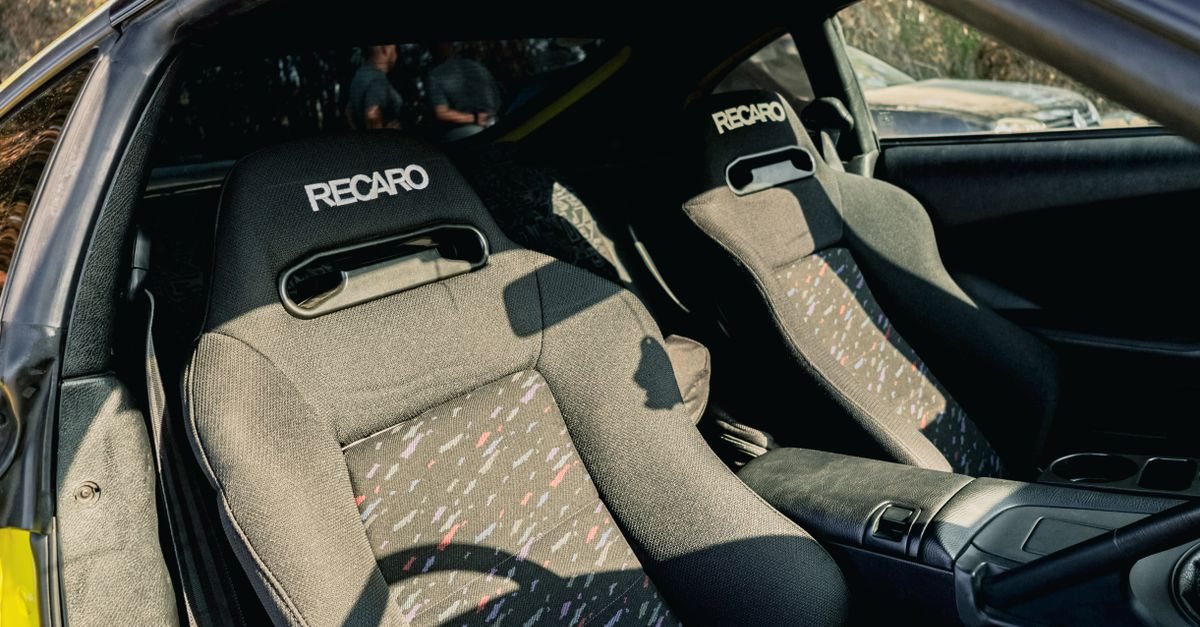
Used Bucket Seats & Harnesses from Japan: Dates & Checks (2026)
The Rundown
- An FIA 8855-1999 seat is finished five years after the manufacture date printed on its mandatory label, plus two further years only if the manufacturer authorised them and stuck on a second label. Seats to 8862-2009 or 8855-2021 get ten years from the year of manufacture. That is Appendix J Article 253 as published on 23 June 2026.
- Harnesses are harsher. The FIA's own 8853-2016 standard says validity expires five years after the year of manufacture, so a belt made on 1 January 2016 and one made on 31 December 2016 both died on 31 December 2021 — the month never counted.
- Your own authority may be softer than the FIA. Motorsport UK's 2026 National Competition Rules allow an 8855-1999 seat two years past its label expiry at national events, and on 4 September 2025 Motorsport Australia added five years to 8853-2016 harnesses for events up to and including national level.
- Seventeen seat models are dead whatever their label says. FIA Technical List No.12, dated 21 April 2026, withdraws them with immediate effect — including RECARO Pole Position (.CS.997.00) and RECARO Profi SPG XL (CS.086.04) — and Motorsport UK excludes withdrawn seats outright.
- No proxy will read the label for you before you bid. Buyee's Photo Service is ¥300 for five photos of a package that has already reached its warehouse, and its terms say you cannot choose the angle or ask for a specific part of the item.
Contents
A used bucket seat from Japan carries a clock you cannot see in the listing. An FIA 8855-1999 seat is finished 5 years after the manufacture date printed on its mandatory label, plus 2 further years only if the manufacturer authorised them and stuck on a second label; seats to 8862-2009 or 8855-2021 get 10 years from the year of manufacture. Harnesses are harsher: an FIA 8853-2016 belt expires 5 years after its year of manufacture, so one made anywhere in 2016 died on 31 December 2021. Every date, figure and rule below was read off the official regulations, technical lists and help pages on 5 August 2026.
A BRIDE ZETA on Yahoo! Auctions for less than a set of pads. A Recaro Pole Position sitting on a shelf at an UP GARAGE branch with three stars against it. A pair of four-point belts, “used, no tears”. These really are the cheapest genuine buckets and harnesses on the planet, and the reason is not Japanese generosity. It is that the FIA clock inside them has already run most of the way down, and the Japanese domestic buyer knows it. Nothing in the listing tells you where that clock stands.
Used seats and belts from Japan — the numbers that decide it
The one number the whole purchase turns on
Article 16 of Appendix J Article 253 — the version the World Motor Sport Council published on 23 June 2026 — says all the occupants’ seats must be homologated by the FIA to the 8855-1999, 8855-2021 or 8862-2009 standards, and not modified. Then it puts a clock on each of them.
| Standard | Technical List | Life the FIA allows | Extension |
|---|---|---|---|
| Seat, 8855-1999 | No.12 | 5 years from the date of manufacture on the mandatory label | 2 further years, only if the manufacturer authorises them, shown by an additional label |
| Seat, 8862-2009 | No.40 | 10 years from the year of manufacture | none stated |
| Seat, 8855-2021 | No.91 | 10 years from the year of manufacture | none stated |
| Harness, 8853-2016 | No.57 | Validity expires 5 years after the year of manufacture | none in the standard |
The harness line is the one that catches people out. The FIA’s 8853-2016 standard document works it through with an example so there is no argument: a harness made on 1 January 2016 and a harness made on 31 December 2016 were both valid only until 31 December 2021. Buying “a nearly new set from late in the year” buys you nothing.
Article 253 also now names exactly one harness standard as compulsory — 8853-2016. The 8853/98 and 8854/98 markings on most used Japanese belts are not on that list. JAF, Japan’s own governing body, said the same thing from its side of the water: its race safety-belt regulation states that use of FIA standard 8854/98 ran until 2024.
If it is going in a rally car, read the 2027 line
The same Article 253 tells rally competitors that 8855-1999 seats are "forbidden as from 01.01.2027", with a narrow set of exceptions — RGT cars homologated before 01.01.2022, R1/R2/R3/Rally5/Rally4 cars whose base model was homologated before 01.01.2020, and national or regional cars entered as such in international events. An 8855-1999 seat bought for a rally car in August 2026 has months, not years.
What your scrutineer will actually accept
The FIA sets the ceiling. Your national authority can be more generous, and two of them are — which is why “is this seat legal?” has no single answer until you name the rulebook.
| Authority | 8855-1999 seat | 8862-2009 / 8855-2021 seat | 8853-2016 harness |
|---|---|---|---|
| FIA — Appendix J Art.253, 23 Jun 2026 | 5 years from the label date, +2 by the manufacturer | 10 years from the year of manufacture | 5 years after the year of manufacture |
| Motorsport UK — NCR 2026 Ed.4, 22 Jul 2026 | National events: up to 2 years beyond expiry of the original homologation label validity | Until 31 Dec of the year stated on the label | National events: up to 5 years after the year stated on the label |
| Motorsport Australia — 4 Sep 2025 | Not covered by that announcement — TBC | Not covered by that announcement — TBC | +5 years beyond the printed expiry, up to and including national level; no extension internationally |
| JAF (Japan) — from 1 Jan 2026 | 5 years from the manufacture date on the label; +2 if returned to the maker and inspected | 10 years from the year of manufacture | — |
Motorsport Australia’s September 2025 announcement carries two conditions worth writing on your hand: the harness must still pass scrutineering for wear or damage before any event, and the FIA hologram must still be visible. An extension is not an amnesty for a shabby belt.
Motorsport UK adds a filter the FIA lists imply but never say out loud. Its rally, cross-country and rallycross technical regulations all require front seats homologated at the time of manufacture “but excluding seats for which the FIA Homologation was withdrawn”. Which brings us to the list nobody reads.
The seats that are dead whatever the label says
Technical List No.12 is the register of every seat ever homologated to 8855-1999. The current edition is dated 21 April 2026, runs to 32 pages, and ends with a run of withdrawal notices. Each is the same sentence: the homologation of the seat, whatever the validity deadline, is withdrawn with immediate effect, and its use is prohibited in all cases where compliance with the standard is mandatory.
There are 17 of them. Two are Recaro — Pole Position (.CS.997.00) and Profi SPG XL (CS.086.04) — and the rest run through Corbeau (four models), GP-Race Europe (three), Cobra Monaco, Bimarco Expert, Rossi Sports, Ektor, Kingdragon and Border Motorseats.
This is why the homologation number on the label outranks the badge on the shell. Two seats can both say Pole Position; only one of them carries .CS.997.00.
The listing will not help you
Yahoo! Auctions gives a seller six condition grades, from 新品、未使用 (shinpin, mishiyō — new, unused) down to 全体的に状態が悪い (poor condition overall). It abolished the generic 中古 (chūko — used) and その他 (other) grades along with the free-text condition field, for new and relisted items, from 31 January 2019 in the browser version. Mercari uses the same six-step ladder. UP GARAGE grades in stars, ★★★★★ for a new part down to ☆☆☆☆☆ for junk — “Part is imperfect, with defects. Repair is required!”
Not one of those scales contains a date.
The shell is not much more talkative. BRIDE’s own FAQ says current models carry a product label on the underside with the model name and a six-digit part number, while some older-generation models carry only a type plate — TTM-A, TTM-B, TTM-C — with no part number at all, so the model has to be identified from the shape and construction of the seat itself.
Searching the FIA lists for “BRIDE” also under-reports, because Bride’s homologations sit under three company names: SHIN NAGOYA for the 2001 Divine and Thrown seats, TEE’S CORPORATION for the F31A/F38A/F77A generation from 2003, and BRIDE itself from 2011. JAF publishes the flat version — a reference table of Japanese-made FIA-homologated seats, current to October 2025, listing Bride alongside Mooncraft, Dome Carbon Magic, JURAN (Tanida), Toyota Boshoku and Nissan Motorsports. Bride is still current, too: the H11A appears on Technical List No.91, homologated in December 2025 to the present 8855-2021 standard.
What makes a used seat or belt scrap
Walk away if any of this is true
- The seat has been in a serious accident. JAF's 2026 seat regulation says a seat that has met a serious accident must be taken out of use immediately, whatever life is left on it — and the label is FIA property. FIA or ASN officials have the right to remove it if the event's chief scrutineer judges the seat's performance is now compromised
- The belts have been in a serious accident. Motorsport UK: "Seat belts once involved in a serious accident must be discarded as they are likely to have stretched." JAF goes further — do not re-use them even if the straps and fittings look externally normal
- Cut, frayed or sun-bleached webbing. JAF names use, chemicals and sunlight as the three things that kill a strap, and says a partly cut or worn strap must be replaced
- Solvent contamination. Petrol or benzine soaked into the webbing means replacement under JAF's rules; Motorsport UK says belts subjected to oil, acid or heat should be replaced
- Bent, deformed, rusted or sticky buckles and tongues — replacement, per JAF
- A mixed set. Motorsport UK: "It is not permitted to mix parts of seat belts. Only complete sets as supplied by manufacturers are to be used"
- Belts already bolted to the seat. Article 253 prohibits anchoring safety harnesses to the seats or their supports, so a "seat with harness fitted" bargain is two jobs, not one
Fresh-looking upholstery on an old shell is a question, not a bonus. BRIDE will not sell fabric on its own, and says why in one line: to prevent the production of imitation and counterfeit goods. So a re-trimmed Bride was not re-trimmed by Bride, unless it went back through an official overhaul — which Bride quotes from ¥50,000 list price, only after it physically has the seat, only through a dealer, and only for current full buckets, the GIAS and STRADIA reclining series and some ZETA III-generation buckets. Whether an overhaul touches the FIA label at all is not stated on Bride’s pages or the FIA’s: TBC. The only extension the regulation recognises is the manufacturer-authorised two years, evidenced by a second label.
The step that has no remote version
Strip it back and one link in the chain cannot be done from Brisbane or Birmingham: somebody has to turn the seat over in Japan, before the money moves, and photograph the homologation label — the date on it, the second extension label if there is one, the shell around all four mounting holes, and the tag on the left shoulder strap of every belt, which is where the 8853-2016 standard requires the homologation label to be.
No proxy service does that. Buyee’s Inspection Plan is ¥300 an order and checks colour, size and quantity. Its Photo Service is ¥300 per package for five photos, and the terms are blunt: you cannot determine how the photos are taken, at a certain angle or of certain item parts, and retakes are not normally accepted. Both happen only once the item has reached the warehouse — after you have bought it. UP GARAGE’s English FAQ shuts the other door: it does not accept returns, and parts ship in the condition shown in the pictures.
That is the step we take on
We are in Japan. Before you commit, we go to the seat — a shop counter, a seller's garage, an UP GARAGE branch — and record what a listing photo never shows: the homologation label and its date under raking light, any extension label, the FIA hologram, the mounting-hole surrounds and the underside of the shell for cracks and repairs, the rails and their part numbers, and the tag on the left shoulder strap of each belt with a date you can read on video. You get the walkthrough first and decide second. Then we quote purchase price, domestic shipping, packing and freight as one total — actual costs plus our handling fee, agreed before anything is bought. Send us the listing URL and the standard your scrutineer works to.
Two routes, honestly priced
| Route | What it costs | What you get, and don’t |
|---|---|---|
| Alone, through a proxy | Item + Buyee’s flat ¥500 purchase fee per order + ¥150–1,500 domestic shipping + optional ¥300 Inspection Plan or ¥300 Photo Service + freight | The cheapest way in. You bid without a label date, and the photos arrive after payment with no say over the angle |
| Retail, in English | UP GARAGE’s overseas site: item price plus a shipping cost that must appear on the item page — no price shown for your country, no order | Star-graded condition, real photos, an English FAQ. No returns, no disassembly, nothing about homologation dates |
| Seat back to the maker | BRIDE overhaul from ¥50,000 list, quoted once they have the seat, dealer only | New trim on a supported model. EUROSTER, DIGO, CUGA, VORGA, BRIX and ERGO are refused, as are limited editions and OEM seats |
Where a line genuinely depends on the job — freight lane, crate size, which authority is judging you — the honest answer is not a percentage. It is actual cost plus a handling fee, quoted as one total before anything is bought.
The buying mechanics are covered elsewhere: our proxy and exporter comparison for accounts and fees, the oversized freight guide for why a 12 kg bucket bills like 60 kg, and the collection-only tier for the seats nobody will post at all.
None of that is the hard part. The hard part is a two-line label on the underside of a shell in a warehouse in Saitama, and the fact that nobody has turned it over.
Frequently asked questions
Where is the expiry date on a used Japanese bucket seat?
On the mandatory homologation label, not on the shell and not in the listing. For an 8855-1999 seat the label carries the manufacture date and the life runs five years from it. JAF's 2026 seat regulation reproduces five different label designs for that one standard, because the artwork changed in 2012, again in 2014, and again in July 2017 for re-homologated seats — so a photo of a label only helps if you can match it to the right generation. If a maker granted the extra two years, there is a second label showing the new expiry and carrying the manufacturer's quality-inspection mark. A missing, painted-over or scratched label is not a paperwork problem: the label is the homologation.
Are Takata harnesses from Japan still legal to use?
It depends which rulebook is judging you, and for FIA-standard events it is now mostly no. Takata's FIA entries — TK-MPH-340, TK-MPH-341 and RACE 4 — sit on Technical List No.24, the register for the 8854/98 standard. Appendix J Article 253 published on 23 June 2026 names only 8853-2016 as compulsory, and JAF's race safety-belt regulation states that use of 8854/98 ran until 2024. Motorsport UK still writes the old standards into its rules, allowing 8853/98 and 8854/98 belts until 31 December of the year stated on the label. Technical List No.24 shows how far apart those years sit: TK-MPH-340 tops out at a 2022 label year, while RACE 4, homologated in 2012, can carry one as late as 2032.
Can a proxy service check the label for me before I bid?
No, and the published terms explain why. Buyee's Inspection Plan is ¥300 per order and covers colour, size and quantity — it catches being sent the wrong item, not an expired one. Its Photo Service is ¥300 per package for five photos, and the terms state you cannot determine how the photos are taken, at a certain angle or of certain item parts. Both are triggered once the item has reached the warehouse, which is after you have paid. UP GARAGE's English FAQ closes the other exit: it does not accept returns, and parts are sold in the condition shown in the pictures. Someone has to be standing next to the seat in Japan before the money moves.
 Silvia and 180SX Windscreen From Japan: Used vs New Glass (2026)
  Buying a GT Wing From Japan: Prices and How a 1.7 m Wing Ships (2026)
  Buying a Used Intercooler or Radiator from Japan (2026)
  Buying a Used A'PEXi Power FC From Japan: Prices and Fitment (2026)