
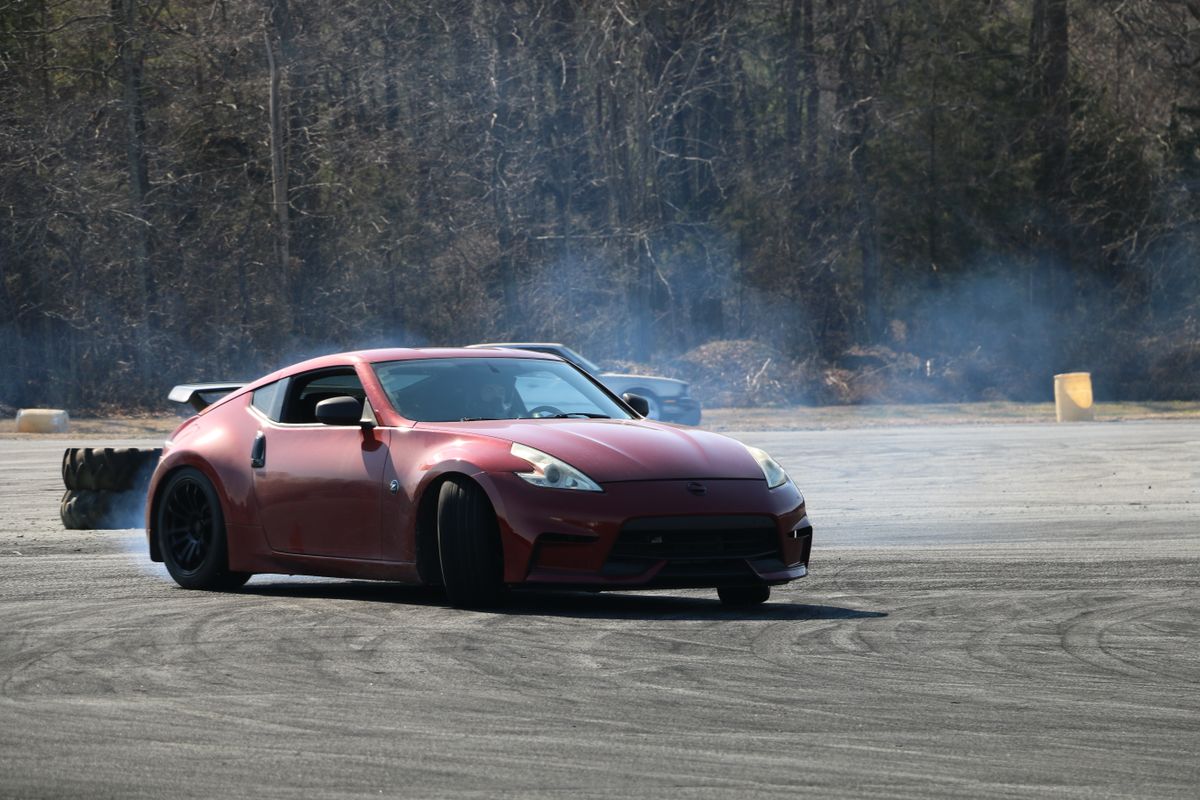
Can You Drift at Tsukuba Circuit? Gymkhana Course Guide (2026)
The Rundown
- Yes, but never as a walk-up. Tsukuba Circuit (Ibaraki) states on its own gymkhana page, checked 11 September 2026, that it runs no individual sports-driving slot on the Gymkhana Course, leaving 2 ways on: whole-course hire, or an outside organiser's day.
- Hiring the 8,679 m² gymkhana pad yourself is allowed and priced: ¥70,400 for a weekday afternoon (12:30–16:00) or ¥81,400 for a weekday morning, ¥145,200 for a weekday 8:00–16:00, rising to ¥253,000 on a Saturday or public holiday and ¥286,000 on a Sunday.
- No circuit licence is needed. The 2026 gymkhana rulebook requires four-wheel drivers to be 18 or over and to hold an ordinary car licence, and it names the International Driving Permit in writing as acceptable.
- Drifting is restricted by the clock and by noise: the rulebook limits drift running to 9:00–12:00 and 13:00–16:00, caps plated cars at 96 dB measured 0.5 m behind the pipe, and caps a tandem pair at 100 dB combined.
- D1 Grand Prix ran Rounds 3 and 4 here on 27–28 June 2026, and the official calendar lists organiser drift and slide days on the pad on 4 October, 27 October, 26 November and 13 December 2026.
Contents
Drifting at Tsukuba Circuit at a glance — verified 11 September 2026
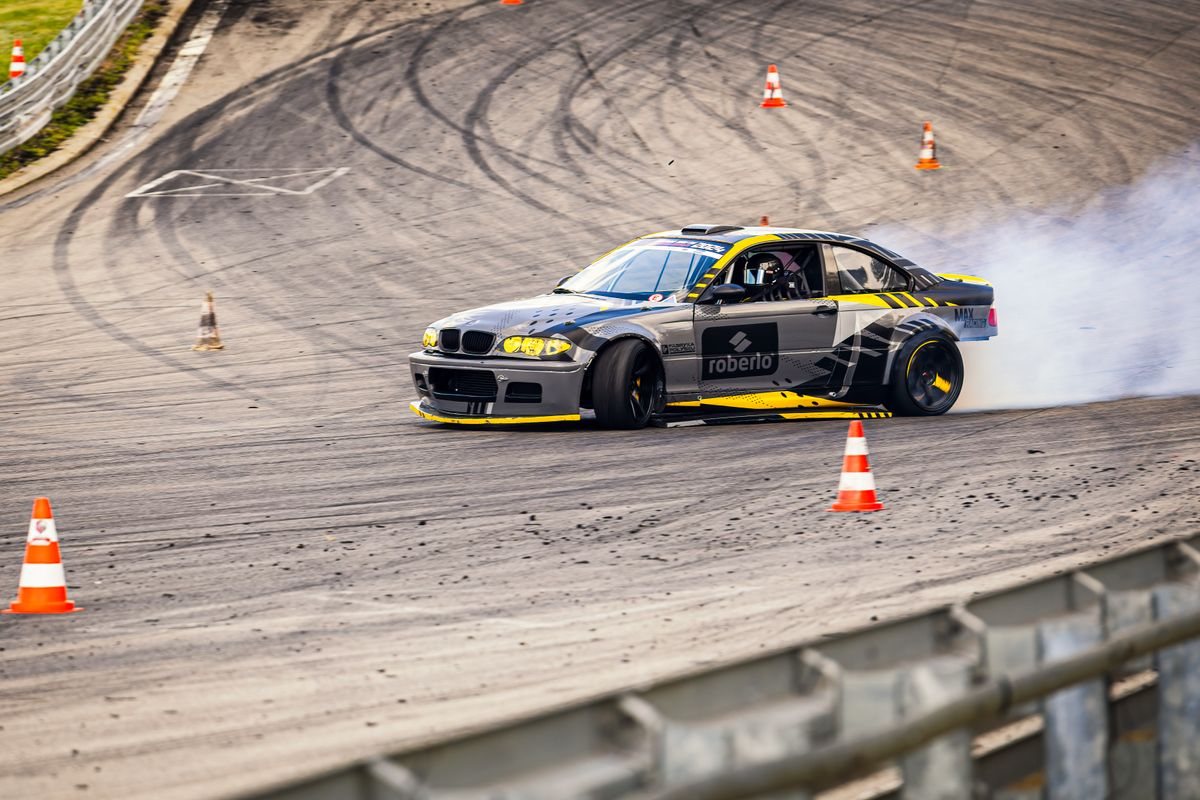
Yes — you can drift at Tsukuba Circuit (Ibaraki), on the Gymkhana Course (ジムカーナ場, jimukāna-jō, the flat tarmac pad circuits use for cone courses), but never by walking up and buying a session. Tsukuba’s own page says it plainly: 「現在、ジムカーナ場では、個人単位のスポーツ走行枠は設けておりません」 — “at present, no individual sports-driving slot is provided on the gymkhana course” — leaving two doors, hiring the 8,679 m² pad whole from ¥70,400 for a weekday afternoon, or entering an outside organiser’s 走行会 (sōkōkai, a club-run track day). Every figure, rule and date below was checked on the official Tsukuba Circuit pages on 11 September 2026.
That surprises people, because Tsukuba is one of the handful of Japanese circuits the rest of the world knows by name — time-attack records, and D1 Grand Prix Rounds 3 and 4 here on 27–28 June 2026, covered in our Tsukuba D1GP results report. The drifting is real. It just does not come in a single-driver ticket.
Which Tsukuba course can you actually drift on?
All three, on paper — but only one is where drifting lives. The gymkhana pad is a trapezoid of 8,679 m², 61 m across the top and 108 m across the bottom, resurfaced in August 2017, with its own admin building, toilets and parking for 150 cars.
| Course | Drifting? | How you get on it | Published cost |
|---|---|---|---|
| Gymkhana Course | Yes — where drift days run | Whole-pad hire, or an organiser’s event | ¥70,400–¥81,400 weekday half-day; ¥145,200 weekday full day |
| Course 1000 | Yes, under hire only | Whole-course hire, separate drift regulation | ¥242,000 weekday half-day, ¥440,000 weekday full day (four wheels, standard season) |
| Course 2000 | Yes, under hire only | Whole-course hire, plus a maintenance charge | ¥44,000 per hour of drift running, on top of the hire fee |
Course 1000’s drift regulation is worth reading even if you never hire it: drifting there runs anticlockwise, the reverse of normal, with up to 12 cars on track, banned drift zones you must crawl through, and a compulsory 15-minute interval in every 60 minutes. What you cannot do on either main course is drift on a members’ sports-driving day — those slots belong to Tsukuba Motorsports Members and are split into grip classes by lap time, displacement and car type. Drift running appears only in the hire documents.
The practical exception is an organiser who has hired the main circuit and sells you a place on it. KK☆BROS runs its 96th event on Course 2000 on Sunday 13 September 2026 at ¥18,500 for unlimited running, split into a grip hour from 8:00 and a drift hour from 9:00, with 35 drift entries and 30 cars on course at once. That is the cheapest published way a single driver slides a car at Tsukuba — and it is the main circuit, not the pad.
What does hiring the gymkhana pad actually cost?
| When | Half-day | Full day |
|---|---|---|
| Weekday, Mar–Dec | ¥81,400 (8:00–12:00) / ¥70,400 (12:30–16:00) | ¥145,200 (8:00–16:00) |
| Sat & public holidays, Mar–Dec | Not offered | ¥253,000 |
| Sunday, Mar–Dec | Not offered | ¥286,000 |
| Weekday, Jan–Feb | ¥61,050 (9:00–12:00) / ¥70,400 (12:30–16:00) | ¥126,500 (9:00–16:00) |
| Sat & holidays / Sunday, Jan–Feb | Not offered | ¥221,100 / ¥249,700 |
All figures include 10% consumption tax. Two options sit on top: timing gear, and the water truck — a sprinkler rental that exists only for the gymkhana course, at ¥22,000 for a full day or ¥11,000 for a half-day, requested 30 days ahead, prepared and removed by the circuit but filled and driven by you. That truck is why so many calendar entries carry the tag 全面散水 (zenmen sansui, “fully watered”): a soaked pad lets a low-power car break traction safely and saves tyres.
Split across a club, the weekday afternoon is roughly ¥3,500 a head for twenty cars. Alone, it is a five-figure day for one driver.
Two rules that quietly close the door
You pay Tsukuba the full fee by bank transfer 30 days before the date, and cancelling inside 15 days costs 100% of the fee — 70% inside 30 days, 60% inside 60 days, 50% inside 90 days. Separately, the circuit publishes a list of applications it will not accept, and the first line on it is 「代行業者等によるお申し込み」 — applications made through agents. A hire is meant to be taken in the hirer's own name.
Do you need a licence, and what do the rules say about drifting?
No circuit licence at all. The 2026 gymkhana rulebook, dated January 2026, sets the four-wheel bar at 18 or over, holding an ordinary car licence, and writes 「国際運転免許証含む」 — “International Driving Permit included” — into the same line. Our licence and IDP guide covers what that permit does and does not buy you elsewhere in Japan.
The drift-specific rules are tighter than the entry bar:
What the 2026 gymkhana rulebook requires
- Drift hours: 「ドリフト走行は、9時~12時および13時~16時に限ります」 — drift running is limited to 9:00–12:00 and 13:00–16:00, even inside a full-day hire
- Noise: plated cars must stay within their shaken (車検, statutory inspection) spec and under 96 dB, measured 0.5 m behind the pipe at 45° at 75% of peak-power revs. Straight-through pipes are banned outright
- Tandem: in 追走 (tsuisō, a chasing pair), both cars must be legal individually and the pair must not exceed 100 dB combined
- Banned: burnouts in one spot, accelerating out of the paddock, running close to the guardrails, unnecessary revving — the pad sits in farmland with neighbours
- Kit: flame-resistant long sleeves and trousers, no exposed skin; non-slip gloves (work gloves refused); closed shoes (no sandals); full-face or jet helmet. No cameras or radios mounted on helmets or suits
- Passengers: one, front seat, same kit as the driver, windows closed. Under-18s need a guardian's consent, junior-high age or above, 150 cm or taller, a prior declaration, and the car alone on the pad
The running-density table caps a four-wheel course-setting session at 2 cars and basic practice at 3; “PVC drift”, which the rulebook notes as kei cars, is capped at 5 and may not run mixed with ordinary cars. Gates open an hour before your slot, engines may start 40 minutes before, and everyone must be out within 60 minutes of the end.
Which drift days are on the calendar?
Tsukuba tags every entry on its official race and event calendar with the course it uses, which makes the pad’s programme easy to read. These are the four-wheel slide and drift days listed after 11 September 2026:
| Date | Event (all on the gymkhana pad) | Detail from the official listing |
|---|---|---|
| Sun 4 Oct 2026 | Fumippa gymkhana drift practice day | Entry through the organiser’s own site |
| Thu 8 Oct 2026 | ZENKAI DRIVING — Slide & Grip | 12:30–16:00, 8 cars, wet surface, all drivetrains |
| Tue 27 Oct 2026 | Tsukuba Slide Control class (fully watered) | 12:00–16:00, one car at a time; the listing says practice rental cars can be arranged in limited numbers |
| Mon 23 Nov 2026 | ZENKAI DRIVING 1Day — Slide & Grip | 8 cars in the morning, 15 in the afternoon |
| Thu 26 Nov 2026 | Tsukuba Slide Control class (fully watered) | Same organiser, same format |
| Sun 13 Dec 2026 | Fumippa gymkhana drift practice day | The last Fumippa date published for 2026 |
Two things to read off that table. First, most are wet-pad car-control schools rather than smoke-and-angle drift days — which, for a first time on a Japanese surface, is arguably better. Second, every one is entered through a small Japanese club, by form, email or phone in Japanese, not through Tsukuba. Our guide to entering a Japanese track day as a foreigner covers how those entries work, and the event calendar tracks competition dates nationwide.
How do you reach Tsukuba Circuit without a car?
The circuit is at 159 Muraoka-otsu, Shimotsuma, Ibaraki, and its access page gives exactly one train route: Akihabara → Tsukuba Express → Moriya → Kanto Railway Joso Line towards Shimodate → Sodo Station → taxi, about 6 km, which the circuit puts at 15 minutes.
That last leg has no bus. Shimotsuma City publishes three bus networks — the Shimon-chan community bus, Kanto Tetsudo Purple Bus and the wide-area link — and none lists Tsukuba Circuit, Muraoka or Sodo Station among its stops. Kanto Railway’s own page for Sodo shows no ticket-window hours and points enquiries to Mizukaido Station on 0297-22-0453, while listing a taxi rank, a lift, toilets and 14 free park-and-ride spaces. The honest picture: a small unstaffed halt with a taxi rank, 6 km short of the gate, and a return ride better arranged before you need it than found on the platform.
The chain that breaks: a paper contract, a domestic transfer, and a taxi from an unstaffed halt
Tsukuba confirms a gymkhana hire by posting a contract (使用契約書) to an address in Japan to be signed, sealed with a hanko and returned, then settled by domestic bank transfer 30 days out — and it refuses applications made through agents. Organiser days are entered in Japanese by form, email or phone. None of that is designed for someone arriving from abroad. Tell us your travel window and we will put you on a Kanto circuit that does sell individual drift running — seat time and ride-alongs near Tokyo: Mobara, Minami Chiba, Nikko and Tsukuruma, with the dates and the last leg handled.
So is Tsukuba worth building a trip around?
As a place to watch, yes — a circuit open since 1970, with real history, that took a D1 Grand Prix weekend in June 2026. As a place to drive, it is one of the more awkward names on the list: the cheap pad has no retail door, and drift running on the main circuit carries a ¥44,000-an-hour surcharge for whoever hires it. Admission follows the same logic — free on weekday sports-driving days, ¥500 for non-members at weekends and holidays, but on a hire day the circuit says entry depends on the hirer and may be refused.
Set that against Fuji Speedway’s Drift Park, which since June 2026 sells a ¥9,900 individual day ticket, or the grassroots tracks in our Kanto guide, and Tsukuba reads as a circuit to see rather than one to slide. Every venue that does sell individual drift running sits in the track directory.
Frequently asked questions
Can I drift at Tsukuba Circuit in 2026?
Yes, but not by turning up and paying at a window. Tsukuba Circuit in Shimotsuma, Ibaraki runs drifting on its Gymkhana Course, an 8,679 m² tarmac pad, and the circuit's own page says in writing that no individual sports-driving slot exists there — you either hire the whole pad or enter an outside organiser's event held on it. A weekday half-day hire is ¥70,400 for the afternoon and a weekday full day is ¥145,200, and the 2026 rulebook restricts drift running to 9:00–12:00 and 13:00–16:00. Drifting is also possible on Course 1000 and Course 2000, but only under whole-course hire and under separate drift regulations. Checked on the official Tsukuba Circuit pages on 11 September 2026.
How much does it cost to hire the Tsukuba gymkhana course?
As of 11 September 2026 the published 2026 rates for the Tsukuba Circuit gymkhana course, tax included, are ¥81,400 for a weekday morning (8:00–12:00), ¥70,400 for a weekday afternoon (12:30–16:00) and ¥145,200 for a weekday 8:00–16:00 between March and December. Saturdays and public holidays are full-day only at ¥253,000 and Sundays are ¥286,000. January and February are cheaper and start an hour later: ¥61,050 for a 9:00–12:00 morning, ¥70,400 for the afternoon and ¥126,500 for a 9:00–16:00 day. The water truck that organisers use to soak the pad is ¥22,000 a day or ¥11,000 a half-day. Payment is the full amount by bank transfer 30 days before the date, and cancelling inside 15 days costs 100% of the fee.
Do I need a licence to drift at Tsukuba Circuit as a foreigner?
No circuit licence is required for the Tsukuba Circuit gymkhana course in Shimotsuma, Ibaraki. The 2026 gymkhana hire rulebook says four-wheel participants must be 18 or over and hold an ordinary car licence, and it puts International Driving Permits in brackets as accepted. That is a lower bar than the members' sports-running days on Course 2000 and Course 1000, which need a Tsukuba Motorsports Members licence — its fixed costs alone are a ¥10,000 joining fee, ¥2,000 sports safety insurance, ¥1,100 admin and ¥2,200 for the card, on top of a pro-rata annual fee, and every licence expires on 31 March regardless of when you join. The kit rules still apply on the pad: flame-resistant long sleeves and trousers, non-slip gloves, closed shoes, and a full-face or jet helmet. Checked on 11 September 2026.
How do I get to Tsukuba Circuit without a car?
Tsukuba Circuit is at 159 Muraoka-otsu, Shimotsuma, Ibaraki, and the route the circuit itself publishes is Akihabara to Moriya on the Tsukuba Express, then the Kanto Railway Joso Line towards Shimodate to Sodo Station, then a taxi for the last 6 km, which the circuit puts at about 15 minutes. There is no published bus for that last leg: Shimotsuma City's community bus network does not list the circuit, Muraoka or Sodo Station among its stops. Kanto Railway's own Sodo Station page shows no ticket-window hours and refers enquiries to Mizukaido Station on 0297-22-0453, but does list a taxi rank, a lift, toilets and 14 free park-and-ride spaces. Checked on 11 September 2026.
When was D1 Grand Prix at Tsukuba Circuit, and can I watch drifting there?
D1 Grand Prix ran Rounds 3 and 4 at Tsukuba Circuit on Saturday 27 and Sunday 28 June 2026 as TSUKUBA DRIFT, with Masashi Yokoi winning both days; the official reports counted 4,841 spectators over three days and every reserved seat sold out. Outside events, Tsukuba's published admission is free on weekday sports-driving days, and ¥500 per person for non-members at weekends and on public holidays, with elementary-age children free and junior and senior high school pupils free on production of a student ID. On a hire day the circuit says admission depends on what the hirer is running and that entry may be refused, so a gymkhana drift day is not a reliable spectator plan. Checked on 11 September 2026.
 Drifting in Kanto (2026): Every Track You Can Reach From Tokyo
  Can You Drift at Suzuka Circuit? Rules, Fees, Alternatives (2026)
  Drift Tyres in Japan: Where to Get Them and What They Cost (2026)
  Can You Drift at Fuji Speedway? Drift Park Guide (2026)